Taking notes sounds simple enough. You listen, you write things down. But if you've ever looked back at your notes before an exam and thought, "What does any of this mean?" you know there's more to it than that.
Research in cognitive science consistently shows that how you take notes matters far more than whether you take them at all. Students who use structured note-taking methods retain up to 34% more information and perform significantly better on exams compared to those who write notes without a system.
The good news? You don't need to overhaul your entire study routine. You just need the right method for how you learn. In this guide, we'll walk through seven proven note-taking methods, help you choose the best one for your situation, and share practical tips to make your notes actually useful when it's time to study.
Why Note-Taking Matters
Before diving into specific methods, it's worth understanding why note-taking is so powerful in the first place.
When you take notes, you're not just creating a record of what was said. You're actively processing information. Your brain has to listen, interpret, filter, and translate ideas into your own words. This process alone boosts comprehension and memory.
Psychologists call this the encoding effect. The act of writing something down forces your brain to engage with the material at a deeper level than passively listening. Studies on the encoding effect have shown that students who take notes, even if they never review them, perform better on tests than students who only listen.
But there's a second benefit: external storage. Your notes become a personalized reference you can revisit. When you combine the encoding effect with regular review using techniques like active recall and spaced repetition, retention jumps dramatically.
The takeaway is clear: good note-taking is one of the highest-leverage study habits you can develop. Now let's look at the methods that work best.
7 Proven Note-Taking Methods
Not every method works for every student or every class. Here are seven approaches, each with distinct strengths. Try a few and see which ones fit your learning style.
1. Cornell Notes
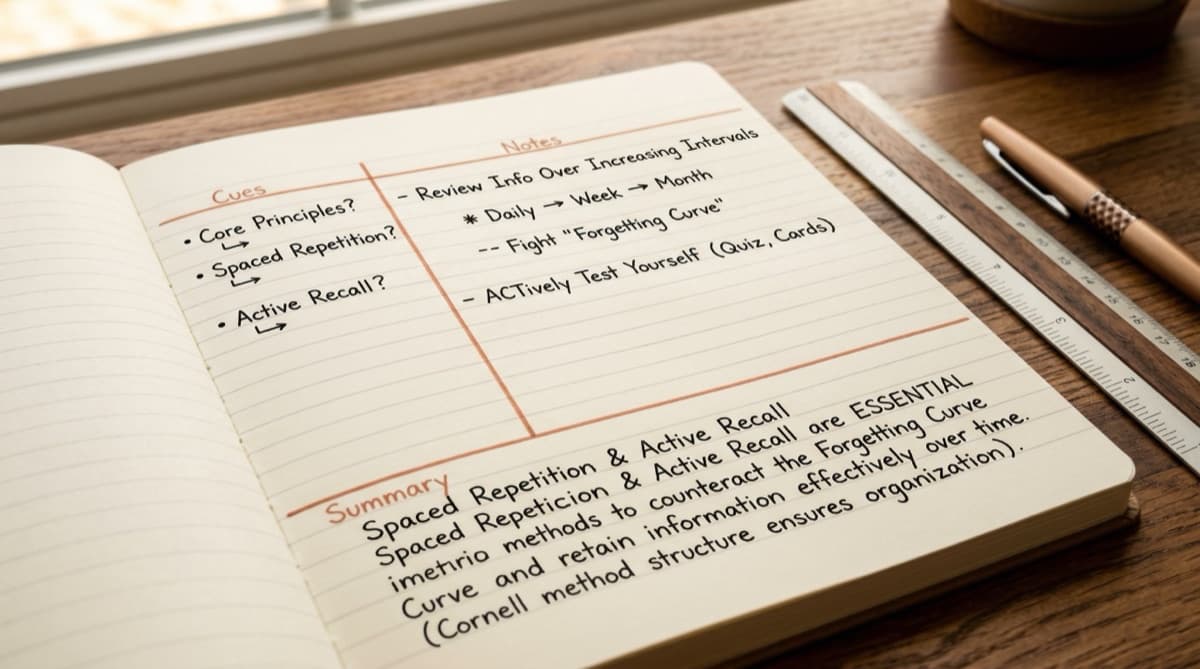
The Cornell Method is one of the most well-researched note-taking systems in education. Developed at Cornell University, it divides your page into three sections: a narrow cue column on the left, a wide notes column on the right, and a summary section at the bottom.
Here's how it works:
- During the lecture, write your main notes in the right column. Focus on key ideas, definitions, and examples.
- After the lecture (within 24 hours), review your notes and write questions or keywords in the left cue column.
- At the bottom, write a 2-3 sentence summary of the page's main points.
- To study, cover the right column and use the cue column to test yourself.
The Cornell Method is especially powerful because it builds active recall directly into the review process. Instead of passively re-reading, you're testing yourself every time you study.
Best for: Structured lectures, any subject where review and retention matter.
Want a deeper breakdown? Read our complete Cornell notes guide or grab our free Cornell notes template to get started.
2. Outline Method
The Outline Method is probably the most intuitive approach. You organize information hierarchically using indentation. Main topics sit at the left margin, subtopics are indented once, and supporting details are indented further.
It looks something like this:
- Main Topic
- Subtopic A
- Detail or example
- Another detail
- Subtopic B
- Key fact
- Supporting evidence
- Subtopic A
The outline method works well when the lecture or reading material already follows a logical structure. It's also easy to scan and review, which makes it a natural fit for writing essays or organizing study guides.
Strengths:
- Clear hierarchy of ideas
- Easy to review and reorganize later
- Works well for text-heavy subjects like history, literature, and social sciences
Limitations:
- Struggles with fast-paced lectures where structure isn't obvious
- Can become overly detailed if you try to capture everything
Best for: Well-organized lectures, textbook reading, humanities and social science courses.
3. Mind Mapping
If you're a visual learner, mind mapping might be the method that clicks for you. Instead of linear notes, you start with a central idea in the middle of the page and branch outward with related concepts, subtopics, and details.
How to create a mind map:
- Write the main topic or lecture theme in the center of your page
- Draw branches for major subtopics
- Add smaller branches for supporting details, examples, and connections
- Use colors, symbols, or small illustrations to differentiate themes
Mind maps are excellent for seeing relationships between ideas that linear notes might miss. They're also great for brainstorming, essay planning, and subjects where concepts connect in non-linear ways.
Strengths:
- Shows connections between ideas at a glance
- Engages visual and spatial memory
- Great for big-picture understanding
Limitations:
- Hard to capture large amounts of detail
- Can get messy with information-heavy lectures
- Difficult to do neatly in real time
Best for: Visual learners, brainstorming sessions, subjects with interconnected concepts like biology or philosophy.
4. Boxing Method
The Boxing Method groups related information into distinct visual boxes on the page. Each box contains notes on a single topic, concept, or theme. As the lecture moves to a new topic, you draw a new box.
This method is particularly useful when a lecture covers multiple distinct topics in one session. Instead of everything blending together in a continuous stream of text, each concept is visually separated and easy to identify.
How to use it:
- Listen for when the topic shifts during a lecture
- Draw a box around your notes for the current topic
- Start a new box for the next topic
- Label each box with a clear heading
Strengths:
- Visual separation makes review efficient
- Easy to identify and locate specific topics
- Works well for subjects that cover many discrete concepts per session
Limitations:
- Requires you to recognize topic shifts in real time
- Boxes can become uneven or cramped with longer topics
Best for: Lectures that cover multiple topics, subjects like anatomy, chemistry, or business where information is categorized naturally.
5. Sentence Method
The Sentence Method is as straightforward as it sounds: you write each new piece of information as a separate sentence on its own line. There's no hierarchy, no grouping, just a running list of key statements.
This method works best in fast-paced lectures where information comes quickly and there isn't time to organize it into outlines or boxes. Your goal is simply to capture the most important points as concise, standalone sentences.
Example:
- Mitochondria are the primary energy producers in eukaryotic cells.
- ATP is produced through oxidative phosphorylation.
- The electron transport chain occurs on the inner mitochondrial membrane.
Strengths:
- Easy to keep up with rapid lectures
- No organizational overhead during class
- Captures a lot of information quickly
Limitations:
- No built-in structure, so review can feel disorganized
- Requires post-lecture organization to be useful for studying
- Relationships between ideas are not obvious
Best for: Fast-paced lectures, classes with dense factual content, situations where you need to capture as much as possible.
Tip: After class, go back and organize your sentence notes using another method, like the outline or boxing method. This two-pass approach gives you both speed during class and structure for review.
6. Charting Method
The Charting Method organizes notes into a table format with columns and rows. It's ideal when the lecture involves comparing multiple items across the same set of criteria.
For example, if a history lecture covers three different revolutions, your chart might look like:
| French Revolution | American Revolution | Russian Revolution | |
|---|---|---|---|
| Causes | ... | ... | ... |
| Key Figures | ... | ... | ... |
| Outcome | ... | ... | ... |
| Time Period | ... | ... | ... |
How to set it up:
- Identify the categories being compared (these become your columns)
- Identify the comparison criteria (these become your rows)
- Fill in each cell as the lecture progresses
Strengths:
- Perfect for comparative analysis
- Information is organized and easy to review
- Reduces redundancy since similar details align in rows
Limitations:
- Requires you to know the categories in advance, or at least early in the lecture
- Not flexible for unstructured or free-flowing content
Best for: Comparing topics, subjects with clear categories like science classifications, historical events, or literature analysis.
7. AI-Powered Note-Taking
Traditional note-taking methods all share one limitation: they require you to listen, process, and write simultaneously. No matter how good your method is, you'll inevitably miss things, especially during fast or complex lectures.
AI-powered note-taking changes that equation entirely. Tools like NoteTube can automatically generate structured notes from videos, PDFs, articles, and other learning materials. Instead of splitting your attention between listening and writing, you can focus on understanding while AI handles the capture.
Here's what AI note-taking typically offers:
- Automatic transcription and summarization of video lectures and recordings
- Key point extraction so you get the most important ideas without manual filtering
- Structured output that organizes notes into clear sections and highlights
- Instant notes from any source including YouTube videos, uploaded PDFs, and articles
This doesn't mean you should stop taking notes manually. The encoding effect we discussed earlier is real, and the act of writing helps you learn. But AI tools are powerful as a complement. Use them to capture everything, then apply a method like Cornell Notes on top for active review.
For example, you can use NoteTube as a video to notes converter to generate complete notes from a recorded lecture, then spend your study time creating cue questions and testing yourself rather than transcribing.
If your source is a lecture video, see our guide on how to turn a YouTube video into notes with AI.
Best for: Video lectures, recorded content, supplementing any other note-taking method, students who want to maximize both capture and comprehension.
How to Choose the Right Method
With seven methods to pick from, how do you decide? Here are the key factors to consider:
Match the method to your subject:
- Structured, hierarchical content (history, literature) pairs well with the Outline Method or Cornell Notes
- Comparative topics (science classifications, historical parallels) suit the Charting Method
- Creative or interconnected subjects work with Mind Mapping
- Fast-paced, fact-heavy lectures call for the Sentence Method
Match the method to your learning style:
- Visual learners tend to prefer Mind Mapping and the Boxing Method
- Linear thinkers often gravitate toward the Outline Method or Cornell Notes
- If you learn best by reviewing and self-testing, Cornell Notes has built-in review mechanics
Match the method to the pace:
- Slow, structured lectures give you time for Cornell Notes, Charting, or Outlines
- Fast-paced lectures may require the Sentence Method or AI-powered tools to keep up
Don't be afraid to combine methods. Many successful students use the Sentence Method during class and reorganize into Cornell Notes afterward. Others use AI to capture everything and then create mind maps for revision.
Digital vs. Handwritten Notes
This is one of the most debated questions in education. Research offers insights, but the answer isn't as clear-cut as you might expect.
The Case for Handwriting
A widely cited study by Mueller and Oppenheimer found that students who took handwritten notes performed better on conceptual questions than those who typed. The reason? Handwriting is slower, which forces you to paraphrase and process information rather than transcribing verbatim.
Advantages of handwriting:
- Forces deeper processing since you can't write everything
- Fewer distractions (no browser tabs or notifications)
- Better for diagrams, mind maps, and visual notes
- Tactile engagement may strengthen memory encoding
The Case for Digital Notes
Digital notes have their own significant advantages, especially for organization and accessibility.
Advantages of digital notes:
- Faster capture, which helps in fast-paced lectures
- Easy to search, reorganize, and share
- Cloud sync means your notes are always accessible
- Can incorporate multimedia like images, links, and recordings
- Works seamlessly with AI note-taking apps that enhance your workflow
The Verdict
The best approach depends on your goals. For deep conceptual learning, handwriting has an edge. For speed, organization, and accessibility, digital wins. Many students use a hybrid approach: handwriting during class for encoding benefits, then digitizing and organizing notes later.
Whatever you choose, the method you use and how consistently you review matters far more than the medium.
Tips for Better Note-Taking
Regardless of which method you choose, these practical habits will improve the quality and usefulness of your notes.
1. Prepare before class. Skim the reading or lecture outline beforehand. When you have a rough idea of what's coming, it's easier to identify key points and organize your notes in real time.
2. Focus on ideas, not transcription. Your goal is to capture the meaning, not every word. Paraphrase concepts in your own language. If you find yourself transcribing verbatim, slow down and summarize instead.
3. Use abbreviations and symbols. Develop a personal shorthand. Common examples: "w/" for with, "b/c" for because, arrows for cause and effect, stars for important points. This speeds up your writing without losing meaning.
4. Review within 24 hours. This is the single most impactful habit you can build. Research on the forgetting curve shows that you lose the majority of new information within a day unless you review it. Even a 10-minute review session dramatically improves retention.
5. Leave space for additions. Don't cram your notes edge to edge. Leave margins and blank lines so you can add clarifications, connections, or questions later. This is especially useful when combining notes with textbook reading.
6. Connect new information to what you know. When you encounter a new concept, ask yourself how it relates to something you've already learned. Writing these connections in your notes creates stronger memory associations and deeper understanding. This is a core principle of how to study effectively.
Take Smarter Notes with AI
Good note-taking is a skill, and like any skill, it improves with practice and the right tools. The seven methods in this guide give you a solid foundation, whether you prefer the structured review of Cornell Notes, the visual connections of Mind Mapping, or the speed of the Sentence Method.
But you don't have to do it all manually. NoteTube uses AI to generate structured notes from any video, PDF, or article in seconds. Upload a lecture recording or paste a YouTube link, and you'll get organized notes, key takeaways, and study materials instantly. It's like having a perfect note-taker in every class.
Combine AI-generated notes with your preferred method for the best of both worlds: complete capture and deep understanding.
Ready to transform how you take notes? Try NoteTube free and see how AI-powered notes can save you hours of study time every week.
Create Perfect Notes in 30 Seconds
NoteTube uses AI to generate structured notes from any video, PDF, article, or text. Start free today.