You've been making teaching content on YouTube for a while. Maybe 2,000 subscribers. Maybe 50,000. The comments are positive. People ask for your notes, your slides, your study guide, your method.
But your ad revenue is a fraction of what your viewers think you make.
This post isn't about walking away from YouTube. YouTube is how your students found you in the first place. This is about turning the audience you've already built into actual income — without abandoning the channel that built it.
The frame is additive. Keep the channel. Add the product.
The YouTube education economics most viewers don't see
A viewer who watches a 20-minute lecture you spent two weekends preparing probably assumes you earned a few dollars from that view. The reality is usually closer to a fraction of a cent.
YouTube's payout to creators is driven by RPM (revenue per thousand views), not the headline CPM advertisers pay. According to Influencer Marketing Hub's 2024 benchmarks, most channels see RPMs in the $1–$5 range across niches, and educational and study channels typically sit at the lower end of that band. Backlinko's analysis of YouTube creator earnings found that a substantial share of small and mid-size channels earn under $100/month from AdSense even at meaningful view counts.
Three forces compound against educational creators specifically.
First, ad-blocker prevalence. Study audiences are disproportionately students, and students disproportionately use ad-blockers. A 2024 HubSpot Blog research summary and the long-running Backlinko ad-blocker usage data both peg ad-blocker use among 18–24-year-olds at materially higher rates than the general population. Every blocked impression is RPM you don't earn.
Second, demonetization risk on exam-prep content. Test names, mentions of specific medications in medical content, discussions of historical violence — YouTube's automated systems flag a wide range of educationally legitimate material as "not advertiser-friendly." A demonetized lecture earns nothing.
Third, the structural ceiling of an attention-only model. The only way to earn more is to get more views, which means the algorithm has to keep working in your favor, forever. You're renting a relationship with your audience from a third party.
None of this is YouTube's fault. YouTube is a video discovery platform with an ad-funded business model. It does what it does well. It's just that "ad-funded video platform" and "the most efficient way for an educator to earn from their teaching" are not the same problem.
What your audience is actually asking for in the comments
Open the comments on any small educator channel. The pattern is the same everywhere.
- "Can you share these notes?"
- "Where can I get the slides from this lecture?"
- "Is there a study guide for this chapter?"
- "Do you sell anything? I'd buy it."
- "Any chance of a worksheet I can practice with?"
Each of those is a sale that isn't happening.
The bottleneck isn't demand. The audience has already raised their hand. The bottleneck is infrastructure. You don't have a checkout. You don't have a place to host the file. You don't have a way to get paid that doesn't involve PayPal links in pinned comments. You don't have a content vehicle that's more than a video.
And the content vehicle matters. A "study guide" your viewer imagines is not a single PDF. It's a deck of flashcards they can quiz themselves with. A practice quiz with feedback. A summary they can skim before the exam. A chat they can ask follow-up questions to. The format your audience actually wants is the format that takes the most hours to produce by hand.
This is where the math has historically failed. The audience exists. The willingness to pay exists. The labor cost of packaging it has eaten any reasonable hourly rate.
The additive funnel: YouTube to NoteTube
Here's the mechanic, concretely.
Your video stays on YouTube. The thumbnail, the title, the watch time, the algorithm signals — none of that changes. Your audience finds you the same way they always have.
The only thing that changes is one line in your video description:
Study pack for this lecture → notetube.ai/@yourhandle
That link points at your NoteTube creator profile. On the profile is the published study material that goes with the lecture — flashcards, a quiz, a summary, AI chat trained on your source content, and any notes or roadmaps you want to share.
You decide which items are free and which are paid. A common pattern: free flashcard deck as the lead, paid full kit ($15–$25) as the upgrade. Free roadmap covering your channel's overall topic, sitting at the top of the profile as the anchor.
The funnel is additive because nothing on YouTube changes. You don't move the audience. You give the audience a place to go when they're ready to buy what they were already asking for.
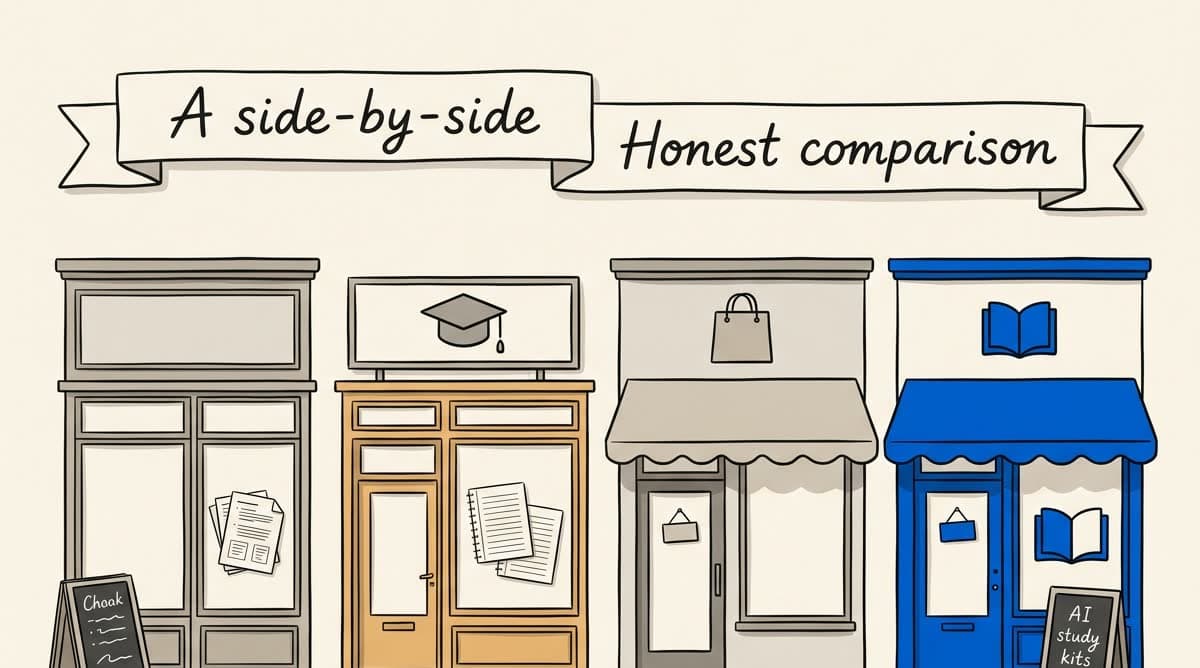
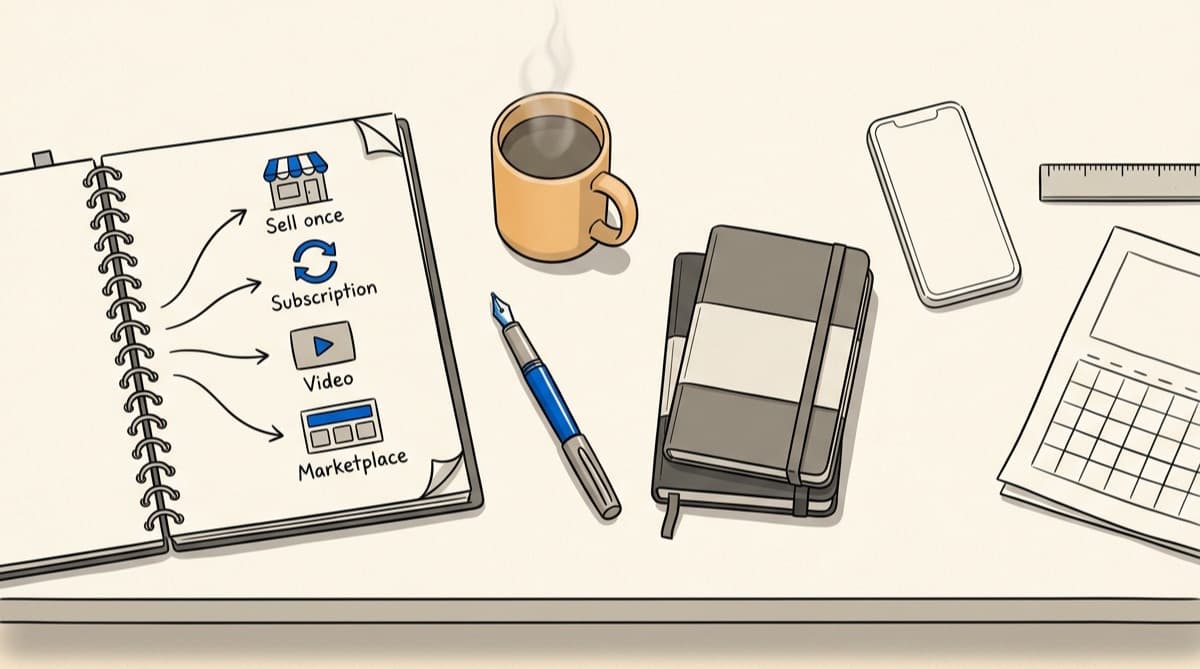
If you want the broader landscape of options — sell-once, subscription, ad-supported, marketplace — we wrote a hub piece on how to monetize your teaching in 2026 that walks through all four with honest trade-offs.
The math on a small channel
Let's run numbers on a deliberately conservative scenario.
A channel does 5,000 monthly views across its catalog. That's small. A serious tutor with a year of consistent uploads sits there or above.
Industry-standard click-through on a product link in a YouTube description for a warm, educational audience runs around 1–2%. Use 1% — the lower end. That's 50 monthly clicks on the NoteTube profile link.
Of profile visitors, a warm-traffic conversion rate for a clearly relevant product typically sits in the 20–40% range. Use 30%, again on the conservative side of that band (per Shopify's conversion-rate benchmark data, the cross-industry average is lower, but warm funnel traffic from a creator's own audience consistently outperforms cold ad traffic).
That's 15 sales of a $15 study pack per month.
The fee math, pulled directly from NoteTube's fee-math.ts source of truth and the matching test cases: on a $5 sale, the creator keeps $3.64. On a $50 sale, the creator keeps $38.60. Interpolating to $15, after Stripe's processing fee and the 20% platform fee, the creator nets approximately $11.41 per sale.
15 sales × $11.41 = about $171/month.
Compare to AdSense at the same 5,000 monthly views, at the low-end-of-typical $3 RPM: 5 × $3 = $15/month.
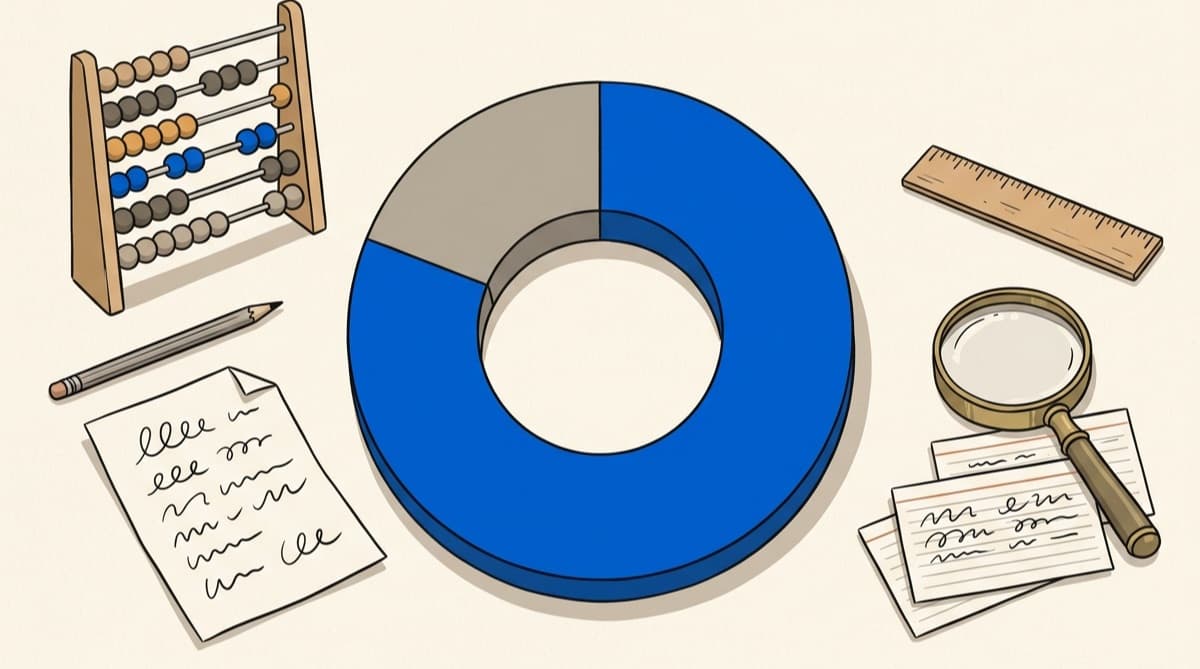
That's a roughly 10x improvement in revenue from the same audience — not because the audience is bigger, but because the funnel terminates in a product instead of an ad impression.
Run the same math with bigger inputs and the picture sharpens. A channel at 20,000 monthly views with the same conversion math reaches roughly $680/month from study packs versus $60 from AdSense. The lever isn't more views; the lever is converting the views you already have.
We worked through more pricing scenarios — $5, $15, $50 — and what they realistically earn over a first six months in our earnings math post for teachers, tutors, and coaches. No invented success stories. Just the math.
How the AI generation actually helps small creators
The funnel math above assumes you can produce the study pack at all. For most small educators, this is the hidden cost that kills the model before it starts.
A 20-minute lecture takes 20 minutes to record. The accompanying study materials — flashcards, a practice quiz, a written summary, a way for the viewer to ask follow-up questions — take roughly two hours to build by hand, if you're fast. Charts and worked-example walkthroughs add more. At any reasonable hourly rate, the unit economics don't pencil.
NoteTube's product wedge is that the AI generates all of those from your source material. You upload the lecture, the slides, the transcript, the PDF — whatever you used to teach the video — and the AI produces a full study kit: flashcards, quiz, summary, and an AI chat that's grounded in your content. You review, edit, and publish.
The marginal cost of creating the study pack drops from hours to minutes. The funnel math we just walked through assumed $11.41 per sale of revenue. If the labor cost is two hours per pack, you're earning a fraction of minimum wage. If the labor cost is fifteen minutes, you're earning a real hourly rate — and the same pack can sell for months or years.
This is also why the additive frame works. You don't have to become a "content packager" in addition to being an educator. The packaging is what the platform does for you, from the same source material you already used to make the video.
The first three things to publish
If you're testing this funnel, don't try to publish your whole catalog at once. Three pieces are enough to validate whether your specific audience converts.
Free flashcard deck for your most-viewed video. This is the lead magnet. Anyone clicking the link from your YouTube description lands on a free, immediately useful asset. They study, they get value, they remember your name, they follow your creator profile. Free is intentional — your job here is to prove the funnel mechanic works, not to extract revenue on the first click.
Paid full study kit ($15–$25) for your second-most-viewed video. This is the conversion test. Bundle flashcards, quiz, summary, and notes for the lecture into one priced item. Run the funnel for 30 days. Watch the conversion rate. The number you're looking for is "more than zero" in the first month — anything past that is signal worth building on.
A free roadmap covering your channel's overall topic. A roadmap on NoteTube is a structured sequence of sessions — think of it as a learning path. Publish a free one that mirrors your channel's curriculum. This becomes the anchor item on your profile. Visitors who arrive looking for "your whole approach" get it; subscribers who want depth in one area can buy individual paid kits.
After 30 days, you'll know two things: whether your audience clicks (your CTR from description to profile) and whether they buy (your conversion rate from profile to sale). Both are real numbers, not vibes. Both tell you what to build next.
What this won't fix
This isn't an "abandon your channel" message and it shouldn't be read as one. YouTube does discovery. NoteTube does monetization. The two surfaces solve different problems for an educator and they're additive, not substitutive.
A few honest limits.
If your audience isn't engaged enough to click a product link in your description, NoteTube won't fix that. The funnel's first step is a click, and the click depends on the trust you've already built. Channels with strong parasocial relationships convert. Channels with high view counts and low comment-to-view ratios often don't.
If your topic doesn't match how your audience studies, the conversion side will struggle. Flashcards and quizzes work well for vocabulary-heavy, fact-heavy, or exam-prep material. They work less well for purely conceptual or narrative content. Honest about that.
If you don't already have a teaching method — source material, a perspective, a way of explaining things — there is no shortcut. The AI packages your teaching. It doesn't replace it.
For engaged audiences with material that maps to study formats, the unit economics improvement is real. The same 5,000 monthly views that earn $15 in ad revenue can earn roughly 10x that in product revenue. The lever isn't growth. The lever is monetization that matches what your audience was already asking for.
Start your creator profile
If you want to test this with your own channel, the creator wizard takes about five minutes. You bring a handle, a short bio, and one piece of source material. The AI generates the first study kit. You decide free or paid.
Two related reads:
- How to Monetize Your Teaching in 2026: A Practical Guide for Educators — the four monetization models, what each one demands, and which fits your situation.
- How Much Can You Earn Selling Study Materials? Real Math for Teachers, Tutors, and Coaches — the $5, $15, and $50 price points worked through honestly, including the $0.99 trap.
If you want the full picture of what publishing on NoteTube looks like — what you can publish, how the marketplace works, what "Founding Educator" means — visit /for-creators.
The audience you've already built is the hard part. You did that. The packaging and the checkout are the parts the platform is here to handle.
Create Perfect Notes in 30 Seconds
NoteTube uses AI to generate structured notes from any video, PDF, article, or text. Start free today.