You've been studying for hours. Your highlighters are running dry, your notes are color-coded, and you've re-read the same chapter three times. It feels productive. But when the exam lands in front of you, your mind goes blank.
Sound familiar? You're not alone. The vast majority of students rely on study methods that feel effective but actually produce poor results. The gap between effort and outcome isn't about intelligence or talent. It's about strategy.
Research in cognitive science has consistently shown that the most popular study habits — re-reading, highlighting, and cramming — rank among the least effective approaches to learning. Meanwhile, the techniques that actually work feel harder and less intuitive, which is exactly why most students never adopt them.
This guide breaks down everything you need to know about how to study for exams effectively. You'll learn how to build a study plan, which techniques deliver the best results, how to adapt your approach for different subjects, and what to do (and avoid) the night before test day.
If you want the full picture on building better study habits beyond exam prep, start with our guide on how to study effectively.
Why Most Students Study Wrong
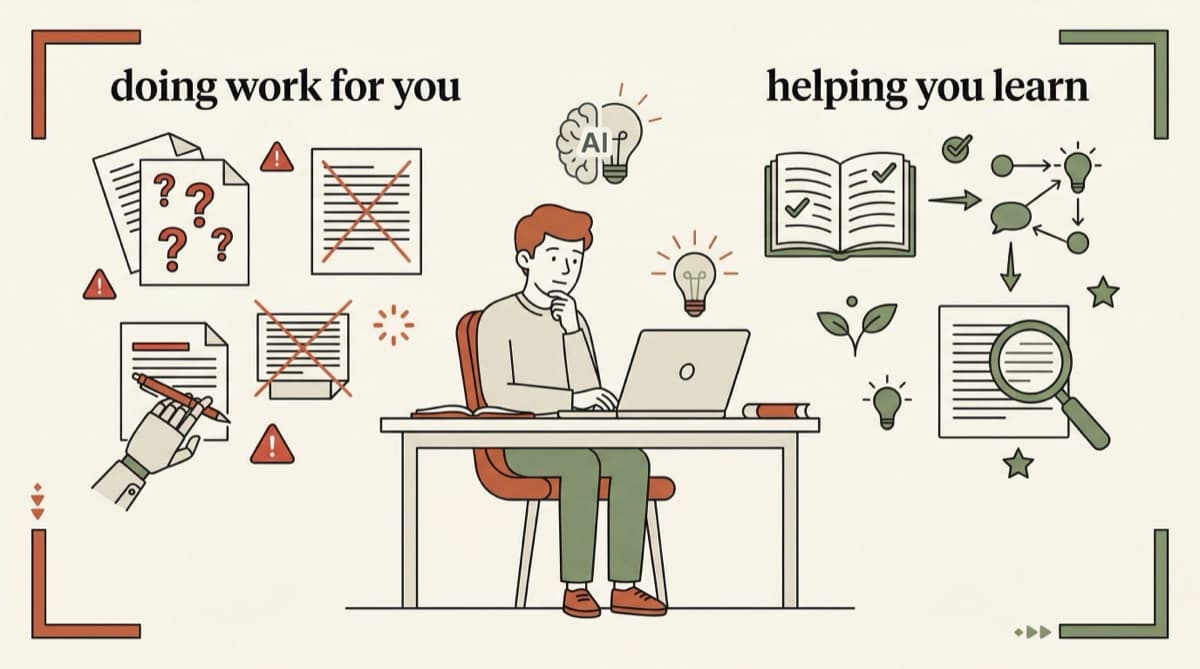
Most students default to passive study methods. These include re-reading textbooks, copying notes, watching lecture recordings on autopilot, and highlighting passages. These activities keep you busy, but they don't force your brain to do the hard work of encoding and retrieving information.
This creates what psychologists call the illusion of competence. When you re-read something, the material feels familiar. That familiarity tricks you into believing you've learned it. But recognition and recall are two very different cognitive processes. Recognizing an answer on a page is easy. Producing that answer from memory during an exam is something else entirely.
The shift you need to make is from passive review to active learning. Active methods require you to engage with the material — retrieving it, applying it, explaining it, and testing yourself on it. They feel more difficult in the moment, and that difficulty is precisely what makes them effective. Cognitive scientists call this the principle of "desirable difficulties": strategies that make learning harder in the short term lead to stronger, more durable memory in the long term.
The good news is that switching to active methods doesn't mean studying more. It means studying smarter. Many students find they can cut their study time significantly once they drop ineffective habits and adopt evidence-based techniques.
Create a Study Schedule
Walking into an exam without a study plan is like navigating a city without a map. You might eventually get where you're going, but you'll waste a lot of time and energy along the way.
Work Backwards from the Exam Date
Start with your exam date and work backwards. Count the number of days you have available, then subtract any days you know you'll be unavailable. This gives you your actual study window.
Example: If your exam is in 14 days and you have commitments on 4 of those days, you have 10 real study days to work with.
Map Out Your Topics
List every topic the exam could cover. Then assess your confidence level for each one:
- Strong: You can explain it without notes
- Medium: You understand the basics but need review
- Weak: You'd struggle to explain it at all
Allocate more time to weak and medium topics. It's tempting to study what you already know because it feels good, but your biggest gains come from focusing on gaps.
Build a Realistic Daily Plan
For each study day, assign specific topics and techniques. Be realistic about how much you can cover. A common mistake is creating an ambitious schedule that falls apart by day three.
A practical daily structure looks like this:
- Review previous material (15-20 minutes) — Use active recall to test yourself on what you studied yesterday
- Learn new material (60-90 minutes) — Work through your weakest topics first when your energy is highest
- Practice and apply (30-45 minutes) — Do practice problems, write summaries, or teach the material out loud
- Quick review (10 minutes) — Skim through your flashcards or key concepts before wrapping up
Build in buffer days. Things will take longer than you expect, and having a cushion prevents last-minute panic.
The Best Exam Study Techniques
Not all study techniques are created equal. Here are the methods with the strongest research support, ranked by impact on exam performance.
Active Recall
Active recall is the single most effective study technique available. Instead of passively reviewing your notes, you close them and try to retrieve the information from memory. Every successful retrieval strengthens the neural pathway to that knowledge, making it easier to access during your exam.
How to practice active recall:
- After reading a section, close your book and write down everything you remember
- Convert your notes into questions and answer them without looking
- Use flashcards where you genuinely try to produce the answer before flipping
- Attempt practice problems before reviewing the solution
The key is the effort of retrieval. If you flip a flashcard too quickly or check your notes at the first sign of struggle, you lose most of the benefit. Sit with the discomfort of not remembering for at least 20-30 seconds before checking.
Read our complete active recall guide for a detailed breakdown of five proven methods and a study schedule.
Spaced Repetition
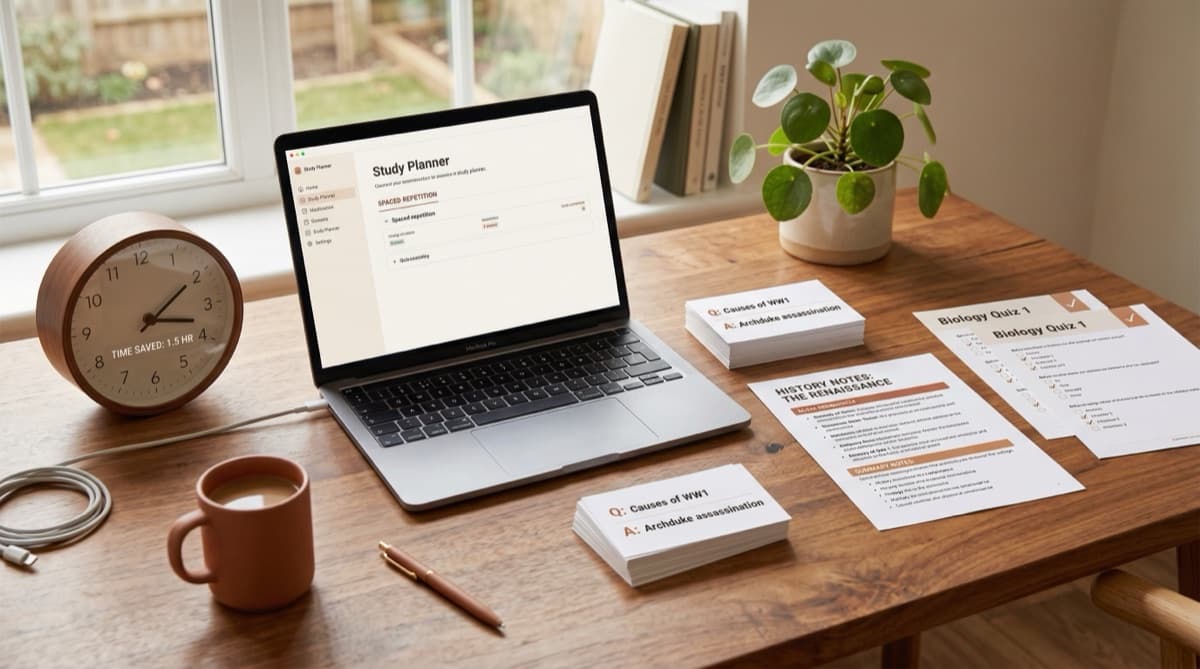
Spaced repetition is a review strategy based on the forgetting curve — the well-documented phenomenon that memory decays exponentially over time unless reinforced. Instead of reviewing everything in one marathon session, you space out your reviews at increasing intervals.
A typical spacing schedule:
- Day 1: Learn the material
- Day 2: First review
- Day 4: Second review
- Day 7: Third review
- Day 14+: Maintenance reviews
Each review session should use active recall, not passive re-reading. The combination of spaced timing and active retrieval is one of the most powerful learning strategies ever studied.
Flashcard apps like Anki automate the spacing for you. But you can also create a simple review calendar using a spreadsheet or planner.
Learn how to implement this system in our spaced repetition guide.
The Feynman Technique
Named after Nobel Prize-winning physicist Richard Feynman, the Feynman Technique is a method for achieving deep understanding of any concept. The core principle is simple: if you can't explain something in plain language, you don't truly understand it.
The four steps:
- Choose a concept you need to learn
- Explain it in simple terms as if teaching it to someone with no background knowledge
- Identify gaps where your explanation breaks down or gets vague
- Go back to the source material, fill in the gaps, and simplify further
This technique is especially powerful for complex or abstract topics. It forces you to move beyond surface-level memorization and build genuine comprehension.
Explore the full method in our Feynman technique guide.
Practice Tests
Practice testing is one of the highest-impact exam preparation strategies. Taking practice tests under realistic conditions does several things simultaneously:
- Simulates exam pressure so you're less anxious on test day
- Reveals knowledge gaps before it's too late to address them
- Builds retrieval strength through active recall
- Improves time management by giving you a feel for pacing
Where to find practice tests:
- Past exams from your professor or department
- End-of-chapter questions in your textbook
- Online question banks for standardized tests
- Study groups where you quiz each other
For maximum benefit, take practice tests under exam-like conditions. Set a timer, put away your notes, and work through the questions as if it were the real thing. Afterward, review every question you got wrong and understand why.
The Pomodoro Technique
The Pomodoro Technique is a time management method that structures your study sessions into focused intervals (typically 25 minutes) followed by short breaks (5 minutes). After four intervals, you take a longer break of 15-30 minutes.
This approach combats two common problems: procrastination and burnout. Knowing you only need to focus for 25 minutes makes it easier to start. Regular breaks prevent mental fatigue and keep your concentration sharp across longer study periods.
Learn how to set it up and customize it for exam prep in our Pomodoro technique guide.
How to Study Different Subjects
The best study approach depends partly on what you're studying. Here's how to adapt your techniques for different subject types.
STEM Subjects
Math, physics, chemistry, engineering, and computer science are problem-solving disciplines. Understanding concepts matters, but being able to apply them under pressure is what earns marks on exams.
Effective strategies for STEM:
- Practice problems are non-negotiable — You cannot learn math by reading about it. Work through problems without looking at solutions first
- Understand derivations, don't just memorize formulas — Know where formulas come from so you can reconstruct them if you forget
- Build a formula sheet from memory — Write out every formula you need without referring to your notes, then check what you missed
- Work through mistakes carefully — When you get a problem wrong, trace through each step to find exactly where your reasoning broke down
- Increase difficulty gradually — Start with basic problems, then move to multi-step and applied questions
Use the Cornell notes template to organize formulas in one column and worked examples in another.
Humanities
History, literature, philosophy, political science, and similar subjects emphasize argumentation, analysis, and interpretation. Exams often require essays or long-form answers rather than calculations.
Effective strategies for humanities:
- Focus on arguments, not just facts — Know what the key debates are, what different scholars argue, and what evidence supports each position
- Create timelines and cause-effect chains — For history, map out how events connect to each other
- Practice writing under time pressure — If your exam includes essays, practice outlining and writing complete arguments within a set time
- Use the Feynman Technique — Explain historical events, philosophical concepts, or literary themes in your own words to test understanding
- Compare and contrast — Create tables that compare different theories, time periods, characters, or perspectives
Languages
Foreign language exams test a combination of vocabulary, grammar, reading comprehension, listening, and sometimes speaking or writing. This requires a mix of study techniques.
Effective strategies for languages:
- Flashcards with spaced repetition are essential for vocabulary — Use apps that support audio and images alongside text
- Practice in context — Don't just memorize word lists. Read sentences, listen to native speakers, and write paragraphs using new vocabulary
- Immersion windows — Set aside time to think, read, or listen exclusively in the target language, even for just 15-20 minutes
- Grammar through pattern recognition — Rather than memorizing rules abstractly, study many examples of correct usage and let the patterns emerge
- Write practice answers — For writing exams, practice composing responses to past prompts and get feedback when possible
The Night Before the Exam
What you do the night before your exam matters more than most students realize — and the answer is not an all-night cram session.
Sleep Is Your Priority
Sleep is when your brain consolidates memories. During deep sleep, your brain replays the day's learning, strengthens neural connections, and transfers information from short-term to long-term storage. Cutting sleep to study more is counterproductive. You're literally disrupting the process that turns studying into lasting knowledge.
Aim for 7-9 hours of sleep the night before an exam. Research consistently shows that well-rested students outperform sleep-deprived students, even when the sleep-deprived group studied more total hours.
Keep Your Review Light
The night before is not the time to learn new material. If you don't know it by now, an extra few hours of cramming won't save you. Instead:
- Do a light review of key concepts — Flip through your flashcards or skim your summary notes
- Focus on your weakest areas — Give them one final pass, but don't obsess
- Stop studying at least an hour before bed — Give your mind time to wind down
- Lay out everything you need for tomorrow — ID, calculator, pens, water. Remove morning stress so you can focus on the exam
Manage Your Anxiety
Pre-exam nerves are normal. A few strategies that help:
- Write down your worries — Research shows that expressive writing before a test reduces anxiety and improves performance
- Avoid comparing yourself to classmates — Other people's study habits are irrelevant to your preparation
- Remind yourself of your preparation — You've put in the work. Trust the process
Common Study Mistakes to Avoid
Even motivated students undermine their own performance with these common errors.
Cramming Everything into One Session
Cramming feels productive because you cover a lot of material quickly. But massed practice produces weak, short-lived memories. Information crammed the night before is largely gone within a week. Spaced study sessions produce dramatically better long-term retention.
Re-reading Notes and Textbooks
Re-reading is the most popular study method and one of the least effective. It creates familiarity without comprehension. Each re-read produces diminishing returns. Replace re-reading with active recall — close the book and test yourself instead.
Highlighting and Underlining
Highlighting gives you the illusion of engagement without requiring actual thought. Studies consistently show that highlighting has minimal impact on learning outcomes. If you must mark your text, limit yourself to very few highlights and supplement with margin notes in your own words.
Multitasking While Studying
Multitasking doesn't exist in the way most people think. What feels like multitasking is actually rapid task-switching, and every switch carries a cognitive cost. Studying with your phone nearby, social media open, or a TV on in the background degrades both comprehension and retention. Research suggests it takes an average of 23 minutes to fully regain focus after an interruption.
Put your phone in another room. Close unnecessary browser tabs. Tell people you're unavailable. Protect your focus.
Studying Without a Plan
Sitting down and opening your notes without a clear objective leads to aimless review. Before each study session, decide exactly what you'll cover, which technique you'll use, and how long you'll spend. Structure turns time into progress.
Study Smarter, Not Harder
The difference between students who struggle and students who excel usually isn't intelligence or hours spent studying. It's method. The techniques in this guide — active recall, spaced repetition, practice testing, the Feynman Technique — are backed by decades of research. They work for every subject, every level, and every type of exam.
The hardest part is letting go of familiar habits that feel productive but aren't. Re-reading feels safe. Testing yourself feels uncomfortable. But that discomfort is the feeling of your brain actually learning.
Start small. Pick one technique from this guide and apply it to your next study session. Once you see the results, you'll never go back to highlighting.
Want to study smarter with less effort? NoteTube is an AI note-taking app that automatically generates flashcards, summaries, and quiz questions from your lectures, PDFs, and study materials. Stop spending hours creating study aids manually and start focusing on the techniques that actually drive results. Try NoteTube free today.
Create Perfect Notes in 30 Seconds
NoteTube uses AI to generate structured notes from any video, PDF, article, or text. Start free today.