11:04
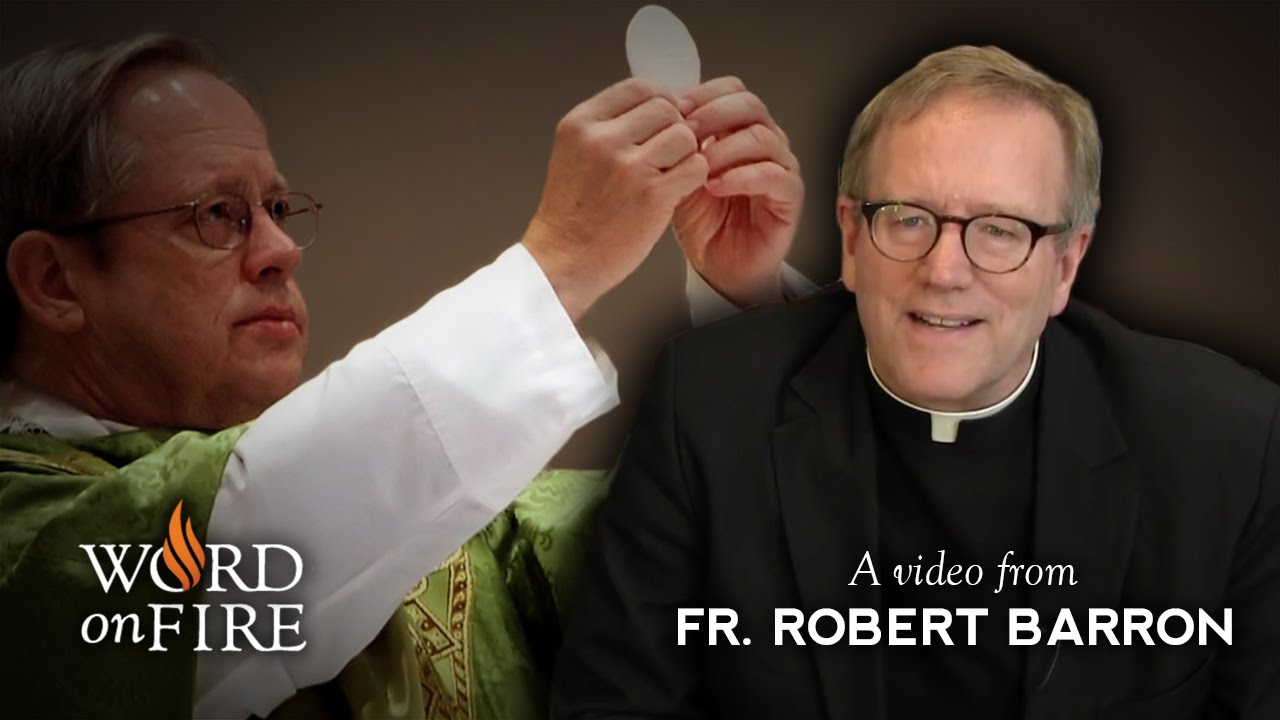
Bishop Barron on the Real Presence of Christ in the Eucharist
Bishop Robert Barron
Overview
This video explores the Catholic doctrine of the Real Presence of Christ in the Eucharist, explaining that Catholics believe Jesus is truly and substantially present in the consecrated bread and wine, not merely symbolically. Bishop Barron grounds this belief in Jesus' discourse in John chapter 6, where Jesus speaks of eating his flesh and drinking his blood. He contrasts this with ordinary human language, emphasizing that Jesus' words, as the Divine Word, have the power to effect reality, transforming the bread and wine into his Body and Blood during Mass through the priest acting in persona Christi.
How was this?
Save this permanently with flashcards, quizzes, and AI chat
Chapters
- The Atlanta Eucharistic Congress, attended by 30,000 people, is a major event focused on honoring the Eucharist.
- The Congress began with a powerful procession and worship, visually representing the Church's belief in the Real Presence.
- The Catholic belief is that the Eucharist is not just a symbol, but Jesus Christ is truly and substantially present under the forms of bread and wine.
This chapter sets the stage by illustrating the profound reverence and belief Catholics have for the Eucharist, highlighting the central doctrine to be explained.
The description of thousands of people marching into the arena, followed by the solemn procession of the Archbishop carrying the Host in a monstrance, culminating in silent worship.
- Jesus' discourse in John 6, particularly his statement 'Eat my flesh and drink my blood,' was deeply troubling to his listeners.
- For first-century Jews, eating flesh with blood was forbidden due to the Old Testament prohibition viewing blood as life belonging to God.
- The crowd's reaction shows they understood Jesus' words literally, finding them problematic and even disgusting.
- Jesus intensified his language, using the Greek verb 'trogon' (to gnaw) instead of 'phagein' (to eat), emphasizing a profound, almost visceral, connection.
This chapter explains the scriptural basis for the Real Presence, addressing why Jesus' teaching was so shocking and how his deliberate choice of words points to a literal, not metaphorical, meaning.
The contrast between Jesus' teaching and the Old Testament prohibition against eating flesh with blood, which made his words about eating his flesh and blood particularly scandalous to his Jewish audience.
- Human words, especially from authoritative figures, can profoundly affect reality and change people's attitudes or circumstances.
- Examples include a coach's praise changing a life, a critique undermining confidence, or a police officer's declaration 'You are under arrest' having legal force.
- God's creative power is demonstrated in Genesis, where God speaks things into existence ('Let there be light').
- Jesus, as the Divine Word made flesh, possesses a unique authority where his words can directly transform reality.
This chapter builds an analogy to help understand how Jesus' words, unlike ordinary human speech, can possess the power to change the very substance of things.
The example of a police officer saying 'You are under arrest,' which, when spoken by someone with proper authority, changes the reality of the person being addressed, unlike if a random person said it.
- At the Last Supper, Jesus took bread and wine and declared, 'This is my body,' and 'This is my blood.'
- Because Jesus is the Divine Word, his words at the Last Supper had the power to change the substance of the bread and wine into his Body and Blood.
- During Mass, the priest acts 'in persona Christi' (in the person of Christ) during the consecration.
- The priest speaks Jesus' words with Christ's authority, causing the bread and wine to be substantially transformed into the Body and Blood of Jesus.
This chapter connects the scriptural and linguistic explanations to the central act of Catholic worship, explaining how the miracle of the Real Presence occurs during Mass.
The priest, acting in the person of Christ, repeats Jesus' words at the Last Supper: 'Take this all of you, and eat it: this is my body... Take this all of you, and drink from it: this is the cup of my blood,' thereby effecting the transformation.
Key takeaways
- The Catholic belief in the Real Presence asserts that Jesus is substantially present in the Eucharist, not just symbolically.
- Jesus' discourse in John 6, particularly his use of strong, literal language, forms the scriptural foundation for the Real Presence.
- The Old Testament prohibitions against consuming blood highlight how radical and challenging Jesus' teaching on eating his flesh and blood was.
- Jesus' words carry divine authority, capable of affecting and transforming reality, unlike ordinary human speech.
- The power of words to change reality is illustrated by examples like legal declarations or divine creation.
- During the consecration at Mass, the priest speaks in the person of Christ, enabling the bread and wine to become the Body and Blood of Jesus.
- The profound nature of the Eucharist calls for a response of worship and reverence, as seen at the Eucharistic Congress.
Key terms
Real PresenceEucharistTransubstantiationJohn 6Divine WordIn Persona ChristiConsecrationMonstranceTrogonPhagein
Test your understanding
- Why was Jesus' teaching in John 6 so difficult for his listeners to accept?
- How does Bishop Barron explain the difference between ordinary human words and the words of Jesus?
- What is the significance of the Greek verb 'trogon' in understanding Jesus' discourse on eating his flesh and blood?
- How does the priest's role during the consecration relate to Jesus' own words and actions?
- What is the Catholic understanding of what happens to the bread and wine during Mass?