1:01:28
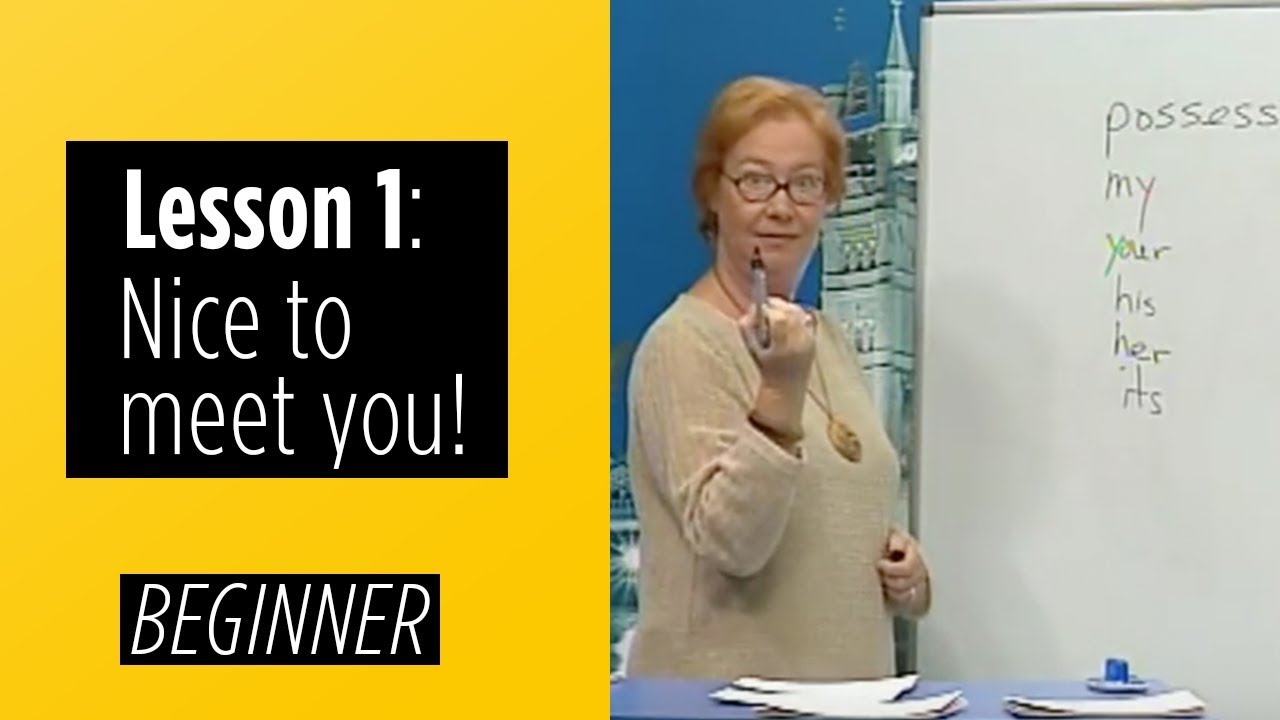
Beginner Levels - Lesson 1: Nice To Meet You!
English For You
Overview
This video serves as a foundational lesson for English language learners, focusing on basic introductions, personal information, and the alphabet. It covers how to state and ask for names (first and last), introduce oneself and others in both formal and informal settings, and use possessive adjectives. The lesson also delves into the English alphabet, distinguishing between vowels and consonants, and introduces the verb 'to be' in its various forms (am, is, are) with contractions. Finally, it touches upon formal address (Mr., Mrs., Miss, Ms.) and basic greetings and farewells, preparing learners for simple social interactions.
How was this?
Save this permanently with flashcards, quizzes, and AI chat
Chapters
- State your full name by saying 'My name is [First Name] [Last Name].'
- Ask for someone's name using 'What is your name?'
- Practice asking and answering about first names ('What is your first name?' / 'My first name is...') and last names ('What is your last name?' / 'My last name is...').
- Introduce others by saying 'This is [Name].'
Learning to introduce yourself and others is fundamental for initiating conversations and building social connections in a new language.
Molly says, 'My name is Molly Stone.' Then she asks, 'What is your name?' and a student replies, 'My name is Lisa Roberts.'
- Understand and use possessive adjectives (my, your, his, her, its, our, their) to indicate ownership.
- Apply these adjectives to nouns like 'name' (e.g., 'my name', 'your name', 'his name').
- Recognize the difference between singular (my, your, his, her, its) and plural (our, your, their) possessives.
Possessive adjectives are crucial for clearly communicating relationships and ownership, which is essential for detailed and accurate communication.
The video demonstrates using 'my name is Molly Stone' and 'your name is Ali Oxo'.
- Learn formal titles for men: Mr. (for both married and single men).
- Learn formal titles for women: Mrs. (for married women), Miss (for unmarried women), and Ms. (gender-neutral, often used when marital status is unknown or irrelevant).
- Practice using these titles in introductions, such as 'Mr. Stone' or 'Ms. Molly Stone'.
Using correct formal titles shows respect and is important in professional or more formal social situations.
Examples include 'Mr. Tom Cruz', 'Mrs. Hillary Clinton', and 'Miss Piggy'.
- Learn the 26 letters of the English alphabet (A-Z).
- Identify vowels (A, E, I, O, U, and sometimes Y) and consonants (all other letters).
- Practice recognizing and saying individual letters and distinguishing between uppercase (capital) and lowercase (small) letters.
- Understand that names typically begin with a capital letter.
Mastering the alphabet is the gateway to reading, writing, and accurate spelling, which are foundational skills for language proficiency.
The video lists vowels as 'A, E, I, O, U, and sometimes Y' and consonants as 'B, C, D, F, G...'.
- Learn the phrase 'Please spell your name' to ask for the spelling of a name.
- Practice spelling names letter by letter, using capital letters for the first letter of each name part.
- Understand that spelling is crucial for accurate identification and record-keeping.
Being able to spell names correctly ensures clear communication and avoids confusion, especially in written contexts.
A student spells their name: 'Capital M O L L Y capital S T O N E.'
- Learn the basic forms of the verb 'to be' for different subjects: I am, you are, he is, she is, it is, we are, they are.
- Understand and use contractions: I'm, you're, he's, she's, it's, we're, they're.
- Practice forming simple sentences using 'to be' (e.g., 'I am Molly', 'You are Ali', 'They are students').
The verb 'to be' is one of the most common and essential verbs in English, used for identification, description, and stating facts.
The video shows examples like 'I am Molly' contracting to 'I'm Molly' and 'You are Ali' contracting to 'You're Ali'.
- Learn to form yes/no questions by inverting the subject and the verb 'to be' (e.g., 'Am I Molly?', 'Are you Ali?', 'Is he Tom?').
- Practice answering these questions with both positive ('Yes, you are.') and negative ('No, you're not.') responses.
- Understand variations in answers, especially for 'Am I...?' (answered with 'Yes, you are/No, you're not') and 'Are we...?' (answered with 'Yes, we are/No, we're not' or 'Yes, you are/No, you're not').
Formulating and answering questions is key to engaging in dialogue and confirming information.
A question is posed: 'Am I Molly?' The correct answer is 'Yes, you are.'
- Understand the difference between formal introductions (for people of higher status, using titles like Dr. and Professor) and informal introductions (among friends).
- Learn standard phrases for introductions: 'It's nice to meet you' and 'It's nice to meet you too'.
- Practice introducing people to each other in both formal and informal contexts.
Knowing how to navigate both formal and informal introductions allows for appropriate social interaction in various settings.
Formal: 'Professor Smith, this is Dr. Jones. Dr. Jones says, 'It's nice to meet you, Professor Smith.' Informal: 'Ali, this is Marie. Marie says, 'Nice to meet you, Ali.' Ali replies, 'Nice to meet you too.'
- Learn common ways to say goodbye: 'Goodbye', 'Bye', 'See you', 'See you tomorrow', 'See you later'.
- Practice using these farewells in different contexts.
Appropriate farewells are essential for concluding conversations politely and indicating future intentions.
Students practice saying: 'Goodbye', 'Bye', and 'See you tomorrow.'
Key takeaways
- Mastering basic introductions and personal information exchange is the first step to communicating in English.
- Possessive adjectives help clarify who something belongs to or relates to.
- Understanding the English alphabet, including vowels and consonants, is crucial for spelling and pronunciation.
- The verb 'to be' (am, is, are) and its contractions are fundamental building blocks for forming sentences.
- Asking and answering yes/no questions using 'to be' enables basic dialogue and information verification.
- Distinguishing between formal and informal introductions ensures respectful and appropriate social interactions.
- Learning common greetings and farewells facilitates smooth social exchanges.
Key terms
First NameLast NamePossessive AdjectivesMr.Mrs.MissMs.AlphabetVowelsConsonantsCapital LettersLowercase LettersSpellVerb 'To Be'ContractionsFormal IntroductionInformal IntroductionGoodbye
Test your understanding
- How do you ask someone for their first and last name?
- What is the difference between 'my name' and 'your name'?
- Explain the difference between vowels and consonants in the English alphabet.
- How do you form a simple sentence using the verb 'to be' and a contraction?
- What are the appropriate phrases to use when making a formal introduction versus an informal one?