10:56
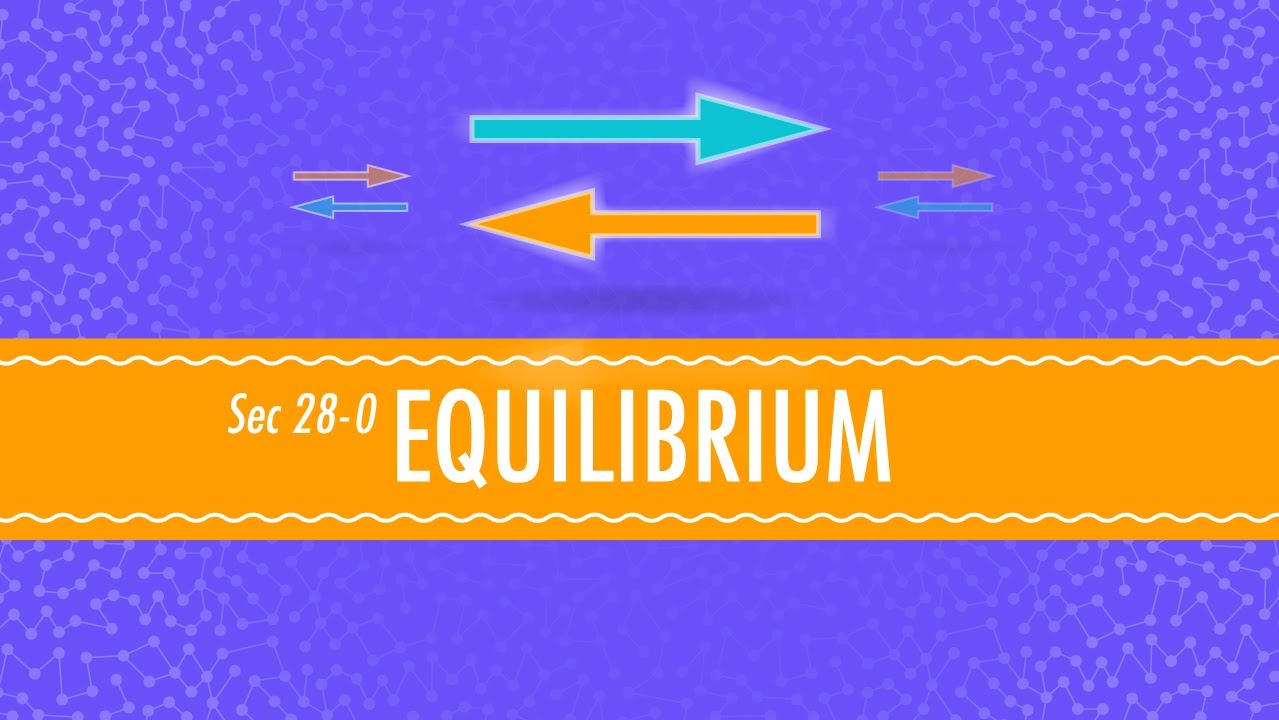
Equilibrium: Crash Course Chemistry #28
CrashCourse
Overview
This video explains the concept of chemical equilibrium, which is a state of balance in reversible chemical reactions where the forward and reverse reaction rates are equal. It details how equilibrium can be disturbed by changes in concentration, temperature, or pressure, and introduces Le Châtelier's Principle, which predicts how a system at equilibrium will shift to counteract these disturbances. The Haber process for ammonia synthesis is used as a primary example to illustrate these principles, highlighting both its industrial importance and the complex history surrounding its development.
How was this?
Save this permanently with flashcards, quizzes, and AI chat
Chapters
- Equilibrium is a state of balance, analogous to balance in everyday life.
- Many chemical reactions are reversible, meaning products can convert back into reactants.
- Chemical equilibrium is reached when the rate of the forward reaction equals the rate of the reverse reaction.
- At equilibrium, there is no observable change in the concentrations of reactants and products, but the reactions are still occurring.
Understanding that many chemical reactions are dynamic and reversible is crucial for comprehending how chemical systems reach a stable state and how they respond to changes.
A person standing on a balanced board, constantly shifting their weight to maintain an upright position, illustrates how equilibrium involves continuous, compensating motion rather than stillness.
- The Haber process, used to synthesize ammonia from nitrogen and hydrogen, is a reversible reaction.
- As ammonia forms, its concentration increases, speeding up the reverse reaction (ammonia breaking down).
- Simultaneously, reactant concentrations decrease, slowing down the forward reaction (ammonia formation).
- Equilibrium is reached when the rates of ammonia formation and breakdown become equal, leading to stable concentrations.
The Haber process is a foundational industrial chemical process; understanding its equilibrium dynamics is key to appreciating how chemists manipulate reactions for practical applications.
Nitrogen and hydrogen combine to form ammonia, but ammonia also breaks down back into nitrogen and hydrogen. Equilibrium is achieved when these two processes happen at the same speed.
- Chemical equilibria can be disturbed by changes in concentration, temperature, or pressure.
- Le Châtelier's Principle states that a system at equilibrium will shift to minimize any applied stress.
- Adding reactants or removing products shifts the equilibrium to favor product formation (to the right).
- Removing reactants or adding products shifts the equilibrium to favor reactant formation (to the left).
- Changes in pressure affect gaseous reactions based on the number of moles of gas involved.
Le Châtelier's Principle is a fundamental predictive tool for chemists, allowing them to control reaction outcomes and optimize product yields by understanding how systems respond to external changes.
In the Haber process, adding more nitrogen gas (a reactant) will cause the reaction to shift towards producing more ammonia (the product) to counteract the added stress.
- Increasing pressure on a gaseous reaction system favors the side with fewer moles of gas, reducing the overall volume and pressure.
- Decreasing pressure favors the side with more moles of gas, increasing the volume and pressure.
- Endothermic reactions (which absorb heat) are favored by higher temperatures.
- Exothermic reactions (which release heat) are favored by lower temperatures.
Controlling pressure and temperature are critical variables in industrial chemistry, enabling chemists to drive reactions towards desired products efficiently and safely.
The Haber process, where 4 moles of gas form 2 moles of gas, is run at high pressure (200 atmospheres) to force the reaction to produce more ammonia.
- A cobalt ion solution can exist in pink (reactant) and blue (product) forms, representing an equilibrium.
- Adding hydrochloric acid (increasing chloride ion concentration) shifts the equilibrium to the blue side.
- Adding water shifts the equilibrium back to the pink side.
- Increasing temperature favors the endothermic reaction, turning the solution blue.
- Decreasing temperature favors the exothermic reaction, turning the solution pink.
This visual demonstration provides a tangible way to see how changes in concentration and temperature dynamically shift chemical equilibria, reinforcing the abstract principles discussed.
A pink cobalt solution turns blue when acid is added, and back to pink when water is added, demonstrating shifts in equilibrium.
Key takeaways
- Chemical equilibrium is a dynamic state where forward and reverse reaction rates are equal, not a cessation of reaction.
- Reversible reactions can proceed in both directions, allowing systems to reach a balance point.
- Le Châtelier's Principle is essential for predicting how a system at equilibrium will respond to changes in concentration, temperature, or pressure.
- Industrial chemists often work to manipulate equilibria to maximize the yield of desired products, rather than simply accepting a natural balance.
- Understanding equilibrium is fundamental to many chemical processes, including the production of ammonia via the Haber process, which has had profound impacts on agriculture and warfare.
- Pressure significantly affects the equilibrium of reactions involving gases, favoring the side with fewer moles of gas when pressure increases.
- Temperature influences equilibrium by favoring endothermic reactions at high temperatures and exothermic reactions at low temperatures.
Key terms
EquilibriumReversible reactionForward reactionReverse reactionLe Châtelier's PrincipleConcentrationTemperaturePressureHaber processEndothermic reactionExothermic reaction
Test your understanding
- What defines a state of chemical equilibrium?
- How does Le Châtelier's Principle help predict the outcome of disturbing a system at equilibrium?
- What is the relationship between pressure changes and the equilibrium of gaseous reactions?
- How do temperature changes affect endothermic versus exothermic reactions at equilibrium?
- Why do chemists often try to prevent or manipulate chemical equilibrium in industrial processes?