1:31:49
1988 Presidential Debate #1
theCarbonFreeze
Overview
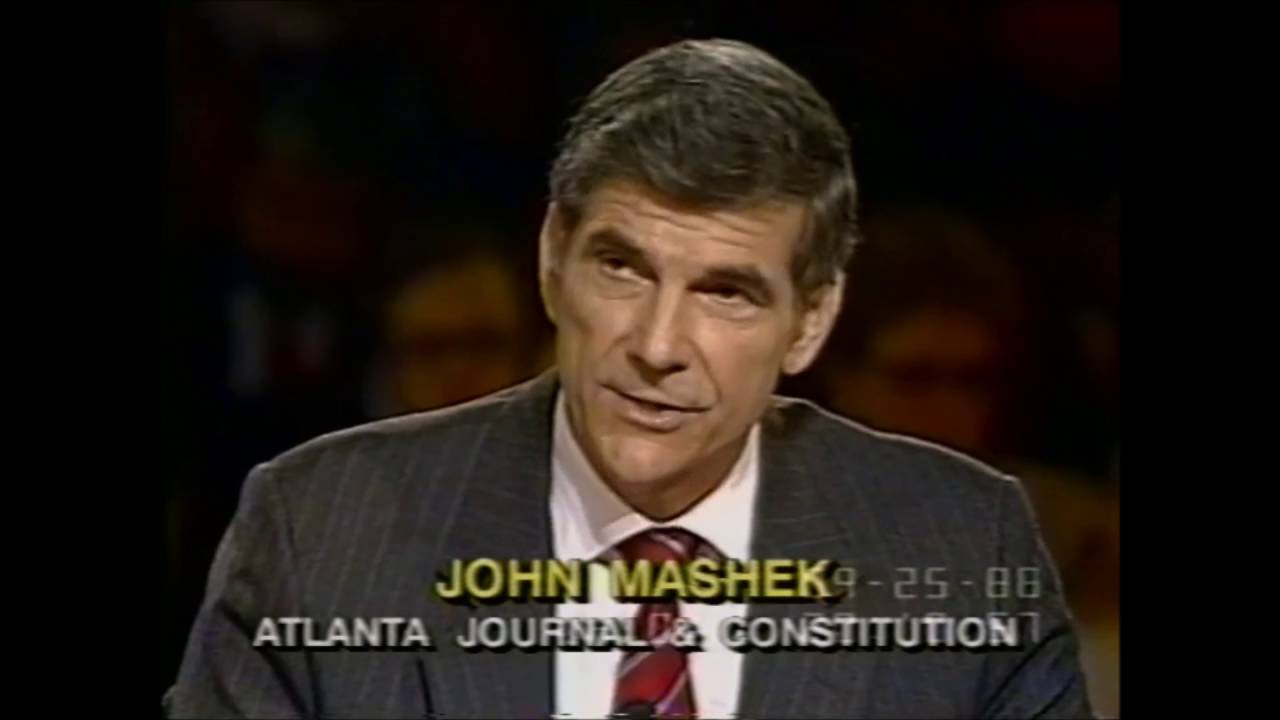
This video features the first presidential debate of the 1988 campaign between Vice President George Bush and Governor Michael Dukakis. The candidates discuss key domestic and foreign policy issues, including the drug crisis, the federal deficit, healthcare access, homelessness, abortion, and national security. They present their contrasting approaches to governance, leadership, and their visions for the country, often critiquing each other's records and proposals. The debate highlights their differing philosophies on the role of government, economic policy, and social issues, aiming to inform voters about their choices for the presidency.
How was this?
Save this permanently with flashcards, quizzes, and AI chat
Chapters
- Vice President Bush attributes the rise in drug use to a deterioration of national values and a past condoning of drug use, advocating for instilling values in schools and stricter enforcement.
- Governor Dukakis emphasizes that leaders must demonstrate values from the top and criticizes the Reagan-Bush administration for dealing with figures like Panamanian dictator Manuel Noriega, who was allegedly involved in drug trafficking.
- Dukakis highlights his state's drug education and prevention programs, starting in early elementary grades, as a model for national implementation.
- Bush defends the administration's handling of Noriega, stating that evidence of drug involvement only emerged later and that the administration brought him to justice.
This exchange sets the stage for the debate by addressing a major public concern and immediately reveals the candidates' differing perspectives on leadership, accountability, and the root causes of societal problems.
Dukakis recounts a personal encounter with a desperate 16-year-old girl addicted to drugs, illustrating the human cost of the crisis and the need for effective intervention.
- Governor Dukakis outlines a deficit reduction strategy including cutting unnecessary weapon systems, investing in economic growth, lowering interest rates, and improving tax collection.
- Dukakis criticizes Bush's proposals, including a capital gains tax cut for the wealthy, as insufficient and potentially harmful to the deficit.
- Vice President Bush advocates for a 'flexible freeze' on spending, emphasizing economic growth through measures like capital gains tax cuts, which he argues increase revenue and create jobs.
- Bush criticizes Dukakis's tax record in Massachusetts and suggests that Democrats in Congress are the primary drivers of excessive spending, advocating for a line-item veto.
- Dukakis argues that Bush's policies disproportionately benefit the wealthy and have led to a massive increase in national debt over eight years.
This section delves into the candidates' economic philosophies, revealing their contrasting views on fiscal responsibility, taxation, government spending, and their potential impact on economic growth and national debt.
Dukakis uses the analogy of 'Joe Isuzu' to criticize Bush's economic proposals, implying they are not to be believed.
- Vice President Bush proposes allowing people to buy into Medicaid and fully enforcing the catastrophic health bill, while opposing mandated employer-provided health insurance to avoid harming economic recovery.
- Governor Dukakis criticizes Bush's healthcare proposals as inadequate for the 37 million uninsured Americans, highlighting his state's universal healthcare plan as a successful model.
- Dukakis argues that responsible employers already pay for the uninsured through higher costs and that job-based health insurance should be the norm.
- The candidates briefly touch upon the AIDS crisis, with Dukakis emphasizing the need for resources, education, and treatment, and Bush highlighting research, education, testing, and ensuring a safe blood supply.
This discussion highlights the candidates' differing approaches to social welfare and healthcare, revealing their priorities for addressing the needs of vulnerable populations and the role of government versus the private sector.
Dukakis shares the story of a father in Houston who fears his son getting injured playing Little League because he cannot afford health insurance.
- Governor Dukakis defends himself against accusations of being 'passionless' and 'technocratic,' citing his leadership in civil rights and his opposition to the Vietnam War as evidence of his passion.
- Dukakis acknowledges learning from past defeats and believes he is a better leader for it, highlighting his state's achievements in welfare reform, universal healthcare, and affirmative action.
- Vice President Bush questions Dukakis's 'liberal' label, referencing his past statements about being a 'card-carrying member of the ACLU' and expressing concern about his political direction.
- Bush clarifies that he is questioning Dukakis's judgment, not his patriotism, and believes his own views are more aligned with the mainstream of America.
- Dukakis resents Bush's questioning of his patriotism, emphasizing his immigrant parents' values and his love for the country, and calls for a focus on substantive issues.
This exchange probes the candidates' leadership styles and core values, exploring how they define themselves politically and how they perceive each other's suitability for the presidency.
Bush repeatedly uses the phrase 'card-carrying member of the ACLU' to characterize Dukakis's political leanings.
- Vice President Bush commits to fully funding the McKinney Act for shelter and emphasizes community involvement ('a thousand points of light') as crucial for addressing homelessness.
- Bush acknowledges that a portion of the homeless population suffers from mental illness and suggests a need for better mental health services, while downplaying his earlier assertion about the prevalence of mental illness among the homeless.
- Governor Dukakis criticizes Bush's administration for cutting affordable housing programs, arguing that this has exacerbated the homelessness crisis.
- Dukakis advocates for a renewed commitment to building and rehabilitating housing for low and moderate-income families, viewing it as essential to the American dream.
- Bush counters by highlighting lower interest rates under his administration and advocating for vouchers and tenant control, warning against excessive government spending that could harm the housing market.
This discussion reveals the candidates' differing priorities and strategies for tackling homelessness and ensuring affordable housing, reflecting their broader views on social responsibility and government intervention.
Bush refers to his 'thousand points of light' initiative, emphasizing the role of private charities and community organizations.
- Governor Dukakis distinguishes between his opposition to the death penalty and his support for abortion, framing the latter as a woman's decision based on conscience and religious beliefs.
- Dukakis criticizes Bush's administration for its furlough program for drug traffickers, contrasting it with his own tough stance on violent crime and low crime rates in Massachusetts.
- Vice President Bush supports the death penalty, particularly for drug traffickers who commit murder, and uses the case of Willie Horton (a furloughed murderer who committed further crimes) to highlight his stance.
- Bush states his position has evolved to favor life, supporting abortion only in cases of rape, incest, or threat to the mother's life, and suggests penalties for illegal abortions would need to be determined.
- Dukakis accuses Bush of being prepared to brand women who have abortions as criminals and criticizes his lack of a definitive stance on penalties.
This highly contentious exchange highlights fundamental moral and ethical differences between the candidates on issues of life, punishment, and individual autonomy, revealing their deeply held beliefs and political strategies.
Bush brings up the case of Willie Horton, a furloughed prisoner who committed further crimes, to illustrate his opposition to Dukakis's approach to crime and punishment.
- Vice President Bush expresses concern about children in inner cities, linking problems like poverty, school dropouts, and crime to single-parent families and crime-infested neighborhoods.
- Bush advocates for empowering local and state governments, supporting programs like WIC and Head Start, and emphasizes community initiatives ('a thousand points of light').
- Governor Dukakis contends that the Reagan-Bush administration has cut crucial federal programs for children, nutrition, and education, hindering opportunities for inner-city youth.
- Dukakis proposes welfare reform that invests in job training and childcare to help families become self-sufficient and highlights his state's universal healthcare as a barrier to poverty.
- Dukakis criticizes Bush's reliance on voluntary efforts, arguing that strong presidential leadership and federal investment are necessary to address systemic issues.
This discussion focuses on the candidates' approaches to urban poverty and social inequality, revealing their differing views on the effectiveness of federal versus local initiatives and the government's role in supporting disadvantaged communities.
Dukakis criticizes Bush's 'thousand points of light' concept, stating he doesn't understand it and that it's insufficient compared to direct federal aid.
- Governor Dukakis dismisses claims of foreign policy inexperience, citing former governors who became successful presidents and questioning Bush's judgment on issues like arms sales to Iran and relations with Panama's Noriega.
- Dukakis argues that strength and values, not just experience, define effective leadership, and criticizes Bush's support for Ferdinand Marcos and his administration's failed Central America policy.
- Vice President Bush defends his foreign policy experience, highlighting arms control achievements under the Reagan administration and criticizing Dukakis's past support for a nuclear freeze, which he claims would have disadvantaged the US.
- Bush emphasizes 'peace through strength' and warns against unilateral cuts in strategic defenses while negotiating with the Soviet Union.
- Both candidates express cautious optimism about Soviet reforms (perestroika and glasnost) but differ on the extent of cooperation and technology sharing, with Bush advocating for continued vigilance and Dukakis pushing for arms reduction treaties and conventional force reductions in Europe.
This segment addresses the candidates' qualifications and strategies for navigating complex international relations, national security threats, and the evolving dynamics with the Soviet Union.
Bush refers to the arms control agreement with the Soviets as a result of strengthening US defenses, contrasting it with the potential outcome of a nuclear freeze advocated by Dukakis.
Key takeaways
- Leadership is defined by a combination of experience, values, and the ability to make tough choices, with candidates presenting contrasting views on which is paramount.
- Effective solutions to complex problems like drug abuse and homelessness require a multi-faceted approach involving government action, community involvement, and a focus on underlying societal values.
- Candidates' economic policies reveal fundamental differences in their approaches to deficit reduction, taxation, and government spending, with implications for economic growth and fairness.
- Healthcare access and social safety nets are critical issues, with candidates offering distinct visions for ensuring coverage and support for vulnerable populations.
- Political labels and past associations (e.g., ACLU membership) can become focal points in debates, used by opponents to question judgment and ideological alignment.
- Foreign policy and national security require a balance between strength, negotiation, and strategic decision-making, with candidates debating the best path forward in a changing global landscape.
- The candidates' differing stances on social issues like abortion and the death penalty reflect deeply held moral and ethical beliefs that shape their policy proposals.
Key terms
Federal DeficitDeterioration of ValuesDrug InterdictionDrug EducationCapital Gains Tax CutFlexible FreezeMandated Health InsuranceUniversal HealthcareACLU (American Civil Liberties Union)McKinney ActAffordable HousingDeath PenaltyAbortionSanctity of LifePerestroikaGlasnostArms Control TreatiesNuclear FreezePeace Through Strength
Test your understanding
- What are the primary causes of the drug crisis according to Vice President Bush, and how do Governor Dukakis's proposed solutions differ?
- How do Governor Dukakis and Vice President Bush propose to address the federal deficit, and what are the key differences in their economic strategies?
- Compare and contrast the candidates' approaches to providing healthcare for uninsured working families.
- What are the core arguments made by each candidate regarding their leadership style and fitness for the presidency, particularly in response to criticisms?
- How do the candidates' views on the death penalty and abortion reflect their broader moral and ethical frameworks?
- What are the main points of contention between Bush and Dukakis regarding foreign policy experience and national security strategy, especially concerning relations with the Soviet Union?