27:12
mod01lec02 - Theoretical Moorings, Sources and Evolution - Part 01
NPTEL-NOC IITM
Overview
This video explores the theoretical foundations, origins, and historical development of environmental law. It begins by explaining why understanding a law's context, theories, and sources is crucial for its effective application. The lecture then delves into various philosophical approaches to environmentalism, including anthropocentric, biocentric, ecocentric, deep ecology, eco-feminism, and environmental justice. It also discusses the 'wise use' theory and its critiques, ultimately emphasizing the importance of environmental justice in decision-making and resource management.
How was this?
Save this permanently with flashcards, quizzes, and AI chat
Chapters
- Legal language can be complex due to its technical nature and interdisciplinary contributions.
- This course aims for clarity, simplifying legal discourse for a broad audience.
- Understanding a law requires examining its theoretical underpinnings, sources, and historical evolution.
- Contextual understanding is vital for formulating and applying laws effectively.
Grasping the 'why' behind environmental law, including its philosophical roots and historical trajectory, is essential for comprehending its purpose and application.
The speaker notes that understanding the context and purpose behind a law aids in its effective application, much like understanding the historical reasons for a particular societal norm helps explain its current practice.
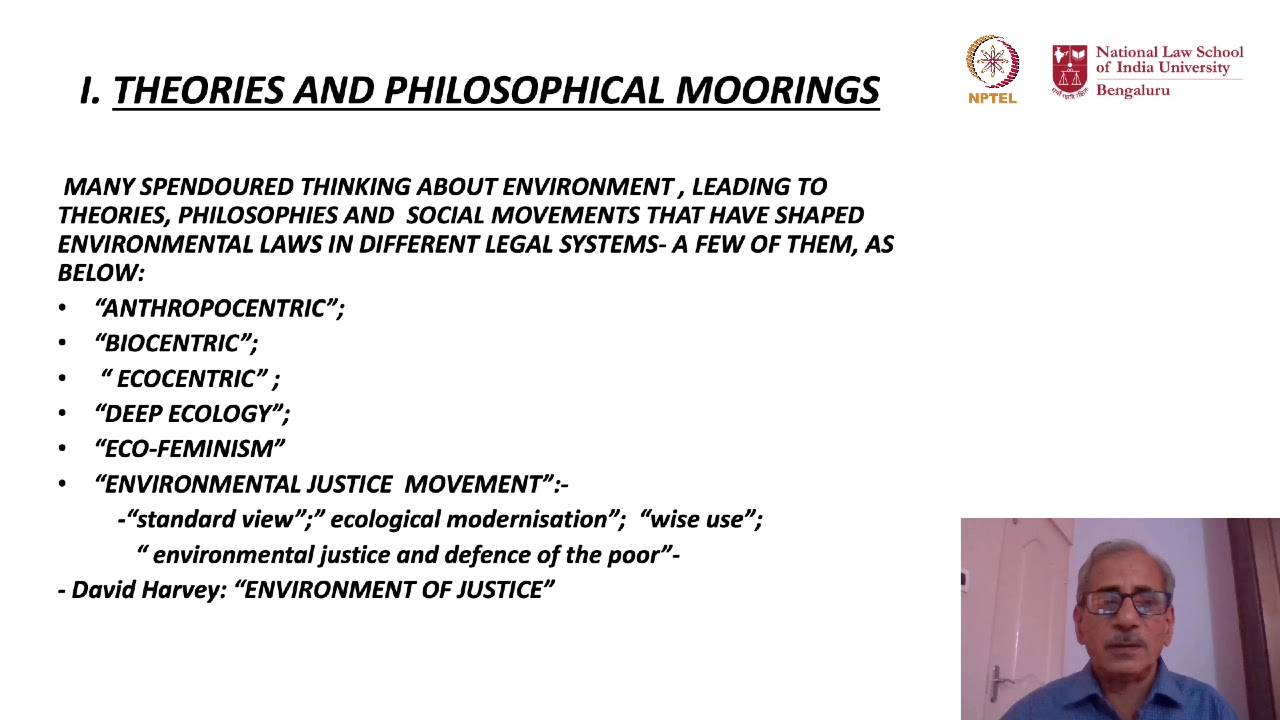
- Anthropocentric approach views all resources as existing for human use and benefit, placing humans at the pinnacle.
- Biocentric approach centers on life itself, recognizing humans as one part of a larger web of life, emphasizing ecological balance.
- Ecocentric approach focuses on protecting entire ecosystems, recognizing their role as life support systems, not just individual species.
- Deep ecology posits humans as equal components of the global ecosystem, advocating for a radical shift in human-nature relationships and recognizing nature's inherent value.
- Eco-feminism draws parallels between the domination of nature and the exploitation of women, advocating for respect for both.
These diverse theories shape how we perceive the environment and our relationship with it, directly influencing the goals and principles of environmental law.
The anthropocentric view, exemplified by Aristotle's 'Man is the measure of everything,' suggests that resources should be nurtured and exploited primarily for human needs and development.
- Environmental Justice critiques the standard view that environmental harm is repairable and compensable, highlighting irreversible resource depletion.
- Ecological Modernization suggests that human activities should not harm the environment, emphasizing ecological preservation even at the cost of human inconvenience.
- A critique of Ecological Modernization points out the potential for selective resource use that benefits some while denying others, particularly concerning the differing development paths of the West and developing nations.
- Environmental Justice advocates for ensuring no one is disadvantaged by environmental decisions and that all, especially the poor and vulnerable, benefit from nature's bounty.
These movements address the fairness and equity in environmental policy, ensuring that development does not disproportionately harm certain populations or deplete resources irreversibly.
The Environmental Justice movement argues that the 'standard view' of development, which assumes environmental damage can always be repaired, fails when resources are exhausted and lost forever, with no possibility of compensation.
- The 'wise use' theory advocates for privatizing resources and trusting individual owners to manage them sustainably due to their intimate connection and dependence.
- This approach suggests that local communities and private owners possess the best knowledge for resource management and conservation.
- A major weakness is that individual owners may prioritize their own benefit over the adverse impacts on neighboring lands or the broader environment.
- This self-interest can lead to chaos and a 'might is right' scenario, necessitating legal intervention.
- Collective, objective thinking from a larger body is often required for better policy and law, mitigating subjective and selfish interests.
Examining the 'wise use' theory reveals the tension between individual property rights and the need for collective environmental stewardship and regulation.
The argument for 'wise use' suggests leaving resource management to private owners, assuming they will naturally conserve what they depend on, similar to how a farmer manages their land.
Key takeaways
- Understanding the theoretical, source, and evolutionary context of environmental law is crucial for its effective application.
- Different philosophical approaches, from anthropocentric to ecocentric, offer varying perspectives on humanity's relationship with nature.
- Eco-feminism highlights the interconnectedness of exploiting nature and exploiting women.
- Environmental Justice emphasizes equitable distribution of environmental benefits and burdens, particularly for vulnerable populations.
- The 'wise use' theory, while promoting individual responsibility, risks environmental degradation due to a focus on self-interest.
- Effective environmental management requires balancing individual incentives with collective, objective policymaking.
- The ultimate goal of environmental law should be to ensure no one is disadvantaged and all can benefit from natural resources.
Key terms
Environmental LawTheoretical UnderpinningsSources of LawEvolution of LawAnthropocentric ApproachBiocentric ApproachEcocentric ApproachDeep EcologyEco-FeminismEnvironmental JusticeEcological ModernizationWise Use TheoryPrivate Property RightsEnvironmental Stewardship
Test your understanding
- Why is it important to understand the theoretical moorings and historical evolution of environmental law?
- How does the anthropocentric approach differ from the biocentric and ecocentric approaches to environmentalism?
- What is the core argument of eco-feminism regarding the exploitation of nature and women?
- What are the main concerns raised by the Environmental Justice movement regarding traditional development approaches?
- What are the potential benefits and significant drawbacks of the 'wise use' theory for environmental management?