57:35
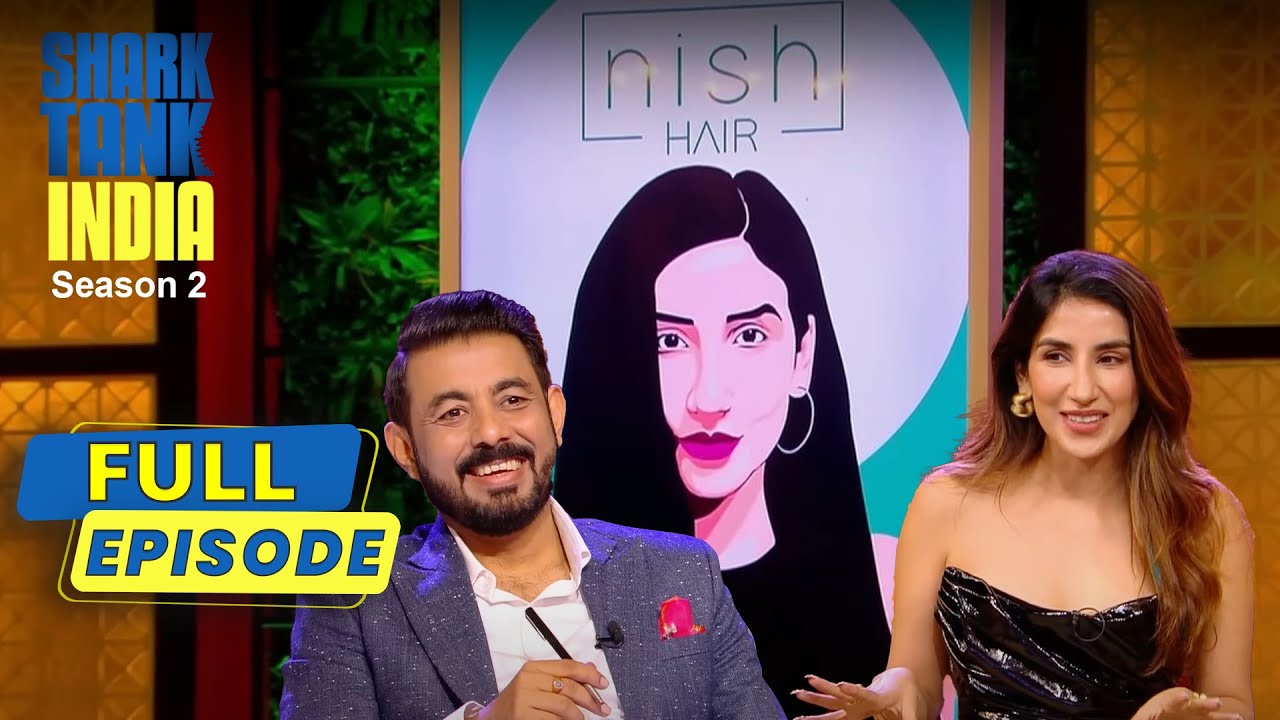
'Nish Hair' की मालिक Parul Gulati ने Sharks का दिल जीता | Shark Tank India S2 | Full Episode
Shark Tank India
Overview
This video features two entrepreneurs pitching their businesses on Shark Tank India. The first is Parul Gulati, founder of Nish Hair, a hair extension and wig company. She seeks investment to scale her profitable, self-funded business. The second is Arjit Soni, founder of MyBike, a bicycle-sharing service. He aims to expand his operations and seeks funding to accelerate growth. The episode also includes a segment on Sugar Cosmetics, a beauty brand founded by a husband-wife duo, showcasing their journey and seeking investment.
How was this?
Save this permanently with flashcards, quizzes, and AI chat
Chapters
- Parul Gulati, an actor, founded Nish Hair to address her own struggles with hair loss and the need for high-quality, affordable hair extensions.
- The company offers a range of products including hair extensions, toppers for hair loss, and colored strands, catering to various needs from postpartum hair loss to fashion trends.
- Nish Hair operates primarily through its own website (NishHair.com) and has achieved significant sales, including ₹80 lakh in the previous month, with a 30% net profit margin.
- Parul emphasizes her hands-on approach, creating content and engaging with customers directly on social media, which has driven organic growth without significant marketing spend.
This chapter highlights how a personal problem can be the genesis of a successful business, demonstrating the power of understanding customer needs and leveraging digital platforms for growth.
Parul shared that she started the business with a sewing machine at home, making extensions herself, which illustrates the humble beginnings and entrepreneurial spirit.
- The Sharks were impressed by Parul's sales figures, profitability, and her ability to grow the business significantly without external marketing.
- Concerns were raised about the increasing competition in the hair extension market and Parul's ability to manage two full-time careers (acting and business).
- Multiple Sharks expressed interest, with offers from Amit Jain (₹1 crore for 2% equity) and Vineeta Singh and Aman Gupta (₹1 crore for 3% equity).
- Parul ultimately chose to partner with Amit Jain, valuing his expertise in scaling businesses and his personal involvement.
This section demonstrates the negotiation process in a funding scenario, showing how entrepreneurs address investor concerns and make strategic decisions about partnerships.
Amit Jain offered Parul ₹1 crore for 2% equity, impressed by her business acumen and growth potential, highlighting the value placed on her existing success.
- Arjit Soni founded MyBike, India's first public bicycle-sharing service, to solve his own commuting problems in Mumbai.
- The business model focuses on a subscription-based service with options for daily, weekly, and monthly plans, aiming for convenience and affordability.
- MyBike utilizes IoT technology with geofencing to manage its fleet and minimize theft and vandalism, boasting a low theft rate.
- The company is seeking ₹2 crore for 1% equity to accelerate its expansion into new cities and enhance its product offerings, including electric bikes.
This chapter explores a solution to urban transportation challenges, emphasizing the role of technology and strategic partnerships in scaling a mobility service.
Arjit demonstrated the user journey on the MyBike app, showing how users can locate nearby hubs, select bikes, choose a plan, and unlock a cycle via Bluetooth, illustrating the service's ease of use.
- The Sharks questioned MyBike's valuation of ₹200 crore, given its current sales figures and the capital-intensive nature of the business.
- Concerns were raised about the unit economics, payback period, and the overall viability of the business model in the Indian context, considering cultural factors and road conditions.
- The Sharks also noted the company's reliance on 'trading' revenue (selling cycles to cities) as a significant portion of its income, rather than purely rental revenue.
- Ultimately, most Sharks passed due to perceived high risk, lack of clear product-market fit at scale, and concerns about the valuation.
This section highlights the critical evaluation of a business model by investors, focusing on financial viability, scalability, and market potential.
One Shark pointed out that the company's contribution margin was only ₹12 lakh from Ahmedabad, questioning the scalability and profitability of the rental business at the proposed valuation.
- Sugar Cosmetics, founded by Vineeta Singh and Kaushik Mukherjee, aims to disrupt the Indian beauty market by offering high-quality, long-lasting makeup designed for Indian skin tones.
- The brand operates on a direct-to-consumer (DTC) model, delivering products directly to customers' homes, which helps in managing inventory and reducing costs.
- They faced initial challenges, including skepticism from investors about an e-commerce beauty brand and the husband-wife co-founder dynamic.
- Sugar Cosmetics has shown strong growth, doubling its revenue year-on-year, and is currently profitable with a 5% net profit margin.
This chapter illustrates how a DTC model and a focus on specific market needs can lead to rapid growth and success in a competitive industry.
Vineeta explained that their previous venture, Fab Bag (a beauty subscription service), acted as a learning lab, allowing them to understand customer needs and manage inventory efficiently before launching Sugar Cosmetics.
- The founders sought ₹1 crore for 2% equity, valuing the company at ₹50 crore.
- Sharks acknowledged the brand's strong growth, repeat customer rate (30%), and profitability, but questioned the unit economics and customer acquisition cost (CAC).
- Despite some concerns about the husband-wife dynamic and the competitive landscape, multiple Sharks were impressed by the founders' vision and execution.
- Offers were made by Anupam Mittal (₹1 crore for 5% equity), Vineeta Singh (₹1 crore for 5% equity), and Amit Jain (₹1 crore for 2% equity).
This section delves into the financial details of a growing e-commerce brand, showcasing how founders justify their valuation and how investors assess profitability and future potential.
The founders detailed their unit economics, showing that after all costs (COGS, shipping, payment gateway, marketing), approximately ₹100 per order remained as profit, with a 30% repeat customer rate.
Key takeaways
- Personal problems can be powerful motivators for entrepreneurship, leading to innovative solutions.
- Direct-to-consumer (DTC) models can be highly effective for scaling businesses, especially in niche markets.
- Strong organic growth driven by customer engagement and product quality can be as effective as traditional marketing.
- Entrepreneurs must be prepared to justify their valuations with solid financial data and a clear growth strategy.
- Building a brand requires understanding customer needs, consistent product quality, and effective storytelling.
- Navigating investor concerns, such as competition, team dynamics, and unit economics, is crucial for securing funding.
- The beauty industry in India presents significant opportunities for brands that cater specifically to local needs and preferences.
Key terms
Hair ExtensionsHair TopperDirect-to-Consumer (DTC)Organic GrowthUnit EconomicsCustomer Acquisition Cost (CAC)ValuationEquityProfitabilityBicycle Sharing ServiceIoT TechnologyGeofencingSubscription ModelBeauty IndustryColor Cosmetics
Test your understanding
- How did Parul Gulati leverage her personal experience to build a successful business like Nish Hair?
- What were the main concerns raised by the Sharks regarding Arjit Soni's MyBike business, and why did most of them pass on the deal?
- Explain the direct-to-consumer (DTC) business model used by Sugar Cosmetics and its advantages.
- What are the key factors that investors consider when evaluating the valuation of a startup like Sugar Cosmetics?
- How do Sugar Cosmetics and Nish Hair differentiate themselves in their respective competitive markets?