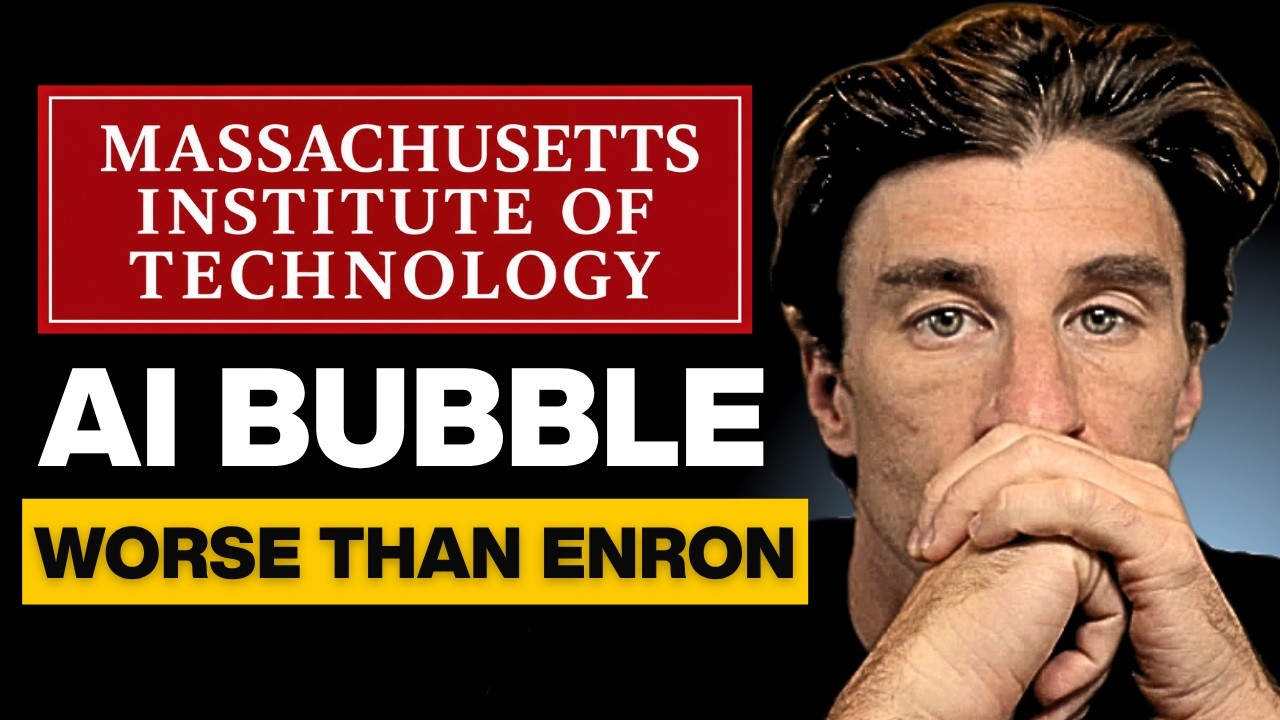
MIT Just Revealed the AI Bubble's Fatal Flaw
Brendan Dell
Overview
This video explores the potential AI bubble, drawing parallels to historical financial manias like the dot-com bubble and Enron. It questions the sky-high valuations of AI companies like OpenAI and Anthropic, arguing that their future potential is being overvalued based on a "prophecy" of limitless growth through scaling. The core argument is that the assumption that larger AI models will continue to yield exponentially better performance is flawed, as evidenced by recent studies showing open-source models rapidly closing the gap with proprietary ones at a fraction of the cost. The video suggests that if this "scale is everything" narrative collapses, it could lead to a significant market correction, impacting investors and the broader economy.
Save this permanently with flashcards, quizzes, and AI chat
Chapters
- The current mania around AI IPOs (OpenAI, Anthropic) is fueled by a potentially false narrative of limitless potential.
- This hype exacerbates existing wealth inequality, as speculative investments benefit a few while the broader impact on society is uncertain.
- The core issue is an overinvestment in abstract AI technology driven by high confidence, which often precedes a market backlash.
- Short seller Jim Chanos profited by identifying fundamental flaws in company narratives, exemplified by his bet against Enron.
- Enron, like some AI companies today, was valued based on future potential and complex accounting ('gain on sale') rather than current earnings.
- Chanos's analysis revealed Enron was unprofitable, costing more to operate than it earned, a stark contrast to its inflated stock price.
- AI companies like OpenAI and Anthropic promote a narrative that scaling up models (data, compute, size) inevitably leads to greater intelligence and unique capabilities.
- This 'scale is everything' hypothesis suggests that bigger models are inherently defensible ('moats') and justify massive valuations.
- The core question is whether simply increasing model size will continue to yield significant performance gains and lead to true artificial general intelligence (AGI).
- Leading AI researchers, including OpenAI's co-founder Ilia Sutskiver, suggest the era of easy gains from scaling is over.
- Current large models excel at specific tests but generalize poorly, indicating limitations not solved by simply increasing size.
- MIT research shows open-source models achieve ~90% of closed-model performance at a fraction of the cost, rapidly closing the gap.
- The 'moat' of proprietary, large-scale models is eroding as open alternatives become increasingly capable and cost-effective.
- Technology bubbles don't burst because the tech fails, but when speculative wealth must be converted into actual money.
- If AI models are perceived as merely 'normal, useful, and improving' rather than 'limitless,' trillion-dollar valuations will seem unjustified.
- Companies and investors who cannot convert their perceived wealth into cash before this realization occurs risk being 'left holding the bag.'
- Historical examples show that 'limitless' claims are often disproven by practical limitations, despite the rhetoric.
- The core assumption that bigger LLMs are always better is currently not supported by data.
- The defensibility ('moat') of frontier models is questionable if open-source alternatives quickly match their performance at lower costs.
- The financial sustainability of companies relying on massive compute for scaling is at risk if debt and chip depreciation outpace returns.
- Investors should look beyond the prophecy and analyze the foundational value and scalability of AI technologies.
Key takeaways
- The current AI boom may be a bubble fueled by an unproven 'prophecy' of limitless scaling, similar to past financial manias.
- Short sellers like Jim Chanos historically succeeded by identifying fundamental flaws beneath hype, a strategy applicable to analyzing AI companies.
- The core assumption that larger AI models will indefinitely yield exponentially better performance is increasingly challenged by research and the rise of capable open-source alternatives.
- The 'moat' protecting leading AI companies is likely weaker than claimed, as open models rapidly close performance gaps at significantly lower costs.
- Technology bubbles burst not when technology fails, but when speculative wealth cannot be converted into tangible monetary value.
- Relying on future potential ('prophecy') rather than current demonstrable value is a risky investment strategy, often leading to significant losses.
- The most valuable skill in an age of AI may be independent, rational thinking, rather than blindly accepting the narrative of automated intelligence.
- Investors should scrutinize the foundational economics, scalability, and competitive landscape of AI companies, not just their future promises.
Key terms
Test your understanding
- What is the primary 'fatal flaw' of the current AI bubble as presented in the video?
- How does the Enron case serve as a historical parallel to the current AI market hype?
- What evidence does the video present to challenge the 'scale is everything' narrative in AI development?
- Why is the distinction between 'wealth' and 'money' crucial when discussing the potential bursting of the AI bubble?
- What factors should investors consider to assess the true value of AI companies beyond the hype?