10:57
Number Systems Introduction - Decimal, Binary, Octal & Hexadecimal
The Organic Chemistry Tutor
Overview
This video introduces four fundamental number systems: decimal (base-10), binary (base-2), octal (base-8), and hexadecimal (base-16). It explains the origin of each system's name based on its prefix and the number of unique digits it uses. The core of the video demonstrates a practical method, successive division, for converting a decimal number into its equivalent representations in binary, octal, and hexadecimal formats. This skill is crucial for understanding how computers and digital systems process information.
How was this?
Save this permanently with flashcards, quizzes, and AI chat
Chapters
- Number systems are different ways to represent quantities.
- Understanding various number systems is essential for computing and digital electronics.
- The video will cover decimal, binary, octal, and hexadecimal systems.
Familiarity with different number systems is foundational for anyone working with computers or digital logic, as these systems are the language computers use.
- The decimal system is a base-10 system, meaning it uses ten unique digits: 0 through 9.
- The prefix 'deci' relates to ten (e.g., decade, decimeter).
- This is the system used for everyday counting and calculations.
This is the number system we use daily, so understanding its properties helps in grasping the concepts of other, less familiar systems.
Everyday numbers like 12, 36, and 468 are all represented in the decimal system.
- The binary system is a base-2 system, using only two digits: 0 and 1.
- The prefix 'bi' means two (e.g., bicycle).
- It is fundamental to computers and digital circuits, where 0 often represents 'off' and 1 represents 'on'.
Binary is the language of computers; understanding it is key to comprehending how digital devices operate at their most basic level.
In a digital computer, a 0 can signify an off state, while a 1 signifies an on state.
- The octal system is a base-8 system, using eight digits: 0 through 7.
- The prefix 'octo' relates to eight (e.g., octagon).
- It provides a more compact representation than binary.
Octal offers a slightly more human-readable way to represent binary data compared to long strings of 0s and 1s.
The digits used are 0, 1, 2, 3, 4, 5, 6, and 7.
- The hexadecimal system is a base-16 system.
- It uses the ten decimal digits (0-9) plus six letters (A-F) to represent values.
- A represents 10, B represents 11, C represents 12, D represents 13, E represents 14, and F represents 15 in decimal.
- The prefix 'hexa' means six, and 'decimal' means ten, totaling sixteen.
Hexadecimal is widely used in computing (e.g., for memory addresses and color codes) because it's a very compact and efficient way to represent binary data.
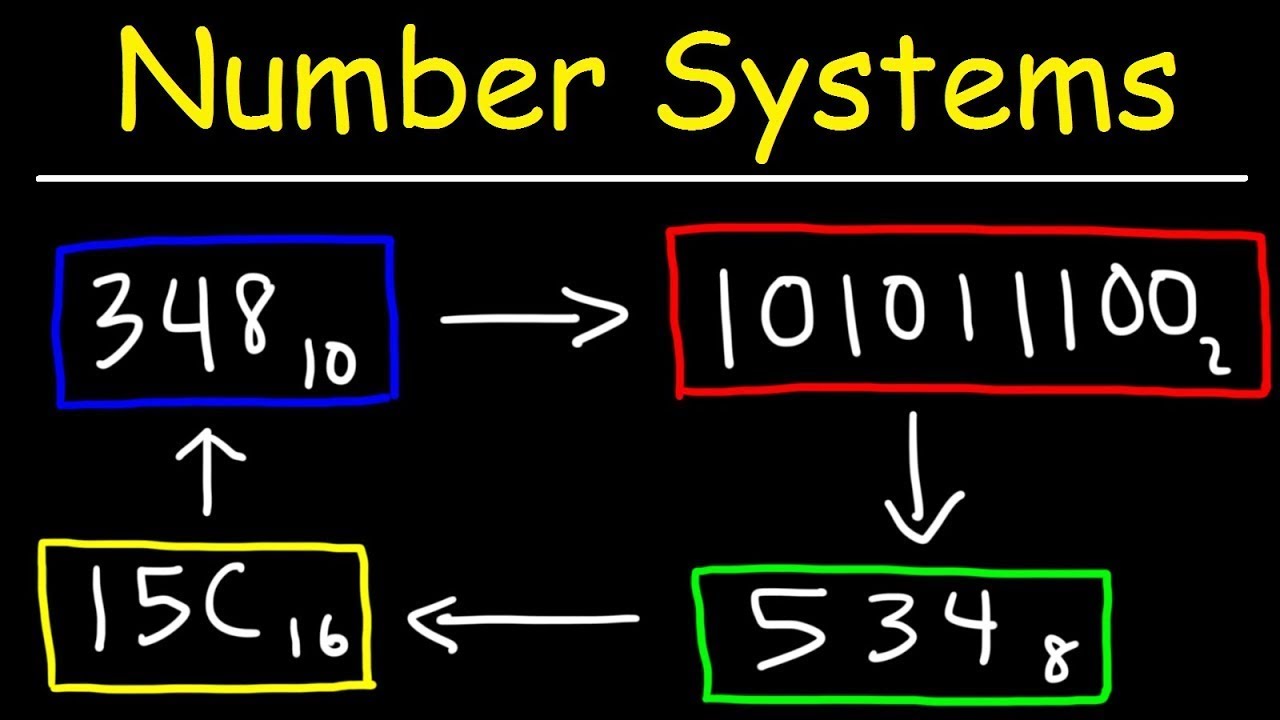
The hexadecimal number '15C' is equivalent to 348 in decimal.
- To convert a decimal number to binary, repeatedly divide the decimal number by 2.
- Record the remainder (0 or 1) of each division.
- Continue dividing the quotient until the quotient becomes 0.
- The binary representation is formed by reading the remainders from bottom to top (least significant bit to most significant bit).
This method provides a systematic way to translate numbers from our familiar decimal system into the binary system computers understand.
Converting the decimal number 348 to binary involves dividing by 2 repeatedly and collecting remainders: 348/2=174 R 0, 174/2=87 R 0, 87/2=43 R 1, ..., resulting in binary 101011100.
- To convert a decimal number to octal, repeatedly divide the decimal number by 8.
- Record the remainder (0 through 7) of each division.
- Continue dividing the quotient until the quotient becomes 0.
- Read the remainders from bottom to top to get the octal representation.
This process allows us to represent decimal values in the octal system, which can be more concise than binary.
Converting the decimal number 348 to octal involves dividing by 8 repeatedly: 348/8=43 R 4, 43/8=5 R 3, 5/8=0 R 5, resulting in octal 534.
- To convert a decimal number to hexadecimal, repeatedly divide the decimal number by 16.
- Record the remainder (0 through 15) of each division.
- Convert remainders 10 through 15 into their corresponding letters (A through F).
- Continue dividing the quotient until the quotient becomes 0.
- Read the remainders (or their letter equivalents) from bottom to top for the hexadecimal representation.
This conversion is highly practical in computing for tasks like representing memory addresses or color values compactly.
Converting the decimal number 348 to hexadecimal involves dividing by 16: 348/16=21 R 12 (C), 21/16=1 R 5, 1/16=0 R 1, resulting in hexadecimal 15C.
Key takeaways
- Number systems differ in their base, which dictates the number of unique digits they use.
- Decimal (base-10) is our everyday system, while binary (base-2) is fundamental to computers.
- Octal (base-8) and hexadecimal (base-16) offer more compact ways to represent binary data.
- Hexadecimal uses digits 0-9 and letters A-F to represent values 0-15.
- The successive division method is a reliable algorithm for converting decimal numbers to other bases.
- When converting, remainders are collected and read in reverse order (bottom-up) to form the new number.
- Understanding these conversions is crucial for interpreting data in digital systems.
Key terms
Number SystemBaseDecimal SystemBinary SystemOctal SystemHexadecimal SystemSuccessive DivisionRemainderMost Significant Bit (MSB)Least Significant Bit (LSB)
Test your understanding
- What is the base of the octal number system and why is it called 'octal'?
- How does the number of digits used in binary differ from the number of digits used in decimal?
- Explain the process of converting a decimal number to hexadecimal using successive division.
- Why is the hexadecimal system often preferred over binary for representing certain types of computer data?
- What does the remainder represent in the successive division method, and how is it used to construct the final number in a different base?