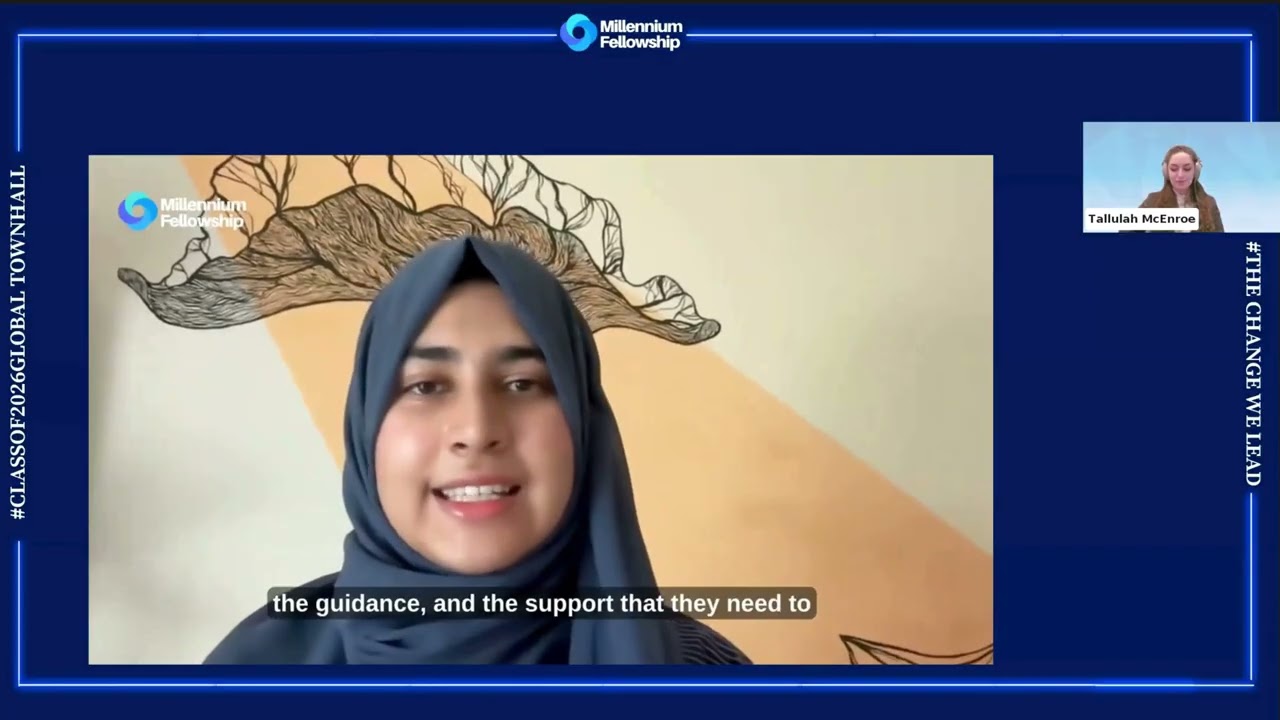
Millennium Fellowship Class of 2026 Town Hall
MillenniumCampusNetwork
Overview
This video is a town hall for the Millennium Fellowship Class of 2026, welcoming new fellows and outlining the program's structure, expectations, and opportunities. It features introductions from fellows, program coordinators, and representatives from partner organizations like the United Nations Academic Impact, HP, and the Coach Foundation. The event emphasizes the fellowship's commitment to civic leadership, advancing the Sustainable Development Goals (SDGs), and fostering a global community of young leaders dedicated to creating positive social impact. Key themes include the importance of personal values, community, collaboration, and turning passion into action.
Save this permanently with flashcards, quizzes, and AI chat
Chapters
- The Millennium Fellowship Class of 2026 is welcomed to a global town hall, emphasizing civic leadership and the UN's Sustainable Development Goals.
- Fellows are encouraged to introduce themselves in the chat, sharing their name, country, campus, project, and SDG focus.
- The host, Tula Mackenro, shares her own background and project focused on reducing inequalities for third culture identities (SDG 10).
- Several Millennium Fellows share personal introductions and highlight their diverse social impact projects.
- Projects range from using AI to help children in hospitals (Rabeek), promoting education and potential (Uk), raising awareness about crises (Marvin Polart), and menstrual hygiene education (A patient).
- Other initiatives include leveraging technology for community benefit (Antonio Rosa), increasing access to higher education for girls (Hiba), supporting children with learning disabilities (Amni Jen), and raising awareness about non-communicable diseases (Mah Sanjay).
- Sam Vagar, Executive Director of MCN, shares a personal reflection on shifting focus from personal achievement to how one lives life and shows up for others.
- He emphasizes the importance of relationships, learning from peers, and leading with core values like empathy, humility, and inclusion.
- The fellowship selects individuals from a vast applicant pool, recognizing their leadership, resolve, and community commitment.
- The UN Charter's emphasis on dignity and the worth of the human person is highlighted as a guiding principle.
- Alexandra Sasha Gorishek from the UN Academic Impact (UNAI) highlights the partnership with MCN in supporting young leaders to advance SDGs.
- Higher education institutions are framed not just as degree-granting bodies but as crucial societal actors, knowledge keepers, and promoters of innovation.
- Universities are uniquely positioned to address complex global issues like climate change and AI advancement due to their trusted status.
- A consensus statement was launched to position higher education as key to creating sustainable futures through societal transformation.
- Program coordinators Joseph Odongo and Awesome outline the fellowship journey from August to November.
- Key components include six on-campus training sessions, opportunities for local and global connections, and the execution of a social impact project addressing an SDG.
- Graduation requires attending all training sessions, at least one global webinar, engaging in social impact work (documented through a tour and report), and participating in community events (town hall and graduation).
- Important deadlines are provided for surveys, impact tours, and project reports.
- Campus Directors are the primary point of contact for fellows on their campuses and for the MCN team.
- Their immediate steps include connecting with their program coordinator and attending mandatory onboarding training sessions.
- Campus Directors must not only attend but also plan, coordinate, and facilitate the six on-campus training sessions.
- They share the same graduation requirements and deadlines as fellows, with the added responsibility of facilitating training.
- Alumni share their transformative experiences within the fellowship, emphasizing community, mentorship, and personal growth.
- They highlight that leadership is about showing up and taking action, not just titles, and that collective effort is key ('no one can whistle a symphony').
- The diversity of the fellows is celebrated as a strength, creating a supportive and inclusive community.
- An announcement is made for the first MCN Global Leadership Summit in Lagos, Nigeria, in March 2027.
- MCN announces a partnership with HP and the HP Foundation for the 'Future of Work Accelerator,' aimed at equipping fellows with skills for the digital economy.
- The Coach Foundation and Coachtopia announce their third year of partnership, supporting the 'Coach Dream It Real Times Scholars Program' focused on circularity and sustainability.
- The Woven Foundation, focused on empowering community-driven organizations and protecting human rights, also joins as a partner.
- These partnerships provide resources, mentorship, and opportunities to expand the fellows' impact and professional development.
- Ten recipients of the Coach Dream It Real Times Coachtopia Scholars are announced, focusing on sustainability and circularity.
- Nicole Gollson, a scholar, shares her project 'Renewed Reviews,' which collects and redistributes used test prep books to underserved students, linking circularity with justice.
- Amabala Impa from the Woven Foundation explains their mission to empower community-driven organizations, shift decision-making power, and protect human rights, especially in East Africa and Eastern Europe.
- The Woven Foundation supports education and resilience-building initiatives.
Key takeaways
- The Millennium Fellowship is a global community united by a shared commitment to civic leadership and advancing the UN Sustainable Development Goals.
- Effective leadership involves not only achieving goals but also embodying values like empathy, humility, and inclusion in daily actions.
- Higher education institutions play a vital role as trusted actors in driving societal transformation and addressing complex global challenges.
- The fellowship provides a structured journey including training, networking, and project implementation, culminating in graduation and a certificate.
- Campus Directors are crucial facilitators, bridging the gap between fellows and the MCN team, and are responsible for organizing local training sessions.
- Collaboration and community are central to the fellowship's success, enabling fellows to achieve more together than they could individually.
- Partnerships with organizations like HP, Coach, and the Woven Foundation offer valuable resources, mentorship, and opportunities to enhance fellows' impact and skills.
- Turning passion into action requires courage, consistency, and leveraging community support, even when facing challenges or lacking all the answers.
Key terms
Test your understanding
- What is the primary mission of the Millennium Fellowship, and how does it relate to the UN's Sustainable Development Goals?
- How does the fellowship structure encourage both individual project development and community engagement among fellows?
- What are the key responsibilities of a Millennium Fellowship Campus Director?
- Describe the core values that the Millennium Campus Network emphasizes for its fellows and leaders.
- How do partnerships with organizations like HP and Coach aim to enhance the fellows' capacity and impact?