21:17
Thermochemistry Equations & Formulas - Lecture Review & Practice Problems
The Organic Chemistry Tutor
Overview
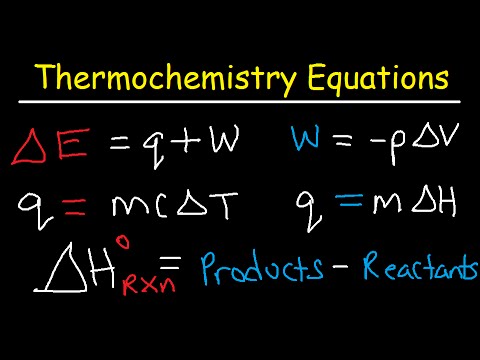
This video explains the fundamental concepts of thermochemistry, focusing on energy changes within chemical systems. It details the first law of thermodynamics, relating internal energy change (ΔE) to heat (Q) and work (W). The video covers how to calculate Q using specific heat capacity (q=mcΔT) and during phase changes (q=mΔH or q=nΔH). It also explains how to calculate work done by or on a gas (W=PΔV) and provides practical examples. Finally, it introduces thermochemical equations, Hess's Law, and calculating reaction enthalpies using heats of formation.
How was this?
Save this permanently with flashcards, quizzes, and AI chat
Chapters
- The change in internal energy (ΔE) of a system is the sum of heat (Q) added to or removed from the system and work (W) done on or by the system (ΔE = Q + W).
- Heat (Q) flows from hotter to colder objects. If heat is released by the system, Q is negative (exothermic). If heat is absorbed by the system, Q is positive (endothermic).
- Work (W) is defined as pressure times the change in volume (W = PΔV). Work done *on* a system (compression) is positive, increasing internal energy. Work done *by* a system (expansion) is negative, decreasing internal energy.
- Conversions between Joules, kilojoules, and calories are essential for calculations.
Understanding the relationship between internal energy, heat, and work is crucial for predicting how chemical reactions will affect the energy of their surroundings and for quantifying energy transfers.
A system absorbs 300 J of heat (Q = +300 J) and expands from 2 L to 3 L at 5 atm pressure (W = -506.5 J), resulting in a net change in internal energy of ΔE = 300 J + (-506.5 J) = -206.5 J.
- When there is a temperature change, heat transfer (Q) is calculated using Q = mcΔT, where 'm' is mass, 'c' is specific heat capacity, and 'ΔT' is the change in temperature.
- Specific heat capacity is the amount of heat required to raise the temperature of 1 gram of a substance by 1 degree Celsius (e.g., water's specific heat is 4.184 J/g°C).
- During a phase change (like melting or boiling), the temperature remains constant, and heat transfer is calculated using Q = mΔH (mass times enthalpy of fusion/vaporization) or Q = nΔH (moles times enthalpy of fusion/vaporization), depending on the units of ΔH.
These equations allow you to quantify the energy needed to change the temperature of a substance or to change its state, which is fundamental to many chemical and physical processes.
To heat 50 grams of water from 25°C to 75°C, the energy required is Q = (50 g) * (4.184 J/g°C) * (75°C - 25°C) = 10,460 Joules.
- A thermochemical equation includes the heat change (ΔH) associated with a balanced chemical reaction.
- If heat is listed as a product, the reaction is exothermic (releases heat). If heat is listed as a reactant, the reaction is endothermic (absorbs heat).
- The heat change in a thermochemical equation can be used with stoichiometry to calculate the heat released or absorbed for a specific amount of reactant or product.
- Conversions between grams, moles, and energy units (kJ) are necessary for these calculations.
This allows us to predict the energy impact of reactions on a larger scale, which is vital for industrial processes and understanding energy production.
For the combustion of propane, if 12,200 kJ of heat is released when 1 mole of propane reacts, we can calculate that reacting 64 grams of oxygen (O2) releases 480 kJ of heat, using the balanced equation and molar masses.
- The enthalpy of formation (ΔHf°) is the heat change when one mole of a compound is formed from its elements in their standard states.
- The enthalpy of a reaction (ΔHrxn) can be calculated using the formula: ΔHrxn = Σ(ΔHf° of products) - Σ(ΔHf° of reactants).
- The enthalpy of formation for elements in their standard states (like O2, H2) is zero.
- This method provides a way to calculate the overall energy change of a reaction even without direct experimental data for that specific reaction.
This provides a powerful tool to predict the energy output or input of a reaction using readily available standard enthalpy data, saving experimental effort.
For the reaction CH4 + 2O2 → CO2 + 2H2O, the ΔHrxn can be calculated as [ΔHf°(CO2) + 2*ΔHf°(H2O)] - [ΔHf°(CH4) + 2*ΔHf°(O2)] = [-393 kJ/mol + 2*(-286 kJ/mol)] - [-785 kJ/mol + 2*(0 kJ/mol)] = -84 kJ/mol.
- Hess's Law states that the total enthalpy change for a reaction is independent of the pathway taken; it's the sum of the enthalpy changes for each step.
- To find the enthalpy of a target reaction, you can manipulate given reactions (reverse them, multiply them by a factor) and add their corresponding enthalpy changes.
- When a reaction is reversed, the sign of its enthalpy change is reversed.
- When a reaction is multiplied by a coefficient, its enthalpy change is multiplied by the same coefficient.
Hess's Law allows us to calculate enthalpy changes for reactions that are difficult or impossible to measure directly by breaking them down into a series of simpler, known reactions.
Given reactions A + B → C (ΔH = +200 kJ) and D + E → 2C (ΔH = -400 kJ), we can find the enthalpy for 2A + 2B → D + E by doubling the first reaction (2A + 2B → 2C, ΔH = +400 kJ) and reversing the second (2C → D + E, ΔH = +400 kJ). Adding these gives the target reaction with ΔH = +400 kJ + +400 kJ = +800 kJ.
Key takeaways
- Internal energy change is a balance between energy entering/leaving as heat and energy transferred via work.
- The sign convention for heat (Q) and work (W) is critical: heat absorbed by the system is positive, heat released is negative; work done on the system is positive, work done by the system is negative.
- Specific heat capacity (mcΔT) applies to temperature changes, while enthalpy of fusion/vaporization (mΔH or nΔH) applies to phase changes at constant temperature.
- Thermochemical equations allow us to treat energy changes as stoichiometric quantities in chemical reactions.
- Heats of formation provide a standardized way to calculate the enthalpy of any reaction by summing product enthalpies and subtracting reactant enthalpies.
- Hess's Law is a powerful tool for calculating enthalpy changes indirectly by combining known reactions.
- Accurate unit conversions (J, kJ, cal, L·atm, mol) are essential for correct thermochemistry calculations.
Key terms
Internal Energy (ΔE)Heat (Q)Work (W)ExothermicEndothermicSpecific Heat Capacity (c)Enthalpy of Fusion/Vaporization (ΔH)Thermochemical EquationEnthalpy of Formation (ΔHf°)Hess's Law
Test your understanding
- How does the sign of Q and W affect the change in internal energy (ΔE) of a system?
- What is the difference between calculating heat transfer during a temperature change versus during a phase change?
- How can Hess's Law be used to determine the enthalpy change of a reaction that is difficult to measure directly?
- Explain the relationship between the sign of ΔHf° for a substance and its stability relative to its constituent elements.
- Why is it important to pay attention to the units when performing thermochemistry calculations?