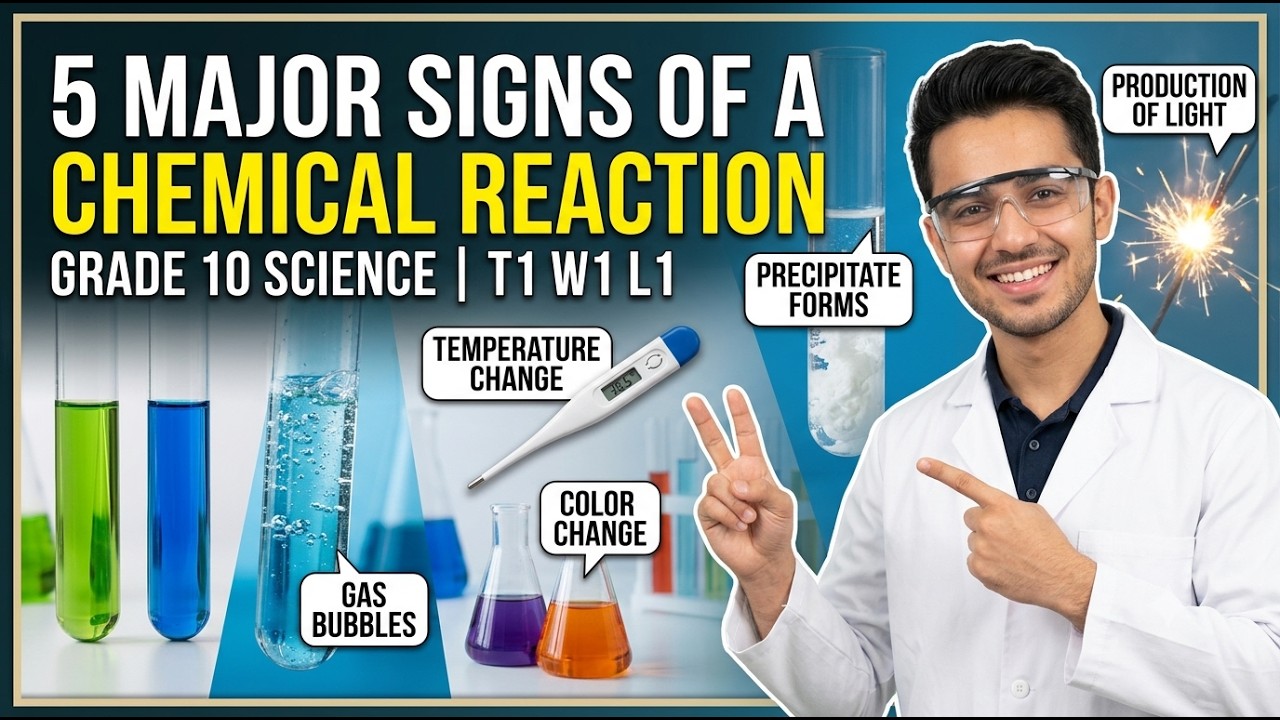
Indicators of a Chemical Reaction | Grade 10 Science (Term 1 Week 1 Lesson 1)
sipryan tv
Overview
This video explains how to identify chemical reactions by observing macroscopic changes, rather than trying to see atoms directly. It contrasts physical and chemical changes, highlighting that chemical changes result in new substances. The video introduces five key indicators of a chemical reaction: gas production, new odor, temperature change, color change, and precipitate formation. It then uses everyday examples like baking soda and vinegar, a browning apple, spoiled milk, rusting iron, and distinguishes these from physical changes like melting ice, tearing paper, dissolving sugar, and mixing paint. The video concludes by emphasizing that chemical reactions are constantly occurring within our own bodies.
Save this permanently with flashcards, quizzes, and AI chat
Chapters
- Physical changes alter a substance's form but not its chemical identity (e.g., melting ice, tearing paper).
- Chemical changes result in the formation of entirely new substances with different properties.
- During a chemical change, atomic bonds break and rearrange, permanently altering the molecules.
- Unbaking a cake is impossible because baking is a chemical change that permanently transforms ingredients into new substances.
- Since atoms are invisible, we look for observable clues that indicate a chemical change has occurred.
- Indicator 1: Production of a gas (seen as bubbling or fizzing).
- Indicator 2: A noticeable new odor is produced.
- Indicator 3: A change in temperature (the substance gets hotter or colder on its own).
- Indicator 4: A sudden change in color.
- Indicator 5: Formation of a precipitate (a new solid that forms from mixing clear liquids).
- Mixing baking soda and vinegar demonstrates multiple indicators of a chemical reaction.
- Vigorous bubbling and fizzing indicate the production of carbon dioxide gas.
- The cup becoming noticeably colder signifies an endothermic reaction, where heat is absorbed from the surroundings.
- These observable changes confirm that the original baking soda and vinegar have been transformed into new substances.
- Slicing an apple is physical, but the browning that occurs later is a chemical change (oxidation) due to reaction with air.
- Dropping Mentos into soda causes a geyser, but it's a physical change because the gas was already dissolved in the soda; the Mentos just provide nucleation sites.
- Milk spoiling produces a sour smell, indicating a chemical change where bacteria create new acids.
- Dissolving sugar in water is a physical change; the sugar molecules remain intact and can be recovered by evaporation.
- Iron rusting is a chemical change, forming a new reddish-brown substance (rust) due to reaction with oxygen and water.
- Mixing red and blue paint to make purple is a physical change, as pigments are blended, not chemically altered.
- Our bodies are constantly performing complex chemical reactions to sustain life.
- Digesting food and breathing oxygen involve breaking and rearranging chemical bonds.
- These internal processes generate energy, gases, and new substances, mirroring the indicators of chemical reactions.
- This highlights that chemistry is an active, ongoing process within us, not just in a lab.
Key takeaways
- Chemical reactions fundamentally transform substances into new materials, unlike physical changes which only alter form.
- The five key indicators—gas production, odor change, temperature change, color change, and precipitate formation—are observable signs of chemical reactions.
- A precipitate is a new solid that forms when two clear liquids are mixed, signaling a chemical change.
- While gas production often indicates a chemical change, the Mentos and soda example shows that physical processes can also release pre-existing gases rapidly.
- Rusting iron and browning apples are examples of chemical changes involving color and new substance formation.
- Dissolving sugar and mixing paint are physical changes because the chemical composition of the substances remains unchanged.
- Chemical reactions are essential for life, constantly occurring within our bodies to produce energy and sustain biological functions.
Key terms
Test your understanding
- What is the fundamental difference between a physical change and a chemical change?
- Describe the five observable indicators that suggest a chemical reaction has occurred.
- How can you identify a precipitate, and what does its formation signify?
- Why is the geyser effect from Mentos and soda considered a physical change, despite producing a large amount of gas?
- Explain how the browning of an apple is a chemical change, while mixing paint is a physical change.