7:44
IGCSE Physics 0625 | Unit 1 - Physical Quantities & Measurement Techniques
Learn Today IGCSE
Overview
This video introduces fundamental concepts in IGCSE Physics, focusing on physical quantities and measurement techniques. It covers the accurate use of rulers and measuring cylinders for length and volume, respectively, emphasizing how to avoid parallax error. The video also explains the difference between scalar and vector quantities, providing examples like speed versus velocity. Finally, it demonstrates how to calculate resultant force, a key concept in understanding how multiple forces acting on an object combine to produce a single, equivalent force, using both graphical and mathematical methods.
How was this?
Save this permanently with flashcards, quizzes, and AI chat
Chapters
- Rulers measure small distances, from millimeters to meters, with examples showing how to find the diameter of an object by measuring a group and dividing.
- For larger distances, a meter ruler or measuring tape is more appropriate than a standard ruler.
- Measuring cylinders are used to find the volume of liquids by observing the change in volume, and can also measure the volume of irregular objects.
- When reading a measuring cylinder, align your eye level with the bottom of the meniscus to prevent parallax error.
Accurate measurement is the foundation of all scientific inquiry. Understanding how to use tools like rulers and measuring cylinders correctly ensures reliable data collection, which is crucial for accurate calculations and conclusions.
Measuring the diameter of a ball by measuring the length of five balls placed side-by-side (6.9 cm - 2.1 cm = 4.8 cm) and then dividing by five (4.8 cm / 5 = 0.96 cm) to find the diameter of a single ball.
- Stopwatches or clocks are used to measure time intervals.
- To find the duration of an event, subtract the initial time reading from the final time reading.
- Ensure all time measurements are in consistent units, preferably seconds, before performing calculations.
Precise time measurement is essential for calculating other physical quantities like speed and acceleration, which are fundamental to understanding motion.
Calculating the time for a runner to complete a lap: If the start time is 5.10 seconds and the end time is 1 minute 50.10 seconds (which converts to 110.10 seconds), the lap time is 110.10 seconds - 5.10 seconds = 105 seconds.
- Physical quantities are classified as either scalar or vector.
- Scalar quantities have only magnitude (a numerical value).
- Vector quantities have both magnitude and direction.
- Speed is a scalar (e.g., 5 m/s), while velocity is a vector (e.g., 5 m/s to the right).
Distinguishing between scalar and vector quantities is critical because they are manipulated differently in calculations. Ignoring direction can lead to incorrect results when dealing with forces, velocities, and displacements.
A woman running at '5 m/s' describes her speed (scalar), but '5 m/s to the right' describes her velocity (vector), including both speed and direction.
- A vector, like force, can be represented by an arrow where length indicates magnitude and the arrowhead indicates direction.
- The resultant force is the single force that has the same effect as all the individual forces combined.
- If forces act in opposite directions, the resultant force is the difference between them, acting in the direction of the larger force.
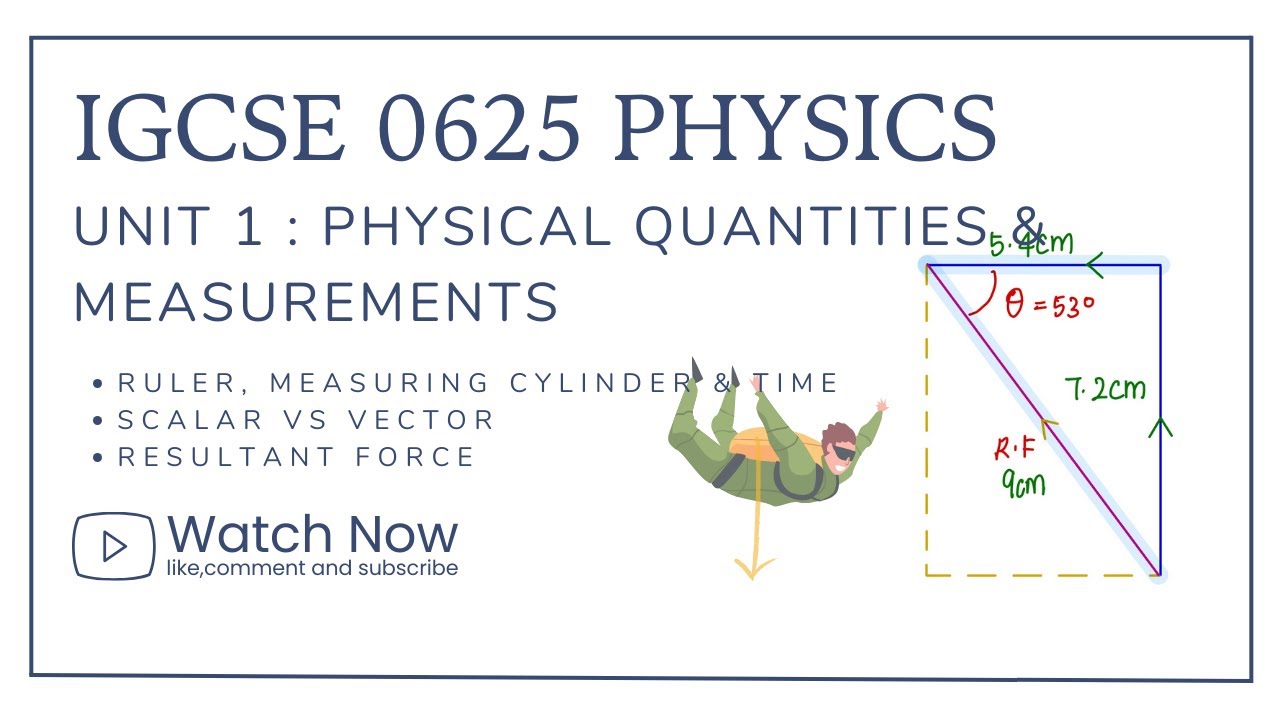
- When forces act at angles, the resultant force can be found using either a scale drawing (vector diagram) or trigonometric calculations (Pythagoras and trigonometry).
Understanding resultant force allows us to predict the motion of an object under the influence of multiple forces. This is fundamental to analyzing how objects move in real-world scenarios, from simple pushes to complex interactions.
A swimmer moving at 0.72 m/s perpendicular to a current of 0.5 m/s results in a resultant velocity relative to the river bank. Using Pythagoras theorem (sqrt(0.72^2 + 0.5^2)) gives a magnitude of approximately 0.9 m/s, and using trigonometry (tan(angle) = 0.72/0.5) gives a direction of approximately 53 degrees relative to the current.
Key takeaways
- Accurate measurement requires choosing the right instrument and avoiding common errors like parallax.
- Time measurements must be consistent and precise for calculating other motion-related quantities.
- Understanding the difference between magnitude (scalar) and magnitude plus direction (vector) is crucial for physics calculations.
- Velocity is a vector quantity, incorporating both speed and direction.
- Resultant force is the net effect of multiple forces acting on an object.
- Resultant forces acting at angles can be calculated using scale diagrams or mathematical methods like Pythagoras' theorem and trigonometry.
- Both graphical and mathematical methods yield the same result for resultant force calculations.
Key terms
RulerMeasuring CylinderParallax ErrorScalar QuantityVector QuantityMagnitudeDirectionSpeedVelocityResultant ForceMeniscus
Test your understanding
- How can parallax error be avoided when using a measuring cylinder?
- What is the key difference between a scalar quantity and a vector quantity?
- Why is it important to specify direction when dealing with vector quantities like velocity?
- Describe the two main methods for calculating the resultant force when forces act at an angle to each other.
- How would you determine the diameter of a single small object using a ruler?