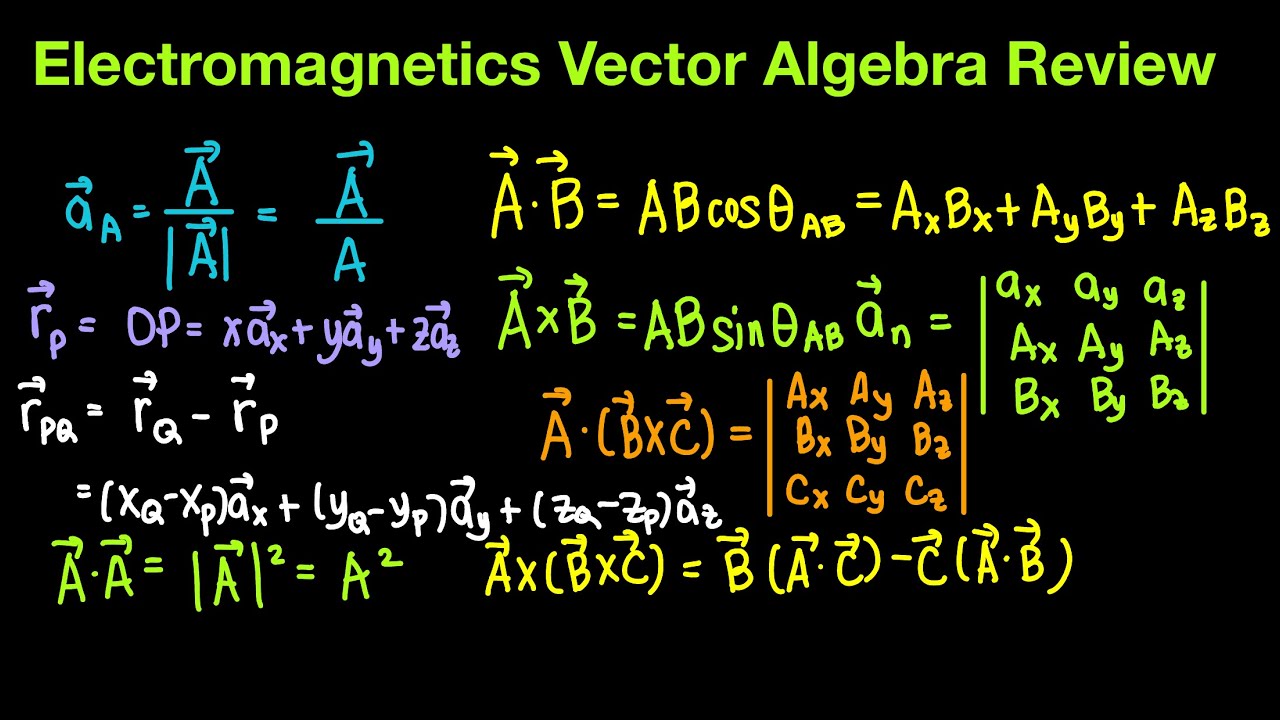
Electromagnetics Ep 7: Vector Algebra Review Part 2
enginerdmath
Overview
This video is the second part of a review on vector algebra, essential for electromagnetics. It covers solving problems involving vector addition, subtraction, scalar triple products, cross products, and calculating the angle between vectors. The presenter walks through several examples, demonstrating how to perform these operations manually and suggesting the use of a calculator for verification. The problems range from basic operations to more complex calculations like finding unknown vector components when vectors are parallel or perpendicular, and determining distances between points given their position vectors. The video concludes by encouraging viewers to practice and subscribe for more tutorials.
Save this permanently with flashcards, quizzes, and AI chat
Chapters
- Vector addition and subtraction are performed component-wise.
- The scalar triple product (A · (B x C)) can be calculated using a determinant involving the components of the three vectors.
- The sign convention for cofactor expansion in determinants is crucial for accurate calculations.
- The cross product of two vectors (B x C) can be found using a determinant with unit vectors in the first row and vector components in the subsequent rows.
- The dot product of two vectors is used to find the angle between them: A · B = |A||B|cos(theta).
- The angle between two vectors can be isolated using the inverse cosine of the dot product divided by the product of their magnitudes.
- The scalar triple product A · (B x C) involves first calculating the cross product B x C and then taking the dot product with A.
- The cross product of two vectors can be calculated using a determinant method.
- The order of operations matters in vector products; A x (B x C) is different from (A x B) x C.
- The components of a position vector directly correspond to the Cartesian coordinates of a point relative to the origin.
- The distance vector between two points (e.g., from T to S) is found by subtracting the position vector of the starting point from the position vector of the ending point.
- The magnitude of the distance vector represents the scalar distance between the two points.
- Two vectors are parallel if one is a scalar multiple of the other (A = k * B).
- Two vectors are perpendicular (orthogonal) if their dot product is zero (A · B = 0).
- These conditions can be used to solve for unknown components of vectors.
- The cross product of a vector with a unit vector (e.g., A x ay) can be calculated using determinants.
- The dot product of a vector with a unit vector isolates the component of the vector along that unit vector's axis.
- The angle between a vector and a unit vector (like az) can be found using the dot product and the magnitudes of the vectors.
Key takeaways
- Vector algebra operations (addition, subtraction, dot product, cross product) are foundational for electromagnetics.
- Determinants are a powerful tool for calculating cross products and scalar triple products.
- The dot product is directly related to the angle between vectors, enabling its calculation.
- Position vectors define points in space and are used to calculate distances and displacements.
- Parallelism implies a scalar relationship between vectors, while perpendicularity implies a zero dot product.
- Unit vectors simplify component analysis and calculations along specific axes.
- Consistent application of component-wise operations is key to accurate vector calculations.
Key terms
Test your understanding
- How do you perform vector subtraction, and why is it important in physics?
- What is the geometric interpretation of the scalar triple product, and how is it calculated?
- How can the dot product be used to determine if two vectors are perpendicular?
- What is the relationship between a position vector and the coordinates of a point in space?
- Describe the conditions under which two vectors are considered parallel, and how does this relate to their components?