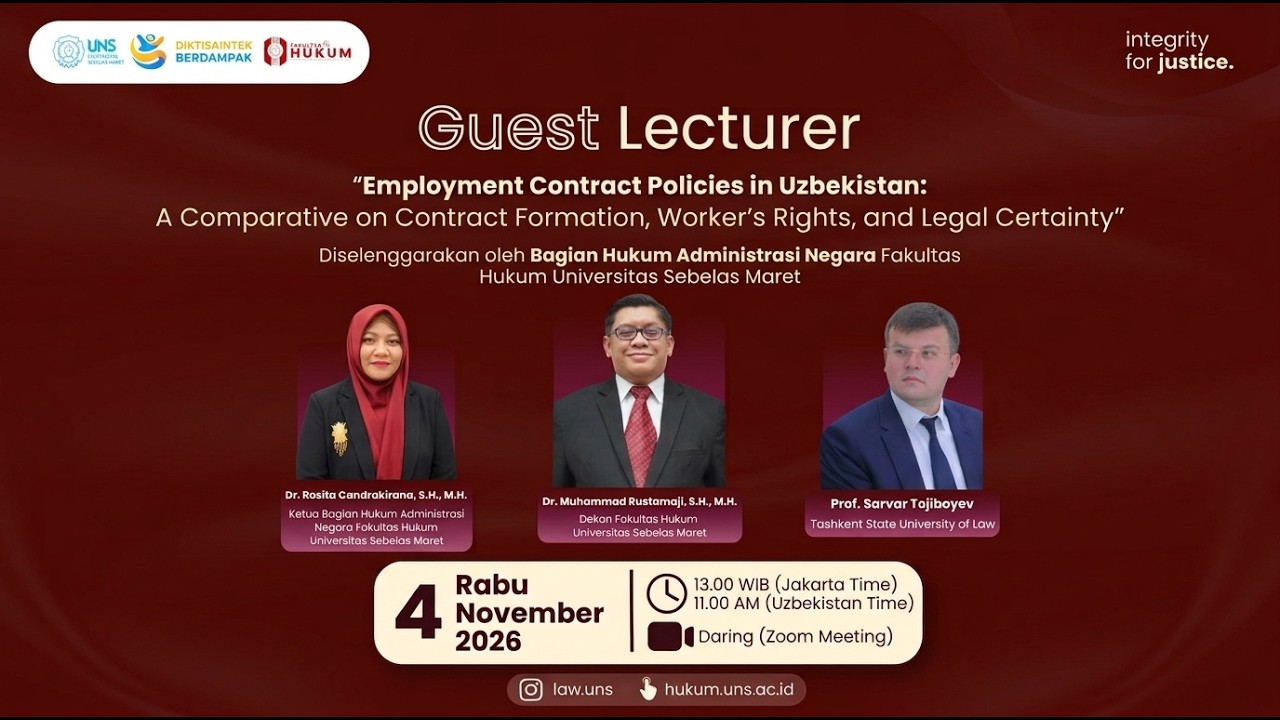
Guest Lecturer | Bagian Hukum Administrasi Negara Fakultas Hukum Universitas Sebelas Mare
Fakultas Hukum UNS
Overview
This lecture explores employment contract policies in Uzbekistan, offering a comparative perspective on contract formation, workers' rights, and legal certainty. It highlights the evolution of Uzbekistan's labor code, emphasizing principles like equality, freedom of labor, and social partnership. The discussion covers the essential elements of employment contracts, distinctions between employment and civil law contracts, and the procedures for concluding, modifying, and terminating employment agreements. The session also touches upon specific issues such as probation, hiring practices, and the treatment of platform workers, drawing parallels and lessons for Indonesia's own labor law landscape.
Save this permanently with flashcards, quizzes, and AI chat
Chapters
- The lecture aims to broaden academic perspectives on employment contracts through a comparative lens between Uzbekistan and Indonesia.
- Uzbekistan's Constitution guarantees rights to decent work, fair pay, and protection against unemployment, with specific protections for pregnant women and mothers.
- International treaties take precedence over national legislation if they offer more favorable terms for employees.
- The new Labor Code of Uzbekistan (effective April 30, 2023) establishes key principles for employment contracts.
- Equality and prohibition of discrimination are central, with recent amendments including criminal records and relatives' status as protected characteristics.
- Freedom of labor includes the freedom to conclude and change contracts, the right to resign, and the ability to dismiss only on statutory grounds.
- Social partnership, the guarantee of rights and duties, and the principle of 'no worsening' of conditions are also fundamental.
- Justified distinctions, such as those based on inherent job requirements or special protection for vulnerable groups, are permitted and not considered discrimination.
- An employment contract is an agreement where an employee performs a labor function under the employer's management in exchange for wages and lawful working conditions.
- Key markers of an employment contract include personal performance, subordination, and regular pay, distinguishing it from civil law service agreements.
- The minimum age for employment is 15, with exceptions for light work or creative/professional roles under specific conditions.
- Contracts must be in writing, electronically or on paper, and registered with state bodies, with electronic labor books becoming standard.
- Mandatory terms include workplace, labor function, start date, pay terms, and working conditions; additional terms can be included if they don't worsen the employee's position.
- Indefinite-term contracts are the default; fixed-term contracts are exceptions requiring specific statutory grounds.
- Contracts can be changed through mutual agreement, transfers, relocation (with notice), secondment, or changes in workplace location.
- Remote work is considered a change in labor conditions if the function remains the same, or a transfer if the function changes.
- Termination grounds include mutual agreement, expiry of fixed-term contracts, employee resignation, and employer dismissal.
- Employer dismissals must be based on specific grounds like liquidation, staff changes, systematic breaches, or single gross breaches of contract/rules.
- Unlawful refusal to hire, such as discrimination or demanding unlisted documents, is prohibited and can lead to claims for reinstatement and damages.
- Probationary periods are optional, must be agreed upon, capped at three months (or six for management), and do not apply to certain protected groups.
- Uzbekistan's new labor code aims to align with international standards, including strong protections against forced labor and the use of technology for contract management.
- Both Uzbekistan and Indonesia face challenges in balancing investment needs with worker protection, offering opportunities for mutual learning.
- The status of platform workers (e.g., ride-hailing drivers) is a complex issue in both countries, often falling into a grey area between employee and partner.
- Lessons for Indonesia include clarifying the status of informal and platform workers and potentially adopting models like Uzbekistan's 'freelancer' status for better regulation.
Key takeaways
- Employment contracts in Uzbekistan are governed by a comprehensive labor code emphasizing employee rights, non-discrimination, and legal certainty.
- The distinction between employment contracts and civil service agreements is crucial, with courts examining the reality of the working relationship to prevent misclassification.
- Indefinite-term contracts are the standard, and fixed-term contracts are permissible only under strict, legally defined circumstances.
- Employers must adhere to specific procedures and grounds for dismissal; arbitrary termination is unlawful.
- Both Uzbekistan and Indonesia are grappling with regulating new forms of work, like platform employment, and can learn from each other's approaches.
- The legal framework in Uzbekistan provides mechanisms for workers to seek remedies for violations, including compensation for damages and moral harm.
- The evolution of labor law in Uzbekistan reflects a commitment to aligning with international standards and protecting workers in a changing economy.
Key terms
Test your understanding
- What are the key principles that underpin employment contracts in Uzbekistan?
- How does Uzbekistani law distinguish between an employment contract and a civil law service agreement, and why is this distinction important?
- Under what conditions can an employer lawfully use a fixed-term employment contract in Uzbekistan?
- What are the primary grounds for dismissing an employee in Uzbekistan, and what recourse do employees have if they believe their dismissal was unlawful?
- What challenges do Uzbekistan and Indonesia face regarding the regulation of platform workers, and what potential solutions were discussed?