AI-Generated Video Summary by NoteTube
YouTube Video q-c7kmGao-I
Overview
This video is an academic notice information session for Spring 2026, hosted by academic advisors from the College of Humanities and Social Sciences. The session aims to help students understand what academic notice means, explore different academic statuses, identify campus resources, and learn strategies for returning to good academic standing. It clarifies that academic notice is triggered when either the CSUF GPA or cumulative GPA falls below 2.0. The presentation details how to check one's academic status using the Titan Degree Audit, explains the potential consequences of academic notice, including continued notice and disqualification warning, and outlines the timeline for these statuses. It also discusses common reasons for academic notice, such as adjusting to college, major dissatisfaction, and time management issues, and provides actionable recommendations and campus resources to support students in improving their academic performance.
This summary expires in 30 days. Save it permanently with flashcards, quizzes & AI chat.
Chapters
- •Welcome and introduction of presenters: Dr. Matt Griscard, Britney Swanson, and Ronnie Escotto.
- •Explanation of attendance tracking via Zoom name and end-of-session survey.
- •Information on makeup surveys for those unable to attend the full session.
- •Session goals: Understand academic notice, learn about academic statuses, identify resources, and plan for good academic standing.
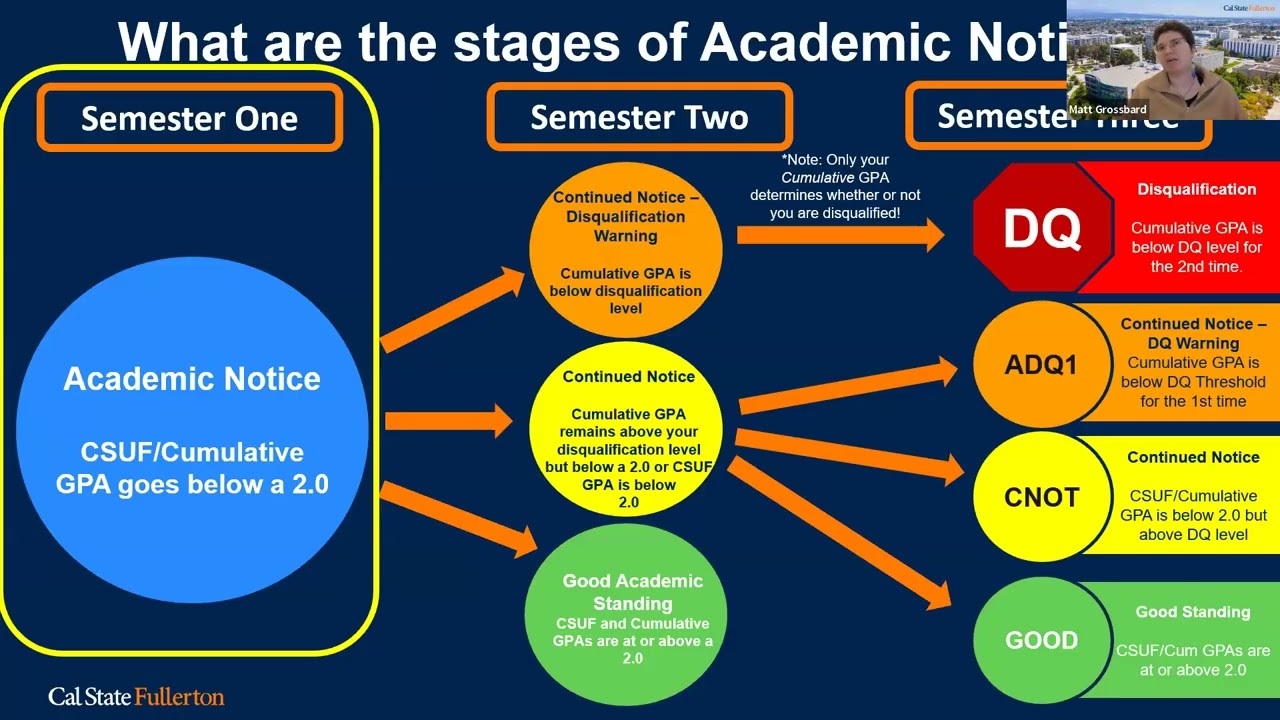
- •Academic notice is a status when CSUF GPA or cumulative GPA drops below 2.0.
- •CSUF GPA includes only courses taken at Fullerton; cumulative GPA includes all attempted units.
- •The Titan Degree Audit is used to determine current GPA status.
- •Instructions provided on how to access and interpret the Titan Degree Audit for GPA information.
- •First semester on academic notice: a warning period after a GPA drop.
- •Possible outcomes: returning to good standing, continued notice, or disqualification warning.
- •Disqualification warning occurs if cumulative GPA drops below a specific level.
- •Disqualification can lead to ineligibility for financial aid and delayed registration.
- •Students cannot be disqualified at the end of the current semester; they have time to improve.
- •Disqualification levels vary based on earned units (class level: freshman, sophomore, etc.).
- •Higher class levels have higher disqualification GPA thresholds.
- •Continued notice is for students whose GPA is below 2.0 but above the disqualification level.
- •Students can remain on continued notice but cannot graduate without a 2.0 GPA.
- •Adjustment to college environment, especially from online or different academic settings.
- •Issues with major choice, lack of motivation, or course difficulty.
- •Lack of study skills, time management challenges, and procrastination.
- •Imbalance in work-life-school balance, demanding work schedules, or family responsibilities.
- •Personal challenges, health issues (illness, injury), stress, anxiety, depression, and financial instability.
- •Understand current academic status and required grades for improvement.
- •Connect with advisors for personalized guidance and resource recommendations.
- •Utilize campus resources like CAPS, Basic Needs Services, and Disability Support Services.
- •Attend classes regularly and communicate proactively with professors.
- •Consider adjusting course schedules, retaking classes (grade forgiveness), or exploring retroactive withdrawals/stopout semesters.
- •Unit limitations for students on academic notice (max 14 units).
- •Grade forgiveness policy allows retaking courses to improve GPA (16 units available).
- •Retroactive withdrawal petitions for extenuating circumstances from previous semesters.
- •Stopout semesters allow a break from studies without losing admission status.
- •Key campus resources: CAPS (mental health), Basic Needs (food, housing, hygiene), Disability Support Services, Tuffy's Closet (professional clothing).
- •Professors' office hours are opportunities for academic support and clarification.
- •Communicate with professors about challenges to seek extensions or understanding.
- •Financial Aid office is the primary resource for all financial aid-related questions.
- •Advisors cannot access or provide specific financial aid information.
- •Mandatory actions include attending this session, a GPA planning workshop (for blue group), and advising sessions.
- •Completion of the online 'Reset Course' is required for all students.
- •Failure to complete required actions will result in a registration hold.
- •Important dates: last day to add/drop classes, last day for instructor permission to add, withdrawal deadlines (non-medical and medical).
Key Takeaways
- 1Academic notice is a warning status triggered by a GPA below 2.0, impacting both CSUF and cumulative GPAs.
- 2Understanding your specific GPA (CSUF vs. cumulative) and disqualification level is crucial for managing academic standing.
- 3You cannot be disqualified at the end of the current semester, providing a window for improvement.
- 4Numerous campus resources, including academic advising, counseling (CAPS), and basic needs services, are available to support students.
- 5Proactive communication with professors and utilizing office hours can significantly aid academic success.
- 6Policies like grade forgiveness and retroactive withdrawals can help improve your GPA, but require careful consideration and advising.
- 7Completing all required academic success actions (workshops, advising, Reset course) is mandatory to avoid registration holds for future semesters.
- 8Taking ownership of your academic journey by utilizing available resources and seeking help is key to returning to good academic standing.