12:06
Action Potential - Nerve Impulse Transmission - Neurons - Biology Series
Medicosis Perfectionalis
Overview
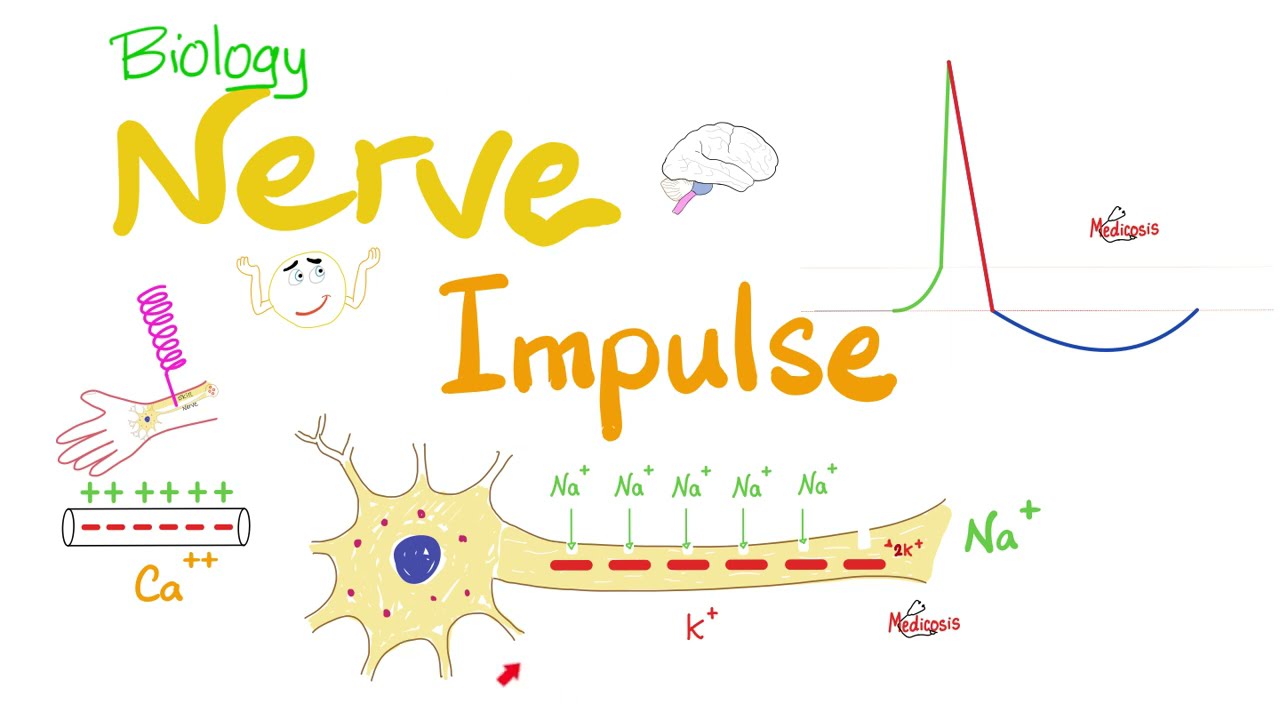
This video explains the fundamental concepts of nerve impulse transmission, focusing on the resting membrane potential and the action potential. It details the roles of ions like sodium and potassium in establishing and changing the electrical state of a neuron's membrane. The video covers the stages of an action potential, including depolarization and repolarization, and introduces the all-or-none principle and refractory periods, emphasizing their importance for proper nervous system function.
How was this?
Save this permanently with flashcards, quizzes, and AI chat
Chapters
- Nerve impulses, or action potentials, are crucial for all bodily functions, including muscle contraction, sensation, and thought.
- The neuron's membrane separates the intracellular fluid (high potassium) from the extracellular fluid (high sodium).
- The action potential involves a rapid change in the membrane's electrical potential, enabling signal transmission.
Understanding action potentials is key to comprehending how the nervous system communicates and controls bodily functions.
The video uses the analogy of muscle contraction, skin sensation, and gland secretion as examples of processes driven by action potentials.
- At rest, the neuron membrane is polarized, with the inside being negative relative to the outside (around -90mV).
- Potassium ions (K+) are the primary drivers of the resting potential, as they tend to leave the cell, making the inside more negative.
- Selective permeability of the membrane favors potassium efflux over sodium influx during rest.
- The sodium-potassium pump actively maintains the ion gradients by pumping 3 sodium ions out for every 2 potassium ions in.
The resting membrane potential is the baseline electrical state of the neuron, essential for its ability to generate an action potential when stimulated.
During rest, potassium ions leave the cell, making the inside of the membrane more negative, establishing the resting potential of approximately -90 millivolts.
- Stimulation that reaches the threshold triggers an action potential, causing depolarization.
- Depolarization occurs when sodium ions (Na+) rapidly enter the neuron, making the inside of the membrane positive (reaching about +35mV).
- This influx of positive charge reverses the membrane's polarity, hence the term 'activation' or depolarization.
- The threshold level is critical; a stimulus must be strong enough to open voltage-gated sodium channels for the action potential to occur.
Depolarization is the rapid electrical signal that propagates along the neuron, carrying information throughout the nervous system.
When a neuron is stimulated sufficiently, sodium channels open, allowing a flood of positive sodium ions into the cell, rapidly changing the membrane potential from negative to positive.
- After depolarization, the membrane repolarizes as sodium channels close and potassium channels open, allowing potassium to leave the cell.
- The efflux of positive potassium ions makes the inside of the membrane negative again.
- Repolarization often overshoots the resting potential, leading to hyperpolarization (e.g., reaching -100mV).
- Inward rectifier potassium channels help bring the membrane potential back up from hyperpolarization to the resting state.
Repolarization and hyperpolarization are essential for resetting the neuron's membrane potential, allowing it to fire again and preventing continuous, uncontrolled signaling.
Following the influx of sodium, potassium channels open, and positive potassium ions exit the neuron, causing the membrane potential to become negative again, even dipping below the resting potential.
- The all-or-none law states that an action potential will either fire maximally or not at all, regardless of the stimulus strength beyond the threshold.
- A refractory period follows an action potential, during which the neuron is less responsive or unresponsive to further stimulation.
- The absolute refractory period ensures that an action potential is a discrete event and prevents backward propagation.
- The relative refractory period allows for stronger stimuli to elicit a response, influencing the frequency of action potentials.
These principles ensure the reliable and controlled transmission of nerve impulses, preventing signal overload and maintaining the integrity of neural communication.
If a stimulus is below the threshold, no action potential occurs; if it meets or exceeds the threshold, a full action potential is generated, similar to a light switch that is either fully on or fully off.
Key takeaways
- Action potentials are the fundamental electrical signals used by neurons to communicate information.
- The balance of sodium and potassium ions across the neuronal membrane is critical for establishing and changing its electrical potential.
- Depolarization, driven by sodium influx, is the 'upward' phase of the action potential, representing excitation.
- Repolarization, driven by potassium efflux, is the 'downward' phase, returning the membrane to a negative state.
- The resting membrane potential is actively maintained by ion gradients and the sodium-potassium pump.
- The all-or-none principle ensures that action potentials are consistent signals, while refractory periods regulate their frequency and prevent overstimulation.
Key terms
Action PotentialResting Membrane PotentialDepolarizationRepolarizationHyperpolarizationSodium-Potassium PumpThreshold StimulusAll-or-None LawRefractory PeriodIon Channels
Test your understanding
- What are the primary ions responsible for the resting membrane potential and the depolarization phase of an action potential?
- How does the sodium-potassium pump contribute to maintaining the resting membrane potential?
- What distinguishes depolarization from repolarization in the context of an action potential?
- Explain the significance of the threshold stimulus in initiating an action potential.
- What is the 'all-or-none' principle, and how does it relate to nerve impulse transmission?