11:53
A Short History of Human Rights
Allversity
Overview
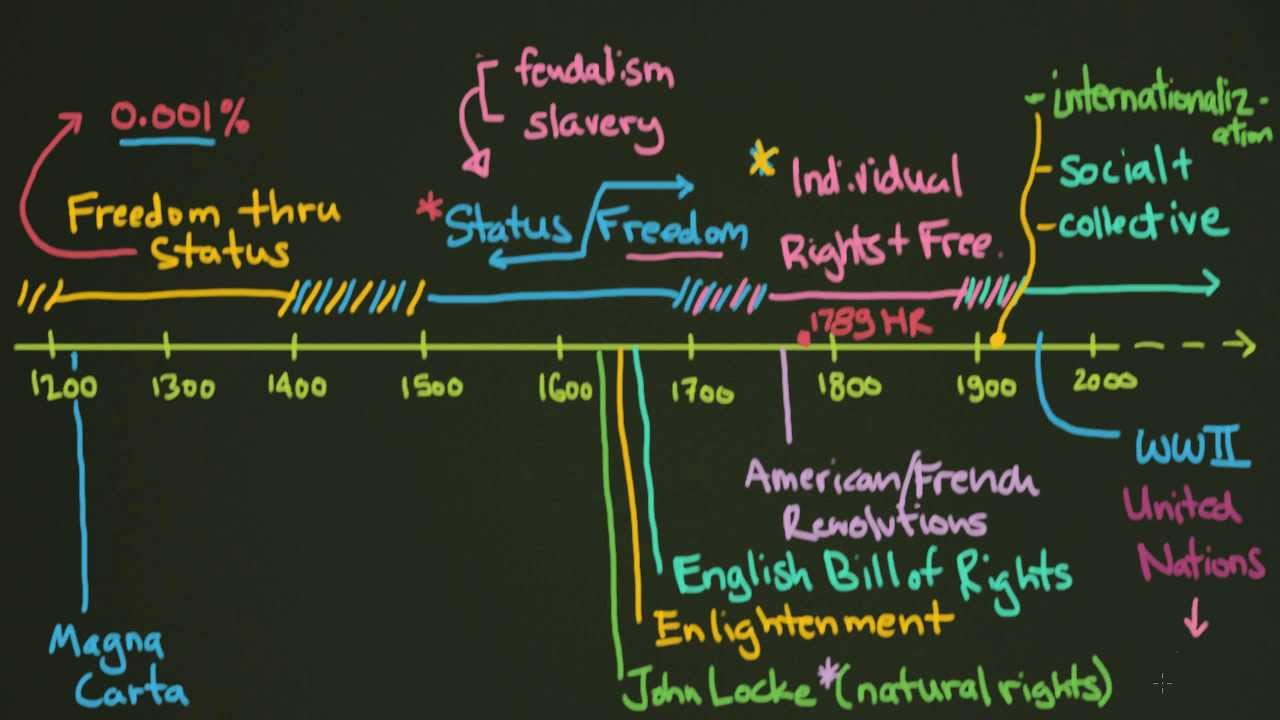
This video traces the historical development of human rights, primarily through a European lens, from the Magna Carta to the modern era. It highlights key milestones like the Enlightenment, the American and French Revolutions, and the establishment of the United Nations. The summary emphasizes that human rights are not a permanent, upward progression but rather a continuous struggle with setbacks and advancements, requiring active participation to uphold and improve.
How was this?
Save this permanently with flashcards, quizzes, and AI chat
Chapters
- The Magna Carta (1215) is an early document associated with rights, but it primarily granted freedoms to a very small elite based on land ownership and status.
- At this time, freedom was largely tied to social status, not an inherent individual entitlement.
- Despite moves towards freedom, widespread feudalism and slavery persisted, meaning many people had no real rights.
Understanding the Magna Carta's limitations reveals that early notions of rights were exclusive and status-based, setting the stage for later struggles for broader inclusion.
The Magna Carta granted rights like the ability to own land, which was a significant freedom but only applicable to a tiny percentage of the population.
- The Enlightenment (17th-18th centuries) fostered intellectual movements that began to separate freedom from status.
- John Locke articulated the concept of natural rights, including life, liberty, and property, as inherent to all individuals.
- The English Bill of Rights (1689) was influenced by these ideas, further codifying certain rights.
The Enlightenment's focus on natural rights shifted the paradigm towards inherent human entitlements, laying the philosophical groundwork for modern human rights concepts.
John Locke's writings proposed that individuals possess fundamental rights to life, liberty, and property, regardless of their social standing.
- The American and French Revolutions were pivotal moments where ideas of natural rights were put into practice.
- These revolutions championed individual rights and freedoms, asserting that they were not dependent on social status.
- The term 'human rights' began to be used in France around 1789, marking a conceptual shift towards universal applicability.
These revolutions demonstrated the power of abstract rights concepts to inspire societal change and led to the formalization of individual rights in foundational documents.
The French Revolution, beginning in 1789, saw the emergence of the term 'human rights' and a push for rights and freedoms not tied to one's social position.
- By the late 1800s, the concept of rights began to expand beyond individual liberties to include social and collective rights.
- This period saw the internationalization of rights, meaning these ideas spread globally.
- Examples of social and collective rights include access to education, employment, welfare, and public health.
The inclusion of social and collective rights broadened the scope of human rights, recognizing that well-being depends on societal structures and resources, not just individual freedoms.
The Mexican Constitution, written in the early 1900s, is cited as an example of incorporating social and collective rights like education and welfare.
- World War II served as a catastrophic catalyst, highlighting the urgent need for global human rights protections.
- The formation of the United Nations (UN) was a direct response to the war's devastation.
- The UN established foundational documents like the Universal Declaration of Human Rights (UDHR), aiming to create a more connected and just global community.
The horrors of WWII underscored the necessity of international cooperation and a universally recognized standard for human rights, leading to the creation of the UDHR.
The establishment of the United Nations after World War II aimed to foster global cooperation and prevent future atrocities, leading to the creation of the Universal Declaration of Human Rights.
- Human rights are not a guaranteed, linear progression towards an ideal state.
- Progress is often marked by significant setbacks, violations, and ongoing struggles.
- Maintaining and advancing human rights requires continuous effort and active participation from individuals and societies.
Recognizing that human rights are fragile and constantly under threat emphasizes the importance of vigilance and active engagement in their protection and promotion.
Despite advancements, human rights are frequently violated, and major setbacks like World War II demonstrate that progress is not guaranteed and requires constant societal effort.
Key takeaways
- Early rights were exclusive and tied to social status, not universal entitlements.
- The Enlightenment introduced the concept of natural rights inherent to all individuals.
- Revolutions in America and France were crucial in translating abstract rights into political action.
- The definition of rights expanded to include social and collective well-being, not just individual freedoms.
- Global events like WWII spurred the creation of international bodies and declarations to protect human rights.
- Human rights are not permanently secured; they require constant effort and face ongoing challenges.
- Active participation is essential for the progress and protection of human rights.
Key terms
Magna CartaStatusFeudalismNatural RightsEnlightenmentIndividual RightsHuman RightsSocial RightsCollective RightsInternationalization of RightsUnited NationsUniversal Declaration of Human Rights
Test your understanding
- How did the concept of 'status' influence the rights granted by the Magna Carta?
- What were John Locke's key contributions to the idea of natural rights?
- Why are the American and French Revolutions considered significant in the history of human rights?
- What is the difference between individual rights and social/collective rights?
- How did World War II impact the development and international recognition of human rights?