AI-Generated Video Summary by NoteTube
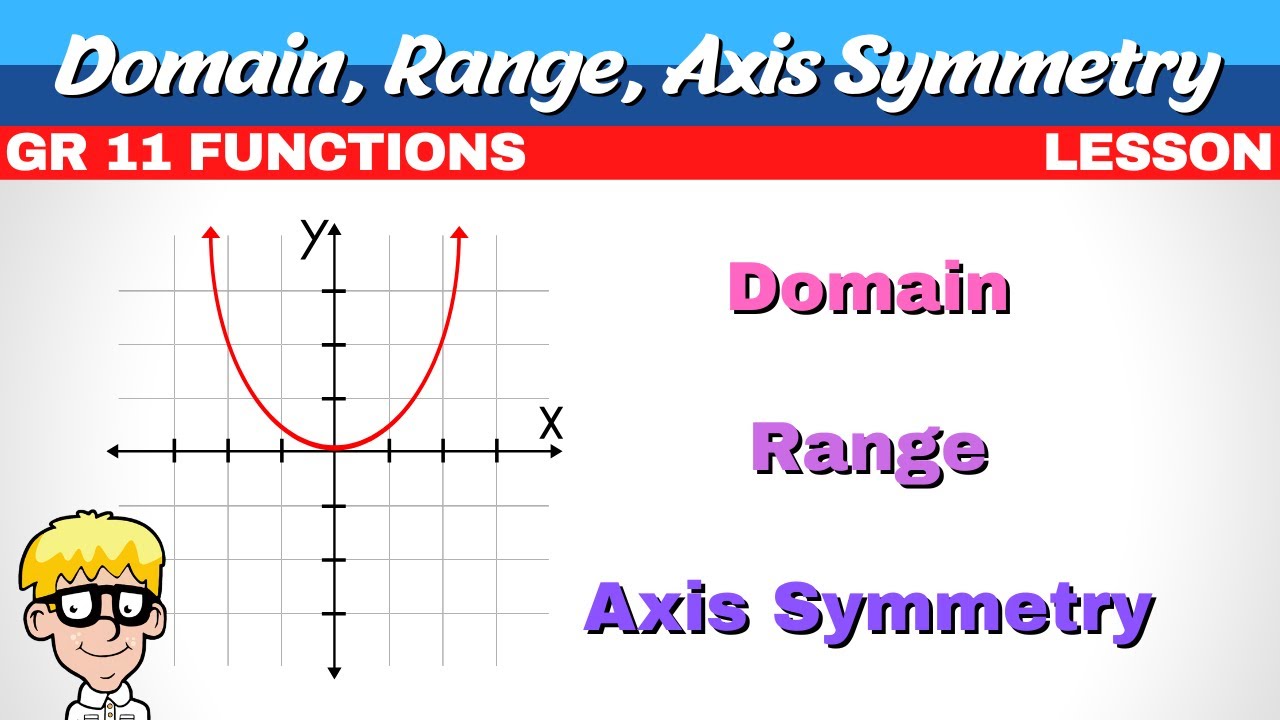
Parabola Domain Range Axis Symmetry Grade | 11 Functions
Kevinmathscience
Overview
This video explains the concepts of domain, range, and axis of symmetry for parabolas. It details how to determine the domain and range by analyzing the possible x and y values a parabola can take, noting that parabolas typically have a domain of all real numbers. The axis of symmetry is identified as the vertical line that divides the parabola into two mirror images, with its equation being x = h, where h is the x-coordinate of the vertex. The video also touches upon asymptotes, stating that parabolas do not have them. Finally, it covers reflections (across the x and y axes) and translations (shifts up, down, left, or right) of parabolas, demonstrating how these transformations affect the equation of the parabola.
This summary expires in 30 days. Save it permanently with flashcards, quizzes & AI chat.
Chapters
- •Domain refers to all possible x-values.
- •Range refers to all possible y-values.
- •Parabolas generally have a domain of all real numbers (-infinity to +infinity).
- •The range depends on whether the parabola opens upwards (minimum y-value) or downwards (maximum y-value).
- •The axis of symmetry is a vertical line that divides the parabola into two identical halves.
- •It passes through the vertex of the parabola.
- •The equation of the axis of symmetry is always in the form x = h, where h is the x-coordinate of the vertex.
- •For parabolas that are not in vertex form, the x-coordinate of the vertex can be found by averaging the x-intercepts.
- •Asymptotes are lines that a graph approaches but never touches.
- •Parabolas do not have asymptotes.
- •Asymptotes are typically associated with rational functions like hyperbolas.
- •Reflection across the x-axis changes the sign of the y-values (y becomes -y).
- •Reflection across the y-axis changes the sign of the x-values (x becomes -x).
- •Reflections create a mirror image of the original graph.
- •Translations involve shifting the graph horizontally or vertically.
- •Shifting right by 'h' units changes x to (x - h).
- •Shifting left by 'h' units changes x to (x + h).
- •Shifting up by 'k' units changes y to (y - k) or adds k to the equation.
- •Shifting down by 'k' units changes y to (y + k) or subtracts k from the equation.
- •Reflecting in the y-axis involves replacing x with -x in the equation.
- •Reflecting in the x-axis involves replacing y with -y, which often means multiplying the entire function by -1.
- •Translating a graph affects the terms inside the parentheses (for x-shifts) and the constant term (for y-shifts).
- •The coefficient in front of the squared term affects the width of the parabola but not its position after translation.
Key Takeaways
- 1The domain of a parabola is typically all real numbers, while the range is determined by its vertex and direction.
- 2The axis of symmetry is a vertical line (x=h) passing through the vertex, crucial for understanding the parabola's shape.
- 3Parabolas do not have asymptotes; they extend infinitely without approaching specific lines.
- 4Reflecting a parabola across the x-axis negates its y-values, while reflecting across the y-axis negates its x-values.
- 5Translations shift the parabola horizontally (affecting x in the equation) and vertically (affecting the constant term).
- 6Understanding how transformations (reflections and translations) alter the equation is key to predicting the new graph's position and orientation.
- 7The vertex form of a parabola's equation (y = a(x-h)^2 + k) directly shows the vertex (h, k) and the axis of symmetry (x=h).