5:22
Introduction to Functions in C
Neso Academy
Overview
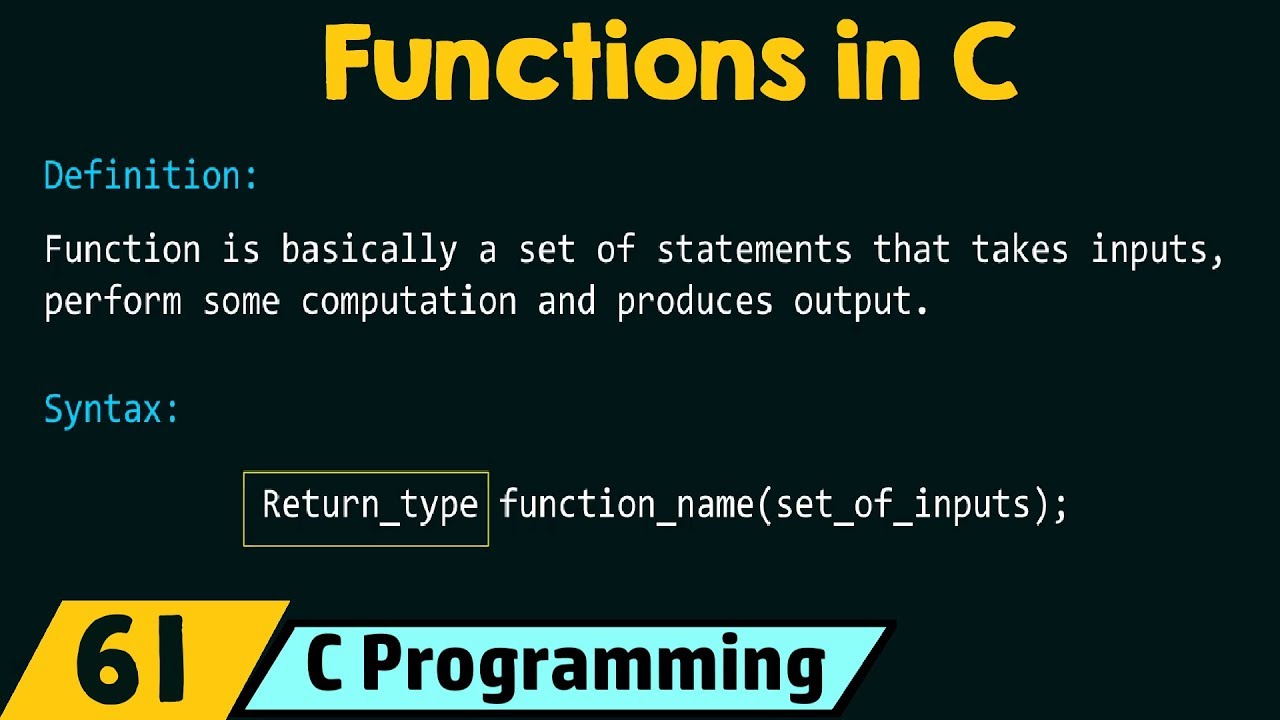
This video introduces the fundamental concept of functions in C programming. It defines a function as a block of code that accepts inputs, performs computations, and returns an output. The video explains the basic syntax of a function, including its return type, name, and parameters. Crucially, it highlights the two primary benefits of using functions: reusability, allowing code to be called multiple times without rewriting, and abstraction, hiding complex internal workings. A practical example of calculating a rectangle's area demonstrates these principles in action.
How was this?
Save this permanently with flashcards, quizzes, and AI chat
Chapters
- A function is a collection of statements designed to perform a specific task.
- It accepts zero or more inputs (parameters).
- It processes these inputs through computation.
- It produces a single output (return value).
Understanding the core definition of a function is essential for building modular and organized C programs.
A function can be thought of as a mini-program that takes ingredients (inputs), cooks them (computation), and serves a dish (output).
- The basic syntax includes a return type, a function name, and a parameter list enclosed in parentheses.
- The return type specifies the data type of the value the function will send back.
- The parameter list defines the types and names of the inputs the function expects.
- Functions can be defined to accept no inputs and/or return no specific value.
Knowing the syntax allows you to correctly define and use functions in your C code.
An example syntax is `int calculate_sum(int num1, int num2)`, where `int` is the return type, `calculate_sum` is the function name, and `(int num1, int num2)` is the parameter list.
- Reusability: Write code once and use it multiple times, saving effort and reducing errors.
- Abstraction: Hide the complex implementation details, allowing you to use a function without knowing exactly how it works internally.
- Improved code organization and readability.
Functions are crucial for writing efficient, maintainable, and scalable C programs.
The `scanf` function in C is a prime example; you use it to read input without needing to understand its internal workings.
- A function `area_of_rect` is defined to calculate the area of a rectangle.
- It takes two integer inputs, `length` and `breadth`.
- Inside the function, the area is calculated by multiplying `length` and `breadth`.
- The calculated `area` (an integer) is returned to the calling part of the program.
- The example shows calling the function twice with different inputs to demonstrate reusability.
This practical example illustrates how functions encapsulate logic, making code cleaner and easier to reuse for repeated calculations.
Calling `area_of_rect(10, 5)` returns 50, and later calling `area_of_rect(50, 20)` returns 1000, showcasing the function's ability to handle different inputs.
Key takeaways
- Functions are building blocks in C that group related statements for a specific task.
- The syntax `return_type function_name(parameter_list)` is fundamental to defining functions.
- Reusability means you can call a function multiple times without rewriting its code.
- Abstraction allows you to use functions without needing to know their internal implementation details.
- Functions improve code organization, making programs easier to read and manage.
- Even simple tasks like calculating area can be effectively managed using functions.
- Functions can accept different types and numbers of inputs, or even no inputs at all.
Key terms
FunctionInput (Parameter)Output (Return Value)Return TypeFunction NameReusabilityAbstractionSyntax
Test your understanding
- What are the three main components of a function's definition in C?
- Why is reusability a significant advantage of using functions in programming?
- How does abstraction provided by functions benefit a programmer?
- What is the purpose of the return type in a C function?
- Describe a scenario where you would use a function that takes no inputs.