(LEC) Pharmaceutical Botany with Taxonomy - LEAF (11-25-21)
Nathaniel Caezar Paulo Pastoriza
Overview
This video introduces the external structure and classification of plant leaves. It defines a leaf as a lateral outgrowth of a stem and explains its primary functions in photosynthesis and gas exchange. The lecture details different leaf arrangements on a stem (alternate, opposite, whorled) and breaks down the typical components of a leaf, including the petiole, blade, and stipules. It also covers variations in leaf size, shape, venation patterns (parallel and net, including pinnate and palmate), and margin types, providing visual examples for each. The session concludes with an activity requiring students to observe and label the external structures of a plant leaf.
Save this permanently with flashcards, quizzes, and AI chat
Chapters
- A leaf is a lateral outgrowth of a plant stem that arises at a node and contains a bud in its axil.
- Leaves develop from meristematic growth tissues, meaning cells capable of division.
- The primary functions of leaves are photosynthesis (food production) and gas exchange.
- The video will focus on the external structure of leaves, with internal structure and processes to be discussed later.
- Leaves can be arranged on a stem in three main patterns: spiral/alternate, opposite, or whorled.
- Alternate arrangement: One leaf per node, with leaves emerging on alternating sides of the stem.
- Opposite arrangement: Two leaves per node, growing directly across from each other.
- Whorled arrangement: Three or more leaves per node, encircling the stem at the same level.
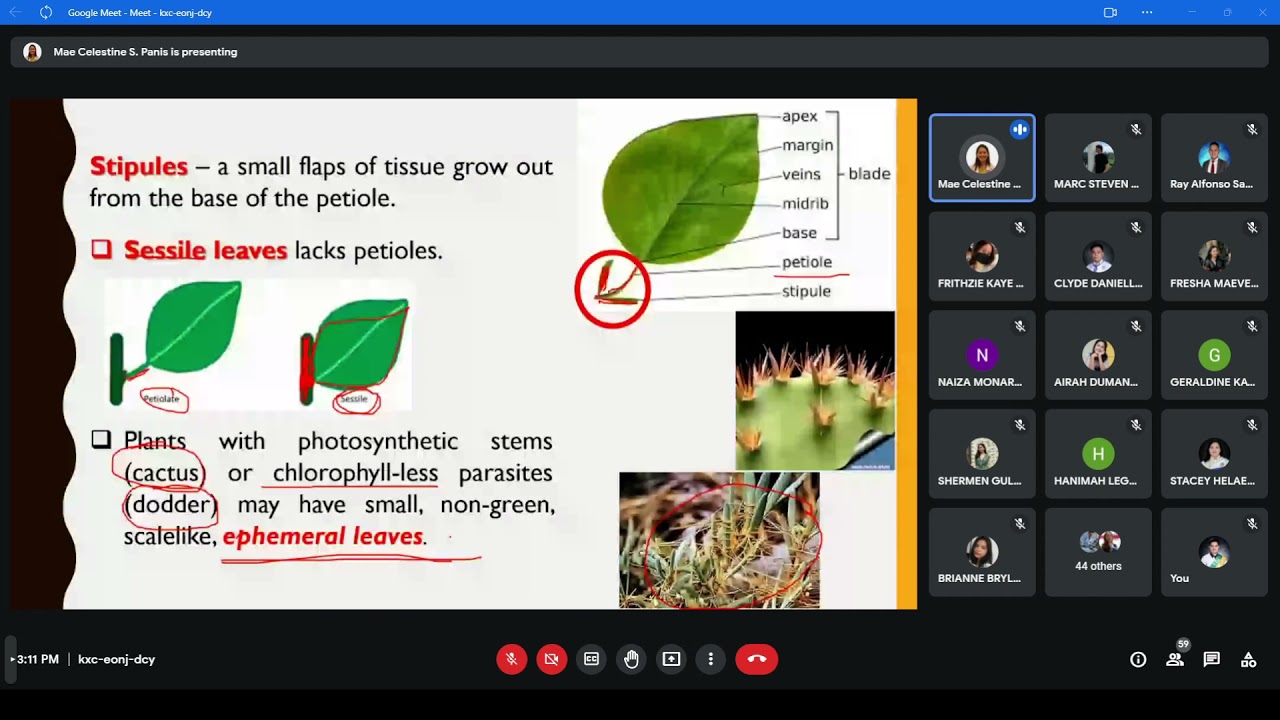
- A typical leaf consists of a petiole (leaf stalk) and a blade (the expanded, flat part).
- Stipules are small, leaf-like appendages found at the base of the petiole in some plants.
- Sessile leaves lack a petiole and attach directly to the stem.
- Ephemeral leaves are short-lived and characteristic of certain plant types.
- Leaf blades vary greatly in size, from fractions of an inch to several feet long.
- Leaf shapes are diverse and can be classified into many categories (e.g., linear, oblong, ovate, elliptical).
- The apex refers to the tip of the leaf blade, which can also vary in form (e.g., acute, obtuse, mucronate).
- Leaf venation refers to the arrangement of vascular tissues (veins) within the blade, crucial for transport.
- Parallel venation: Veins run alongside each other from the base to the tip.
- Net venation: Veins branch and form a network; it can be pinnate (one central midrib with branching veins) or palmate (several main veins radiating from the petiole base).
- Leaf margins are the edges of the blade and can be entire (smooth), toothed (serrate, dentate), or wavy (undulate).
Key takeaways
- Leaves are specialized plant organs designed for photosynthesis and gas exchange, originating from stem nodes.
- The arrangement of leaves on a stem (alternate, opposite, whorled) is a key characteristic for plant identification and affects light capture.
- A typical leaf comprises a petiole and a blade, with stipules sometimes present at the base.
- Leaf size, shape, apex, venation, and margin are diverse features that serve functional and adaptive purposes.
- Understanding leaf morphology is essential for plant identification and appreciating plant adaptations to their environments.
- Parallel venation is common in monocots, while net venation is typical of dicots.
- The external structures of a leaf are interconnected and work together to support the plant's life processes.
Key terms
Test your understanding
- What are the two primary functions of a plant leaf?
- How does the alternate leaf arrangement differ from the opposite arrangement?
- What is the role of the petiole in a typical leaf structure?
- Describe the difference between parallel and net leaf venation.
- Why is it important to study the external structures of leaves?