1:00:55
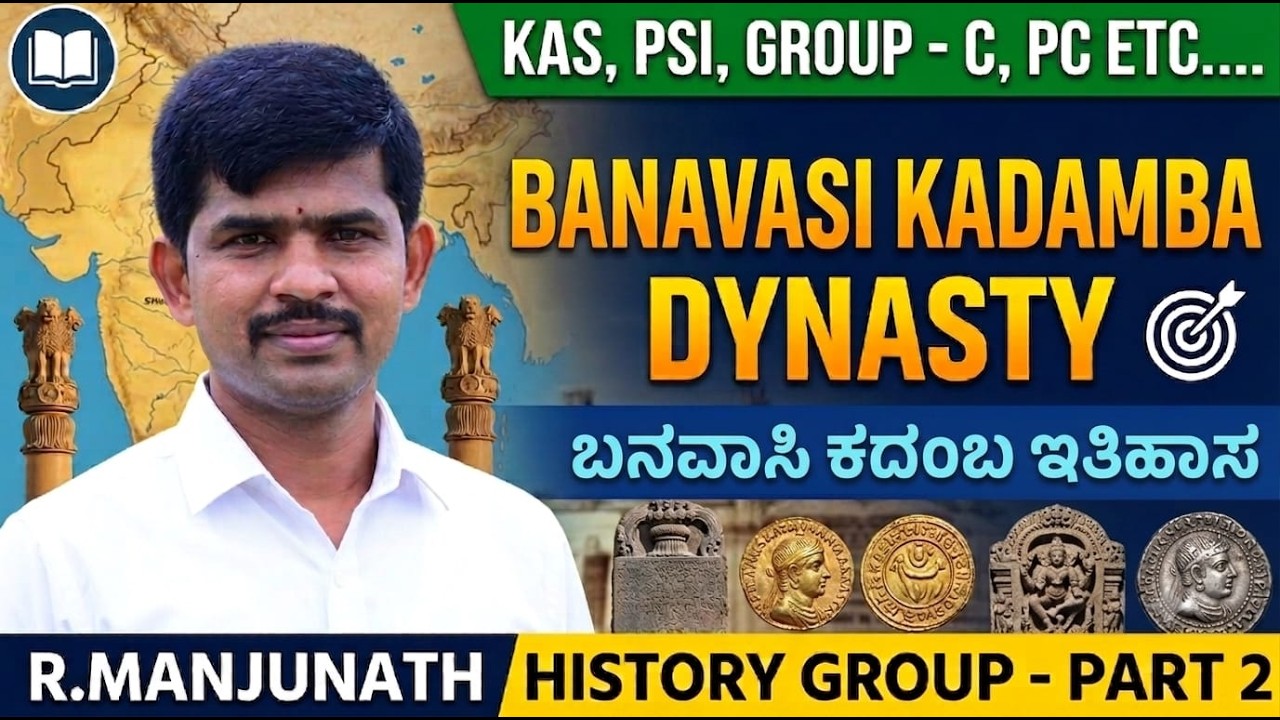
ಕರ್ನಾಟಕ ಇತಿಹಾಸ ಸರಣಿ - 02 ಅಧ್ಯಾಯ - ಕದಂಬರು ( KADAMBA DYNASTY )
R MANJUNATH HISTORY GROUP
Overview
This video delves into the history of the Kadamba dynasty, the first historical kingdom of Karnataka. It covers their origins, significant rulers like Mayura Sharma and Kakutsavarma, their administrative system, contributions to art and architecture, and their eventual decline. The speaker emphasizes the importance of this dynasty in Kannada history and provides detailed information relevant for various competitive exams, particularly for teaching and police recruitment. The video also briefly promotes a geography book authored by Anand Sir, guided by the speaker.
How was this?
Save this permanently with flashcards, quizzes, and AI chat
Chapters
- The Kadamba dynasty is the first historical kingdom of Karnataka, marking a significant milestone in Kannada history.
- The speaker aims to provide free, in-depth history lessons on YouTube for competitive exams.
- This chapter focuses on the Banavasi Kadambas, based on the 'Spardha Itihasa' book.
- The importance of studying Karnataka's history for exams like Police Constable, GPSR, HSTR, and VAO is highlighted.
Understanding the Kadambas is crucial as they represent the foundational historical kingdom of Karnataka, offering insights into the region's early political and cultural landscape.
The speaker mentions that Karnataka history forms a significant part of the syllabus for various state government exams, with at least 6-7 questions expected.
- According to the Devagiri copper inscription of Rashtrakuta King Krishna I, the Kadambas were related to the northern Naga dynasty.
- The Jain tradition suggests Mayura Sharma was the nephew of the Jain founder Jinendranath.
- Tamil texts refer to them as belonging to the Kurumba tribe, but these are considered less reliable.
- The Talagunda inscription states the Kadambas were of Kannada origin, a key point for competitive exams.
Exploring the origins of the Kadambas helps understand their place in the broader historical context of ancient India and their connection to various cultural and dynastic traditions.
The Talagunda inscription is highlighted as the primary source stating the Kadambas' Kannada origin, making it a crucial piece of evidence for exam preparation.
- Mayura Sharma, a Brahmin of the Manyagotra, founded the Kadamba dynasty.
- He received higher education in Kanchipuram under his grandfather, Virasharma.
- An incident involving Pallava king Shivaskandavarma's army led Mayura Sharma to renounce his Brahminhood and become a Kshatriya, adopting the name Mayura Varma.
- He organized a guerilla army with the help of the hill tribes of Srisailam and defeated the Pallavas, reclaiming the Srisailam region.
Mayura Sharma's story illustrates a pivotal moment where personal insult led to the establishment of a major kingdom, showcasing themes of revenge, identity transformation, and military strategy.
The incident where Mayura Sharma, while bathing in the Palar river, was insulted by the Pallava army, leading him to become Mayura Varma, is a key narrative.
- The Gudnapur inscription provides information about Mayura Sharma's ancestors, including his father Bandhusena and grandfather Virasharma.
- The Chandravalli inscription, carved by Mayura Sharma, details his construction of a lake and land grants to Brahmins.
- The Talagunda inscription describes Mayura Sharma's military achievements, including defeating the Pallavas and establishing the kingdom.
- Mayura Sharma is considered the first 'Chakravarti' (Emperor) of Karnataka.
These inscriptions are primary sources that offer direct evidence of the Kadambas' lineage, administrative actions, and military successes, providing invaluable historical data.
The Gudnapur inscription is mentioned as containing details about Mayura Sharma's grandfather, Virasharma, a point specifically asked in KPSC exams.
- Kakutsavarma was a famous Kadamba ruler known for strengthening the dynasty through strategic marriages.
- His daughter Ajita Bhattarika married Narendra Sena of the Vakatakas, and another daughter married a Gupta prince.
- His daughter Lakshmi married Alupa ruler Pashupati, and another daughter married Ganga king Madhava III.
- The Alimidi inscription, dating to Kakutsavarma's reign, is considered the first Kannada inscription and details land grants.
Kakutsavarma's reign highlights the Kadambas' diplomatic prowess and their integration into the larger political network of ancient India through matrimonial alliances.
The Alimidi inscription is presented as the first Kannada inscription, providing crucial linguistic and historical information from Kakutsavarma's era.
- The Kadamba kingdom later split into two branches: Banavasi and Triparvata.
- Mrigeshavarma, who made Palashika (modern Khanapur) his second capital, had the title 'Pralayantaka Paramabrahmana'.
- The Kadambas were eventually defeated and their kingdom absorbed by Pulakeshin II of the Badami Chalukyas.
- The last prominent Kadamba ruler was Krishnavarma II.
The division and eventual fall of the Kadamba dynasty illustrate the cyclical nature of power and the rise and fall of empires due to internal conflicts and external pressures.
The defeat of Krishnavarma II by Pulakeshin II of the Badami Chalukyas is cited as the event that led to the end of the Banavasi Kadamba kingdom.
- The administrative language of the Kadambas was initially Prakrit, later shifting to Sanskrit.
- Rulers used titles like 'Maharaja' and 'Dharma Maharaja', and they consulted elders ('Vriddhopadesha Grahi').
- The kingdom was divided into provinces called 'Mandala' or 'Desha', further subdivided into 'Naadu', 'Vishaya', 'Kampana', and 'Grama'.
- Kadamba temples, characterized by stepped pyramidal towers and square sanctums, are considered the origin of Karnataka's temple architecture.
Understanding their administrative structure, language policies, and cultural contributions reveals the sophistication of the Kadamba society and its lasting impact on Karnataka's identity.
The administrative divisions like Naadu, Vishaya, Kampana, and Grama are presented as a hierarchical system that structured governance.
Key takeaways
- The Kadamba dynasty laid the foundation for Karnataka's historical identity as the first indigenous Kannada kingdom.
- Key inscriptions like Talagunda, Gudnapur, and Chandravalli are vital primary sources for understanding Kadamba history.
- Mayura Sharma's transformation from a Brahmin to a warrior king and his military campaigns against the Pallavas are central to the dynasty's establishment.
- Strategic marriages, as employed by Kakutsavarma, were crucial for consolidating power and forging alliances with major contemporary dynasties.
- The Kadamba period saw significant developments in temple architecture, laying the groundwork for later styles in Karnataka.
- Prakrit and Sanskrit were the administrative languages, reflecting the linguistic influences of the time.
- The eventual decline of the Kadambas was due to internal divisions and the rise of powerful neighboring empires like the Chalukyas of Badami.
Key terms
Kadamba DynastyMayura SharmaKakutsavarmaTalagunda InscriptionChandravalli InscriptionGudnapur InscriptionAlimidi InscriptionPrakritSanskritMaharajaDharma MaharajaMandalaDeshaNaaduVishayaKampanaGramaAgraharaGhatikastanaChalukyas of BadamiPulakeshin II
Test your understanding
- What evidence suggests the Kadamba dynasty's connection to the northern Naga dynasty?
- How did Mayura Sharma establish the Kadamba kingdom after his transformation into Mayura Varma?
- What significant information do the Talagunda and Alimidi inscriptions provide about the early Kadambas?
- Explain the importance of Kakutsavarma's reign in terms of diplomatic relations and dynastic expansion.
- What factors led to the decline of the Kadamba dynasty, and which empire ultimately absorbed them?