39:17
Mid–Term Break — Seamus HEANEY: Detailed Analysis and Video Annotation
Mr. Quakers Teaches
Overview
This video provides a detailed analysis of Seamus Heaney's poem "Mid-Term Break," focusing on its themes, literary devices, and emotional impact. The poem recounts the experience of the speaker returning home from college upon hearing of his younger brother's death in a car accident. The analysis explores Heaney's use of imagery, tone, structure, and language to convey the shock, grief, and awkwardness surrounding death, particularly the death of a child. It highlights the contrast between the title and the poem's somber subject matter, and examines the speaker's detached yet observant perspective amidst the mourning rituals.
How was this?
Save this permanently with flashcards, quizzes, and AI chat
Chapters
- Seamus Heaney, an Irish Nobel laureate, wrote "Mid-Term Break."
- The poem is structured in eight stanzas, with the first seven being tercets (three lines) and the last a single line (monostich).
- It chronicles the speaker's return home and his observations following his brother's accidental death.
- The poem utilizes auditory imagery and creates a sense of suspense before revealing the cause of death.
Understanding the poet's background and the poem's structure provides context for interpreting its themes and emotional resonance.
The poem's structure is noted: seven three-line stanzas followed by a single-line stanza.
- The speaker, feeling unwell or overwhelmed, sits in the college sickbay instead of attending classes.
- The phrase "counting bells kneeling classes" uses alliteration and foreshadows death, as tolling bells traditionally announced death.
- Neighbors drive the speaker home, highlighting a potential inability of his parents to fetch him due to their grief.
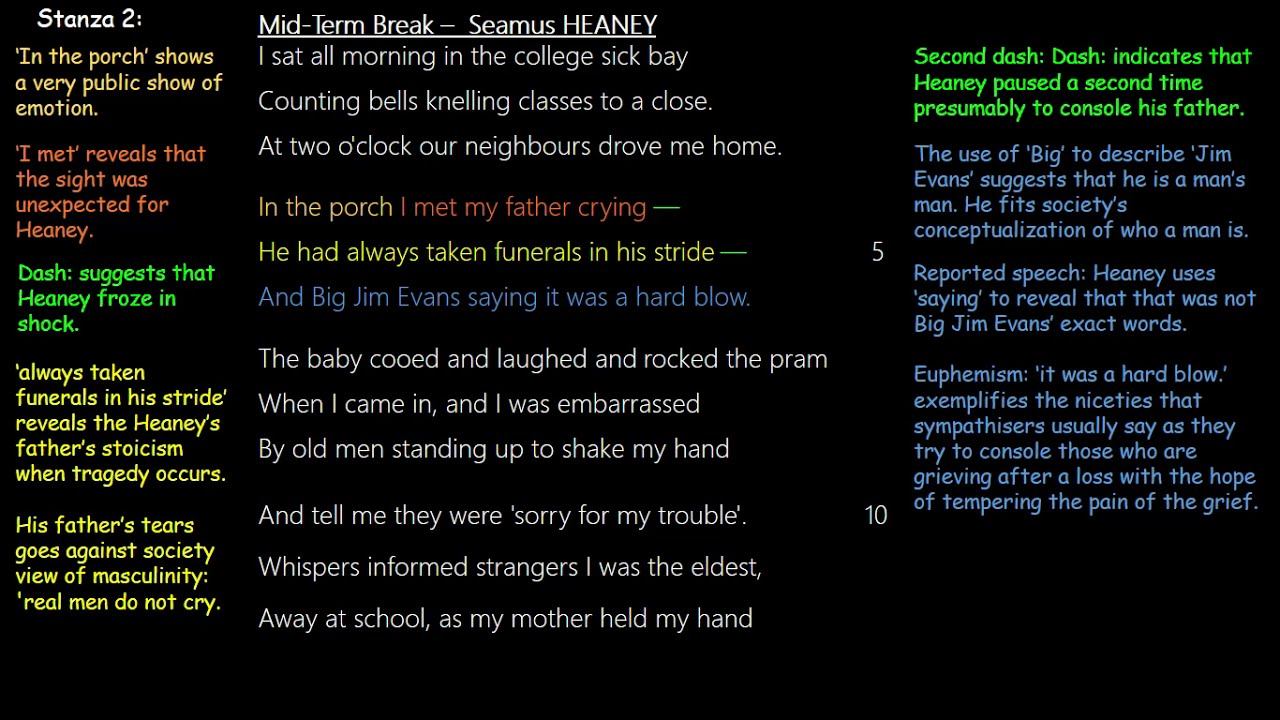
- In the porch, he encounters his father crying, a deeply unexpected and public display of emotion for a man perceived as stoic.
This section establishes the poem's first-person perspective and introduces the initial shock and the disruption of normal expectations surrounding grief.
The speaker's father, usually stoic, is seen crying publicly in the porch.
- Big Jim Evans offers a common, albeit inadequate, platitude: "it was a hard blow."
- The speaker feels embarrassed by older men standing to shake his hand, a reversal of normal social convention during grief.
- Whispers among strangers identify the speaker as the eldest son, perhaps explaining his delayed arrival.
- A baby laughs and rocks its pram, representing innocence and a stark contrast to the surrounding sorrow.
These interactions reveal the awkwardness and societal coping mechanisms surrounding death, contrasting them with the uncomprehending innocence of a child.
A baby is described as laughing and rocking its pram amidst the mourning.
- The speaker's mother holds his hand, symbolizing a protective, almost umbilical connection.
- She expresses grief not through tears but through "angry, deep sighs," suggesting internal suffering and shock.
- The parents' roles appear reversed: the father cries publicly, while the mother internalizes her grief.
- An ambulance arrives at 10 o'clock, bringing the "corpse," "stanched and bandaged," to prepare the body for viewing.
This section deepens the portrayal of grief by showing the mother's internal struggle and the formal, almost clinical, arrival of the deceased's body.
The mother coughs out "angry, deep sighs" instead of weeping.
- The speaker sees his brother for the first time in six weeks, noting the loss of color due to death.
- Snowdrops (symbolizing innocence) and a candle (symbolizing the fleeting nature of life) are bedside.
- The brother has a "puppy bruise" on his temple, indicating the fatal injury from the car accident.
- The description "lay in the forefoot box as in his court" suggests a peaceful, almost voluntary, repose.
This intimate scene focuses on the physical reality of death and the symbolic elements that offer comfort or reflection on the brevity of life.
The speaker observes a "puppy bruise on his left temple" on his deceased brother.
- The poem concludes with a single line, "A four-foot box, a foot for every year."
- This line reveals the brother was four years old, making the "forefoot box" a literal container for his short life.
- The final line acts as a riddle, emphasizing the incomprehensibility and finality of death.
- The poem highlights the theme of life's brevity and the suddenness with which it can end.
The powerful concluding image crystallizes the poem's central tragedy and its reflection on the short, precious nature of human life.
The final line, "A four-foot box, a foot for every year," reveals the deceased brother was four years old.
Key takeaways
- Seamus Heaney uses precise, evocative language and sensory details to capture the complex emotional landscape of grief.
- The poem explores the contrast between outward displays of mourning and internal emotional states.
- Literary devices like foreshadowing, auditory imagery, and symbolism are employed to deepen the poem's impact.
- The title "Mid-Term Break" creates an ironic contrast with the poem's somber subject matter of death.
- The speaker's detached, observational tone reflects a coping mechanism or a state of shock.
- The poem emphasizes the innocence of the deceased child and the profound sense of loss associated with premature death.
- Heaney's structure, particularly the final monostich, serves to deliver a powerful, concluding message about life's brevity.
Key terms
Mid-Term BreakSeamus HeaneyTercetMonostichAuditory ImageryForeshadowingEuphemismSymbolismEnjambmentToneGriefBrevity of Life
Test your understanding
- How does the title "Mid-Term Break" create an ironic contrast with the poem's content?
- What is the significance of the auditory imagery used in the poem, such as tolling bells and sighs?
- How does the speaker's portrayal of his father's and mother's grief differ, and what does this reveal about their emotional responses?
- What is the effect of the poem's structure, particularly the use of tercets and the final monostich?
- How does Heaney use symbolism, like snowdrops and candles, to enhance the poem's themes?