1:36:23
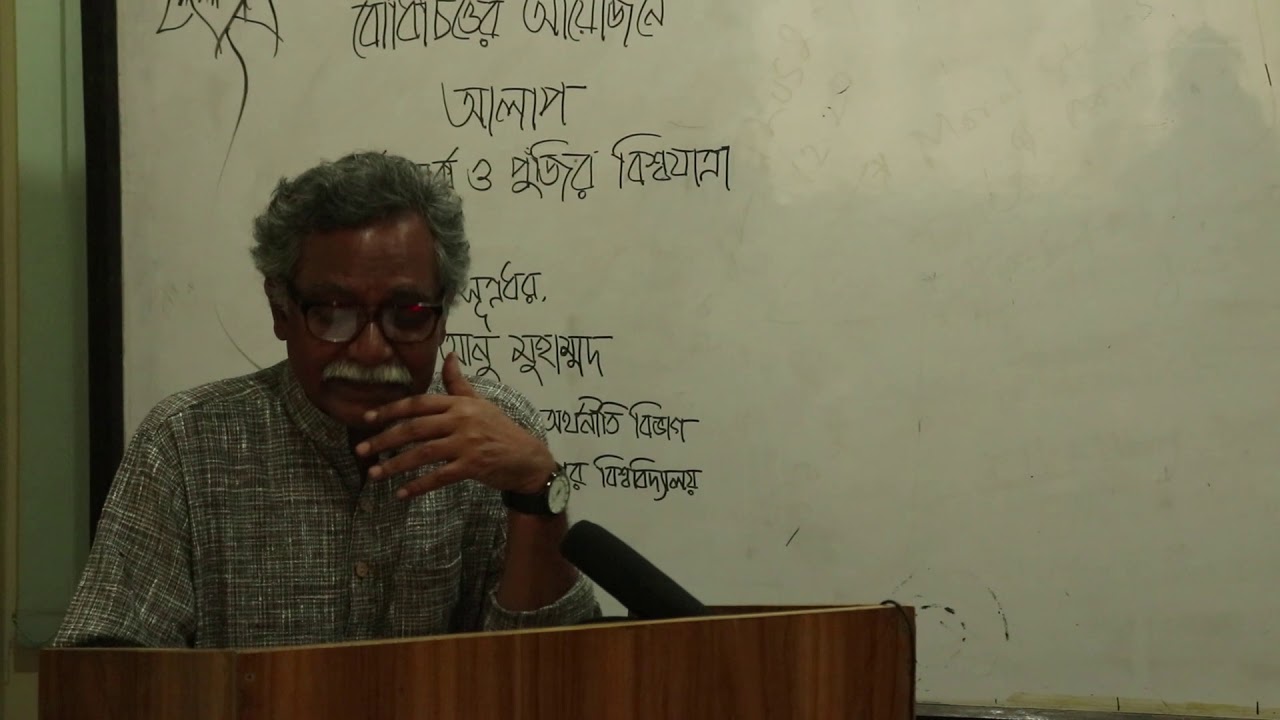
কার্ল মার্ক্স ও পুঁজির বিশ্বযাত্রা ।। আনু মুহাম্মদ ।। বোধিচিত্ত
বোধিচিত্ত
Overview
This video explores the enduring relevance of Karl Marx's theories in understanding global capitalism, particularly in the 21st century. It delves into Marx's critique of capitalism, his analysis of class struggle, and how his ideas on production, exploitation, and technological change continue to resonate. The discussion also touches upon the evolution of capitalism, the role of globalization, and the impact of technology on labor and society, drawing parallels between historical analyses and contemporary issues in countries like Bangladesh and across the global South.
How was this?
Save this permanently with flashcards, quizzes, and AI chat
Chapters
- Karl Marx's ideas have been repeatedly declared dead but continue to be a significant part of our intellectual climate.
- His theories remain relevant because they address fundamental questions about economic systems and social structures.
- Marx's work is inherently multidisciplinary, encompassing economics, philosophy, sociology, and history, making it difficult to analyze one aspect in isolation.
Understanding why Marx's ideas persist despite numerous critiques helps appreciate their foundational impact on social and economic thought.
The speaker notes that while debates about Adam Smith or Ricardo have cooled, discussions about Marx still provoke strong reactions, indicating his continued influence.
- Mainstream economics often operates from an ideological or political position, unlike Marx's critique which aims for a more objective analysis.
- Marx's theory of value, particularly surplus value, is central to understanding capitalist exploitation.
- The concept of surplus value explains how profit is generated through the unpaid labor of workers.
Understanding Marx's critique of economic value and his theory of surplus value is crucial for grasping his analysis of capitalist exploitation.
The speaker explains that profit in capitalism arises from the difference between the value a worker creates and the wage they receive, a concept tied to surplus value.
- Capitalism is characterized by constant revolutionizing of production and social conditions, leading to perpetual uncertainty.
- Technological development is a core driver of capitalist change, constantly disrupting existing structures.
- This dynamic nature distinguishes capitalism from previous epochs, which were more stable.
Recognizing capitalism's inherent drive for constant change and innovation is key to understanding its disruptive and transformative power.
The speaker quotes Marx, stating that capitalism 'uninterruptedly revolutionizes the instruments of production, and thereby the relations of production, and with them all the social relations.'
- Capitalism inherently creates a global system, compelling all nations to adopt its mode of production and 'civilization'.
- This process leads to uneven development, with a global North (center) and a global South (periphery).
- Colonialism and imperialism were crucial stages in the primitive accumulation of capital, fueling capitalist expansion.
Understanding how capitalism expands globally and creates disparities between nations is essential for analyzing contemporary global inequalities.
The speaker mentions the historical role of colonial plunder, like that by the East India Company in Bangladesh, as a source of capital accumulation for the West.
- Modern capitalism leverages technological advancements, such as AI and surveillance, for profit and control.
- The concept of 'primitive accumulation' continues in new forms, including the exploitation of data and digital resources.
- Technological progress, while potentially liberating, is often harnessed by capital to reinforce existing power structures and surveillance mechanisms.
Examining how technology is used within capitalism highlights new forms of exploitation and control, impacting privacy and autonomy.
The speaker discusses how private ownership of technology, like satellite data or media platforms, allows for control and surveillance, turning potential public goods into tools for profit and power.
- Despite its power, capitalism faces inherent contradictions and potential for crisis.
- The pursuit of profit can lead to environmental destruction and social instability.
- Alternative models, inspired by socialist ideas, continue to be explored for more equitable and sustainable futures.
Considering the critiques and potential alternatives to capitalism is vital for envisioning different societal and economic pathways.
The speaker references the historical attempts at socialist revolutions and the ongoing debate about welfare states (like in Scandinavia) as examples of challenges and alternatives to pure capitalist models.
Key takeaways
- Karl Marx's theories remain highly relevant for analyzing the dynamics and contradictions of global capitalism.
- Capitalism's inherent drive for constant change, fueled by technological innovation, leads to perpetual social and economic disruption.
- The generation of profit in capitalism is fundamentally linked to the concept of surplus value, derived from labor.
- Globalization under capitalism creates uneven development and new forms of dependency between the global North and South.
- Technology, while offering potential benefits, is often co-opted by capital for increased control, surveillance, and profit maximization.
- Understanding historical processes like primitive accumulation is key to grasping the origins of capitalist wealth and global inequality.
- The critique of capitalism extends beyond economics to encompass its social, political, and environmental impacts.
Key terms
CapitalismSurplus ValueClass StruggleMode of ProductionPrimitive AccumulationGlobalizationUneven DevelopmentBourgeoisieProletariatExploitation
Test your understanding
- How does Karl Marx's concept of surplus value explain the generation of profit in a capitalist system?
- In what ways does capitalism's inherent drive for technological change lead to social disruption and uncertainty?
- What is meant by 'uneven development' in the context of global capitalism, and how does it relate to historical imperialism?
- How are modern technologies like AI and surveillance being utilized within capitalism according to the video?
- What are some of the fundamental contradictions within capitalism that Marx identified, and how might they lead to future crises?