10:59
Linear transformations and matrices | Chapter 3, Essence of linear algebra
3Blue1Brown
Overview
This video explains the concept of linear transformations in two dimensions and their connection to matrices. It emphasizes visualizing transformations as the movement of space, where lines remain lines and the origin is fixed. The core idea is that any linear transformation can be fully described by where the basis vectors (i-hat and j-hat) land. This understanding provides an intuitive way to grasp matrix-vector multiplication as a linear combination of these transformed basis vectors, rather than relying on memorization.
How was this?
Save this permanently with flashcards, quizzes, and AI chat
Chapters
- A transformation is a function that maps input vectors to output vectors.
- Visualizing transformations involves imagining how every point in space moves.
- Representing vectors as points simplifies visualization compared to arrows.
- Transformations can be understood by observing how an infinite grid of points morphs.
This chapter introduces the fundamental concept of transformations as functions and provides a visual intuition for how they operate on space, setting the stage for understanding their properties.
Imagining every point on an infinite grid moving to a new position as the transformation is applied.
- Linear transformations are a special class of transformations with specific properties.
- Property 1: All lines must remain lines (no curvature).
- Property 2: The origin must remain fixed.
- Linear transformations preserve the property that grid lines remain parallel and evenly spaced.
Understanding these two key properties is crucial for identifying and working with linear transformations, distinguishing them from more complex, non-linear distortions of space.
A transformation that curves lines or moves the origin is not linear, whereas one that keeps lines straight and the origin fixed is.
- A 2D linear transformation is completely determined by where the two basis vectors, i-hat and j-hat, land.
- Any vector can be expressed as a linear combination of i-hat and j-hat.
- The output vector is the same linear combination of where i-hat and j-hat landed.
- This principle allows us to predict where any vector will land without observing the entire transformation.
This insight provides a powerful shortcut for understanding and calculating the effect of any linear transformation, reducing the problem to tracking just two vectors.
If i-hat lands at (1, -2) and j-hat lands at (3, 0), a vector v = -1*i-hat + 2*j-hat will land at -1*(1, -2) + 2*(3, 0) = (5, 2).
- A 2x2 matrix can represent a 2D linear transformation.
- The columns of the matrix correspond to the coordinates where the basis vectors i-hat and j-hat land.
- Matrix-vector multiplication calculates where a vector lands under the transformation.
- This multiplication is equivalent to forming a linear combination of the matrix's column vectors, scaled by the input vector's components.
This chapter bridges the abstract concept of linear transformations with the concrete representation of matrices, showing how matrices encode geometric transformations and how multiplication performs them.
A matrix with columns (a, c) and (b, d) represents a transformation where i-hat lands at (a, c) and j-hat lands at (b, d). Applying this to vector (x, y) results in x*(a, c) + y*(b, d) = (ax + by, cx + dy).
- A 90-degree counterclockwise rotation is represented by a matrix with columns (0, 1) and (-1, 0).
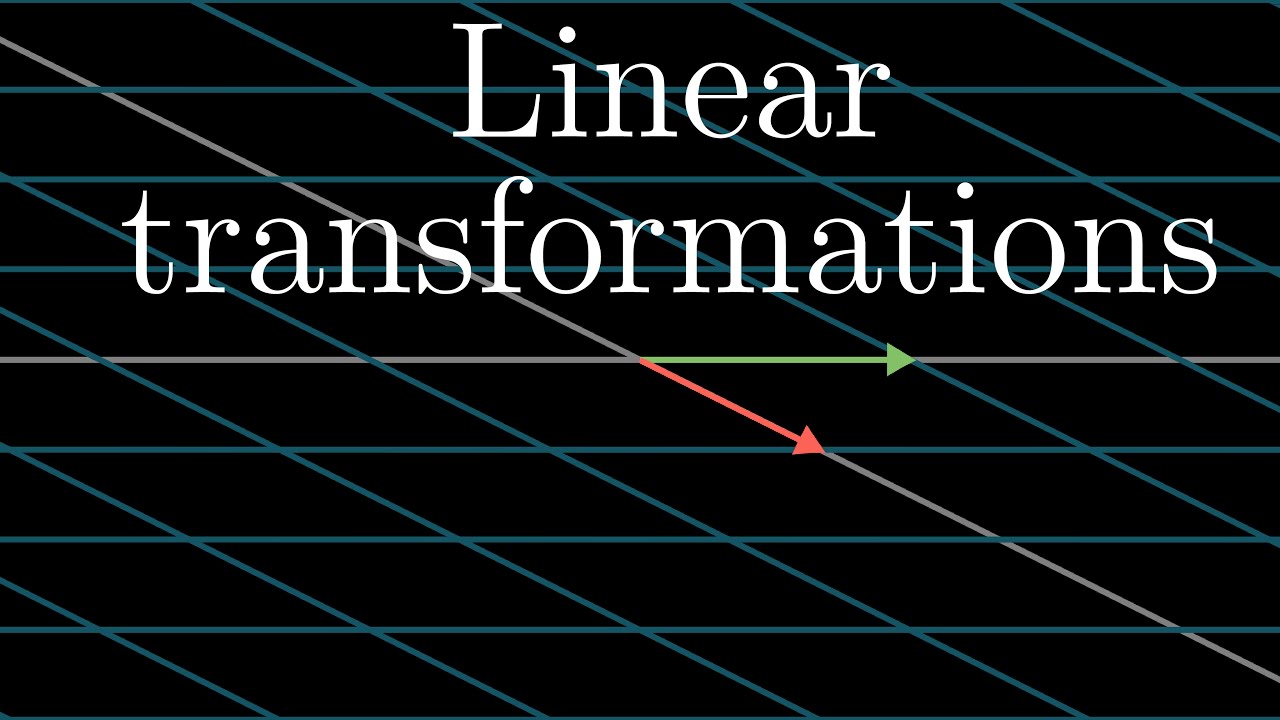
- A shear transformation, where i-hat is fixed and j-hat moves, is represented by a matrix like (1, 0) and (1, 1).
- If the transformed basis vectors are linearly dependent, the transformation collapses space onto a line.
- Viewing matrices as transformations provides a deep understanding for future linear algebra topics.
These examples solidify the connection between specific geometric operations and their matrix representations, demonstrating the practical application of the concepts learned.
A shear transformation where i-hat stays at (1,0) and j-hat moves to (1,1) is represented by the matrix [[1, 1], [0, 1]].
Key takeaways
- Linear transformations are functions that distort space while preserving lines and the origin.
- The effect of any 2D linear transformation is fully determined by where the basis vectors i-hat and j-hat are mapped.
- Matrices provide a numerical representation of linear transformations, with columns indicating the destination of basis vectors.
- Matrix-vector multiplication intuitively represents combining the transformed basis vectors according to the input vector's components.
- Understanding matrices as transformations is key to deeply grasping linear algebra concepts.
- Visualizing transformations as the movement of an entire grid helps build intuition.
Key terms
Linear transformationFunctionVectorBasis vectors (i-hat, j-hat)Linear combinationMatrixMatrix-vector multiplicationOriginGrid linesShear transformation
Test your understanding
- What are the two defining visual properties of a linear transformation?
- Why is it sufficient to know where the basis vectors i-hat and j-hat land to describe a 2D linear transformation?
- How does the concept of a linear combination relate to applying a transformation to a vector?
- What does each column of a 2x2 matrix represent in the context of linear transformations?
- How can you intuitively interpret matrix-vector multiplication as a geometric transformation?