WR offensive overview video #1
Demarion Cobb
Overview
This video introduces fundamental concepts for the WR offense, starting with field terminology like end zones, numbers, and hashes, and distinguishing between the field and boundary sides. It then outlines the team's core culture and offensive standards, emphasizing ownership, teamwork (we/me), knowing assignments, and finishing plays. The offensive philosophy centers on a physical, downhill run game complemented by RPOs and tempo to stress the defense. The system, 'Feed the Cats,' aims to get playmakers the ball in space by utilizing formations, motions, and personnel groupings. Procedures like tempo, signaling, wristbands, huddles, and check-with-me plays are explained as tools to manage game flow and exploit defensive weaknesses. Finally, it details personnel groupings (Green, Blue, Black), receiver positions (X, Z, F), and the roles of the Tight End (Y) and Running Back (T), concluding with an overview of cadence and pre-snap communication.
Save this permanently with flashcards, quizzes, and AI chat
Chapters
- Understand key field markers: back and front of the end zone, top and bottom of the numbers (10-yard line), and hashes.
- Differentiate between the 'field' side (more space) and the 'boundary' side (less space) of the field.
- Recognize that 'inside the hash' refers to the area between the hash marks, and 'outside the hash' is further away.
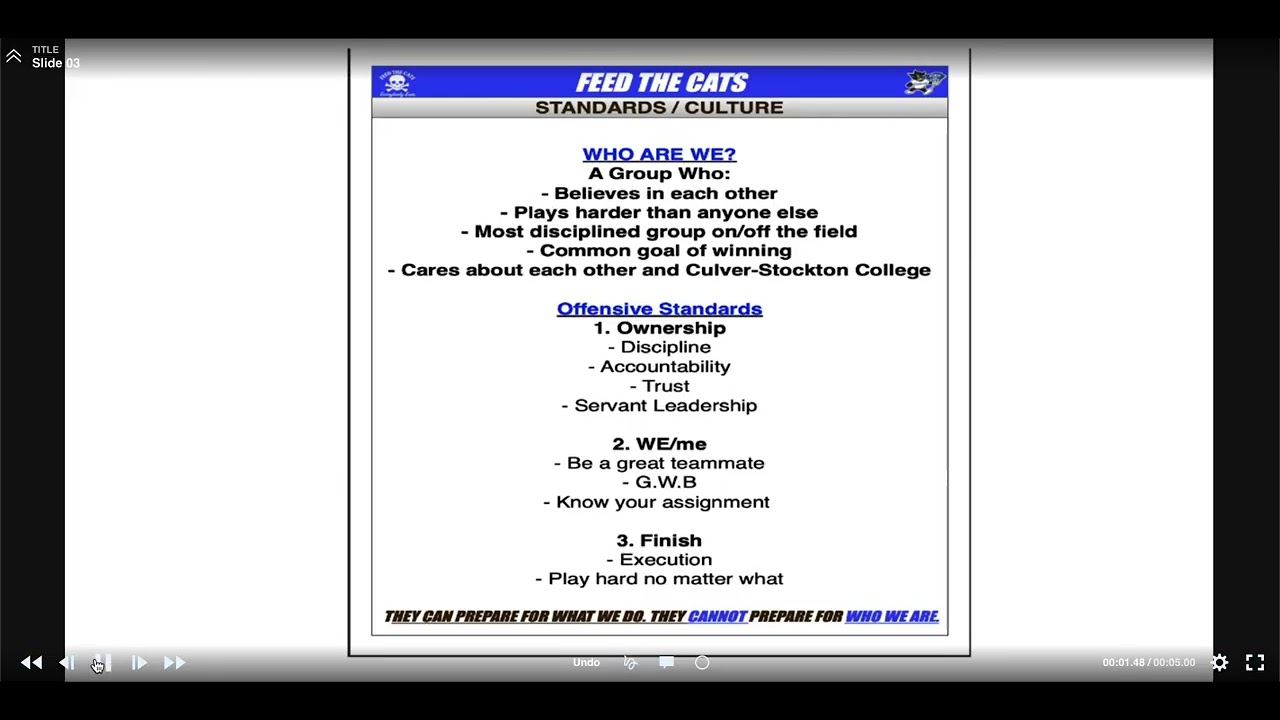
- The offensive culture is built on five pillars: belief in each other, playing hard, discipline, a common goal of winning, and mutual care.
- Offensive standards include Ownership (discipline, accountability, trust), We/Me (teamwork, performing without the ball), Knowing Your Assignment (execution and responsibility), and Finish (playing hard until the clock runs out).
- Accountability extends to coaches, who must provide players with the resources to understand plays and perform well.
- The offense aims to be physical and run downhill, using RPOs (Run-Pass Options) and tempo to create advantages and force the defense to cover the entire field.
- The 'Feed the Cats' system focuses on getting playmakers the ball in space by putting them in optimal positions.
- The principle of 'more ways, not more plays' means using different formations, motions, and personnel to present the same core concepts in varied ways to confuse defenses.
- Tempo is managed through various procedures: 'one words' for fast play calls (e.g., Pittsburgh, Denver), signalers for communicating personnel and plays, and wristbands for longer, more complex plays.
- Huddles are primarily used after timeouts to slow the game down and ensure clarity, while 'check-with-me' plays allow the quarterback to confirm or change a play based on sideline signals.
- The offense operates as a 'field and boundary' team, with play calls and formations oriented towards these sides of the field.
- Huddles involve specific player alignments, with the quarterback calling the play and players clapping and sprinting to the ball within 4 seconds.
- Signalers communicate personnel, shifts, motions, and plays, using color-coded shirts and dummy signalers to make signals harder to decipher.
- Cadence includes a base clap where the ball is snapped on the ball's movement, 'ready' calls (days of the week) for a set snap, and 'check' plays initiated by energy drink names to adjust based on defensive alignment.
- Key personnel groupings are Green (10 personnel: 1 RB, 4 WR), Blue (11 personnel: 1 RB, 1 TE, 3 WR), and Black (12 personnel: 1 RB, 2 TE, 2 WR).
- Receiver positions are defined by field location: Z is the outside receiver on the field side, X is the outside receiver on the boundary side.
- The F (slot receiver/H-back) is a formation adjuster, and the Y is the tight end whose alignment varies. T represents the running back.
- Players use letters (Z, X, F, Y, T) to identify their positions, with alignment often determined by the play call and formation.
Key takeaways
- Mastering field terminology is the first step to effective communication and execution on the offensive side of the ball.
- A strong offensive culture built on discipline, accountability, and teamwork is as important as executing plays.
- The offense's philosophy combines physical running with RPOs and tempo to create a versatile and unpredictable attack.
- 'More ways, not more plays' emphasizes creativity in formations and motions to run the same concepts effectively against different defenses.
- Tempo control procedures allow the offense to dictate the game's pace and exploit defensive vulnerabilities.
- Understanding personnel groupings and player roles is critical for recognizing formations and executing assignments.
- Clear communication, whether through signals, huddles, or cadence, is vital for playing fast and free.
Key terms
Test your understanding
- What are the five core components of the offensive culture, and why are they important?
- How does the offense use 'more ways, not more plays' to create strategic advantages?
- Explain the difference between the 'field' and 'boundary' sides of the football and how it impacts play calling.
- What are the key personnel groupings (Green, Blue, Black), and what do they signify in terms of player alignment?
- Describe the purpose of different offensive procedures like tempo, signaling, and huddles.