ASIAN REGIONALISM
Ayan Dolatre
Overview
This video explores the concept of Asian regionalism, distinguishing it from global governance. It defines Asia as a diverse continent and introduces regionalism as a means for geographically proximate countries with shared goals to cooperate. The video examines the complexities of Asia's geography, history, and diverse development paths, highlighting key examples like China, Japan, and Singapore. It emphasizes the significance of Asia due to its large population, economic power, and the role of organizations like ASEAN and ASEAN+3 in fostering security, economic, and sociocultural cooperation. The discussion also touches upon regionalization (natural connections) versus regionalism (deliberate cooperation) and factors driving integration, such as market needs, development assistance, and production networks.
Save this permanently with flashcards, quizzes, and AI chat
Chapters
- Asia is a vast continent with diverse cultures, languages, and political systems, making it a complex region.
- Regionalism is the process by which countries in a specific geographic area cooperate, even with their differences.
- The term 'Asia' originated from Greek usage to describe lands to their east, highlighting its historical and evolving geographical definition.
- Understanding Asia's diversity is crucial for grasping the challenges and opportunities of Asian regionalism.
- Russia is a transcontinental country with significant territory in Asia, making it part of the Asian continent.
- The Middle East is a geographical and cultural region largely situated in Western Asia, with countries like Lebanon being both Middle Eastern and Asian.
- Timor-Leste (East Timor) is one of Asia's youngest independent states, gaining independence in 2002.
- Historically, Japan was an imperial power that colonized parts of Asia, including Korea and Taiwan, demonstrating a history of conflict and colonization within the region.
- Asian countries exhibit varied development paths, with no single formula for success.
- Large economies like China leverage their massive populations and industrial power, while technologically advanced nations like Japan focus on innovation and manufacturing.
- Smaller nations like Singapore achieve economic importance through strategic locations for trade and shipping.
- A country's size does not automatically determine its success; development is multifaceted and unique to each nation's context.
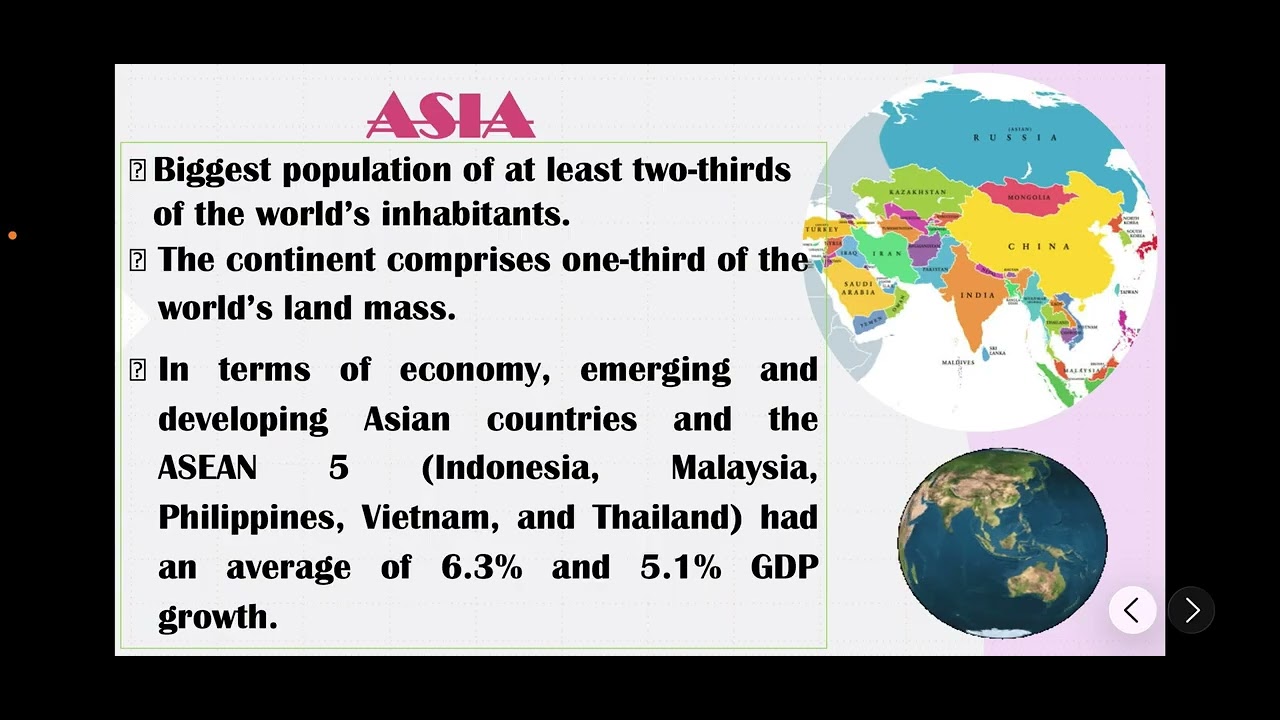
- Asia's immense population and land area make it a critical player in globalization, influencing global markets and consumption.
- The region's strong economies and manufacturing centers contribute significantly to global trade and production.
- The Asian 5 (Indonesia, Malaysia, Philippines, Vietnam, Thailand) are important for their rapid economic growth and contributions to regional trade and investment.
- China's role as the world's leading exporter significantly impacts global supply chains and economies due to its interconnectedness with other nations.
- Regionalization refers to the increasing societal integration and interaction within a region, driven by trade, migration, and cultural exchange.
- Regionalism, in contrast, is the deliberate, organized cooperation and collaboration between countries in a region.
- ASEAN (Association of Southeast Asian Nations) is a prime example of regionalism, comprising Southeast Asian countries working together.
- ASEAN operates on three pillars: security, economic, and sociocultural community, aiming for collective stability, prosperity, and societal ties.
- Integration is often market-driven, fueled by economic needs and opportunities that compel countries to interact and trade.
- Institutions like the Asian Development Bank (ADB) and Japan International Cooperation Agency (JICA) provide financial and technical assistance to promote development and stability.
- Expanding production networks, based on a regional division of labor and comparative advantage, connect economies as countries specialize in different stages of production.
- Financial cooperation, such as the Chiang Mai Initiative and Asian Bond Markets Initiative, is crucial for managing financial crises and ensuring regional economic stability.
- ASEAN Plus Three includes China, Japan, and South Korea, expanding cooperation beyond Southeast Asia to East Asia.
- This partnership focuses on human resources development, inclusive growth, and sustainable development goals.
- Other regional organizations like NAFTA (now USMCA) in North America and the European Union in Europe serve as models for regional integration.
- While models like the EU show the potential for deep integration, Asian regionalism must adapt to its unique historical, cultural, and economic contexts.
Key takeaways
- Asia is a continent defined by immense diversity in culture, politics, and economic development, making regional cooperation a complex but vital endeavor.
- Regionalism is the deliberate cooperation among nations in a geographic area, distinct from regionalization, which describes natural connections.
- Organizations like ASEAN are crucial for fostering security, economic prosperity, and sociocultural ties within Southeast Asia.
- Asia's large population and economic power make it a significant force in the global economy, influencing international trade and development.
- Factors such as market demands, development assistance, and specialized production networks drive deeper integration among Asian countries.
- Cooperation extends beyond individual nations, with initiatives like ASEAN Plus Three involving major East Asian economies to address shared challenges and opportunities.
- While regional models exist globally, Asian regionalism must evolve according to its unique historical and cultural context.
Key terms
Test your understanding
- What is the difference between regionalization and regionalism, and how do they apply to Asia?
- How does the diversity of Asian countries, in terms of development, culture, and history, present both challenges and opportunities for regionalism?
- What are the three main pillars of cooperation within ASEAN, and why are they important for regional stability and prosperity?
- How do factors like market-driven needs, development assistance, and interconnected production networks contribute to greater integration in the Asian region?
- Why is China's role as a major exporter significant for Asian regionalism and the global economy?