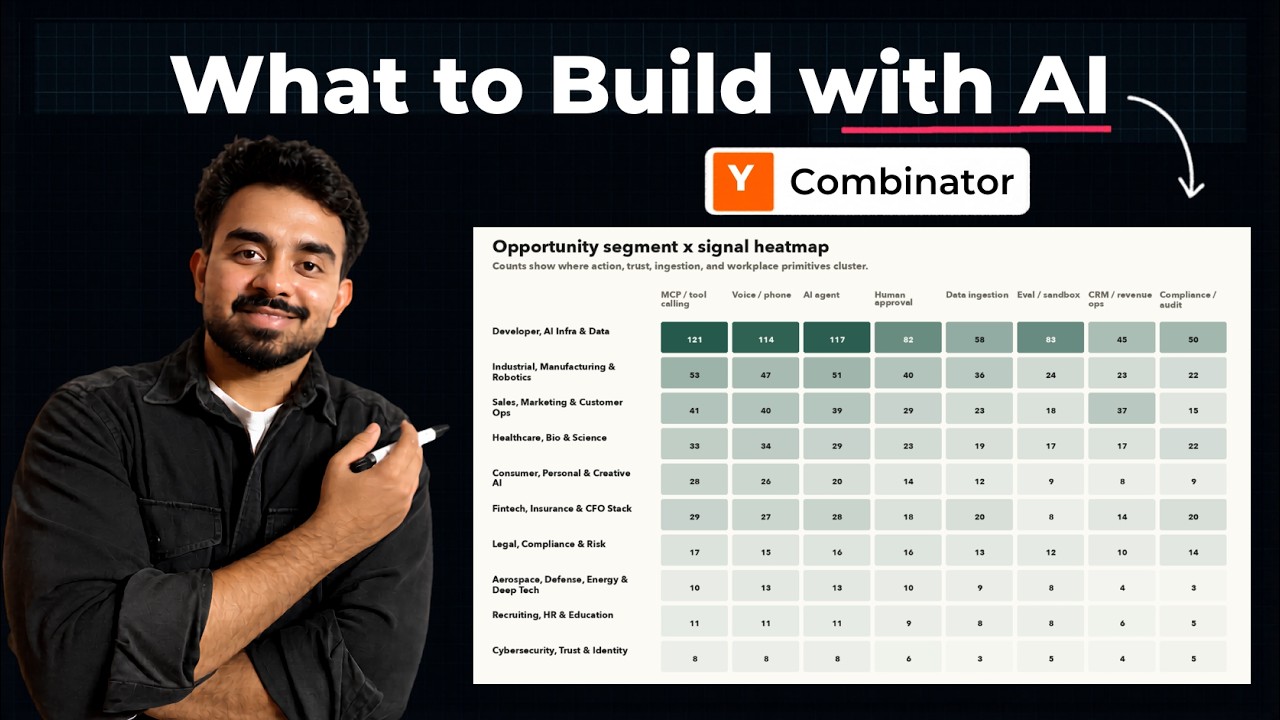
I analyzed 373 AI startups selected by Y Combinator in 2026 (Build these with AI)
Harshit Tyagi
Overview
This video analyzes 373 AI startups selected by Y Combinator in 2026 to identify trends and opportunities for builders. The analysis reveals that AI is now the default, with the real differentiator being ownership of specific, repeatable workflows. The strongest companies are moving beyond simple chatbots to build agentic operating systems that can ingest data, make decisions, take actions within other tools, and maintain audit trails. The video highlights key segments like developer infrastructure, industrial manufacturing, and sales/operations, emphasizing the shift from AI as a feature to AI as a core workflow owner. It also discusses the emerging need for trust layers, security guardrails, and specialized agents that enable small teams to manage complex operations.
Save this permanently with flashcards, quizzes, and AI chat
Chapters
- AI is no longer a unique selling proposition; it's the default for startups.
- The true differentiator for successful AI startups is ownership of a real, repeatable workflow.
- Most selected startups (92.5%) are B2B, focusing on business solutions rather than consumer 'toys'.
- Developer AI Infrastructure and Data is the largest segment, followed by Industrial Manufacturing and Sales/Marketing/Operations.
- The strongest AI companies are building 'agentic operating systems' that go beyond generating text.
- These systems ingest messy data, make decisions, take actions in other tools, and log all changes for human trust.
- The shift is from AI *generation* to AI *doing* – completing tasks and closing full loops.
- Companies that complete work and get tasks done for users command higher value.
- As AI agents take actions, new risks emerge, moving beyond annoyance to potential financial loss and trust erosion.
- A new layer of security and trust is required, including permissions, approvals, audit logs, sandboxing, and rollback capabilities.
- Companies are building specialized products to provide these guardrails for AI agents.
- Trust and traceability are paramount in sensitive domains like legal, finance, and healthcare, becoming the core value proposition.
- Coding agents have evolved from writing code to managing the entire software development lifecycle, including testing and deployment.
- Vertical SaaS companies are emerging that are essentially agentic operating systems for specific industries, owning critical workflows.
- These systems integrate deeply, managing data, decisions, approvals, and updates within their domain.
- The 'one-person business' model is enabled by specialized AI agents handling tasks like research, support, and billing.
- Avoid building shallow tools like generic co-pilots, thin chatbots, or novelty content generators.
- Focus on identifying and owning a deep, painful workflow within a specific niche.
- The recommended strategy is to start as a service, then productize the repeatable workflow.
- Success hinges on solving a real problem with an AI-powered system that manages a complete operational loop.
Key takeaways
- AI is the default; workflow ownership is the key differentiator for startups.
- The future of AI lies in agentic operating systems that actively perform tasks, not just generate information.
- Building trust, safety, and auditability into AI systems is crucial for adoption, especially in critical applications.
- Specialized AI agents can enable small teams to manage complex operations and compete in large markets.
- Focus on solving deep, painful workflows in specific niches rather than building generic AI tools.
- The 'service-to-product' model is a viable path for AI startups to gain traction and refine their offerings.
- AI is moving beyond software into physical operations like manufacturing and logistics.
Key terms
Test your understanding
- What is the primary differentiator for AI startups beyond simply using AI technology?
- How do agentic operating systems differ from traditional AI chatbots or features?
- Why is a 'trust layer' becoming increasingly important for AI applications?
- What is the recommended approach for founders looking to build a successful AI startup, according to the analysis?
- How is AI impacting industries beyond software, such as manufacturing and logistics?