27:42
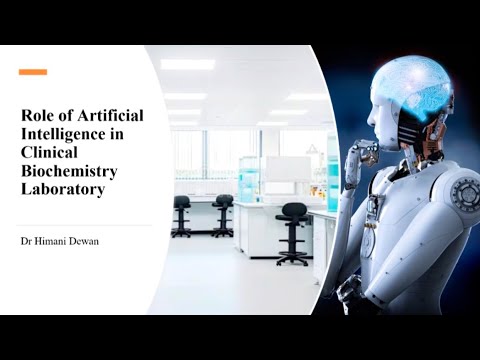
Role of Artificial Intelligence in Clinical Biochemistry Laboratory
Dr Himani Dewan
Overview
This video explores the transformative role of Artificial Intelligence (AI) in clinical biochemistry laboratories. It details how AI enhances efficiency, accuracy, and diagnostic capabilities through automation, advanced data analysis, and predictive modeling. The discussion covers AI's application in quality control, workflow optimization, point-of-care testing, and laboratory training, while also addressing the significant challenges, ethical considerations, and future directions for AI integration in this field. The ultimate goal is to create smarter, more adaptive, and reliable laboratory ecosystems.
How was this?
Save this permanently with flashcards, quizzes, and AI chat
Chapters
- AI integrates computer algorithms and machine learning to analyze complex biochemical data.
- It automates repetitive tasks and assists in clinical decision-making.
- AI enhances efficiency, accuracy, and diagnostic capabilities in labs.
Understanding the fundamental role of AI sets the stage for appreciating its specific applications and benefits in improving laboratory operations and patient care.
AI analyzes complex biochemical data and automates repetitive tasks.
- AI-controlled robotics automate pre-analytical steps like sample sorting, centrifugation, and reagent dispensing.
- AI embedded in analyzers performs real-time calibration, predicts reagent needs, flags errors, and enables predictive maintenance.
- AI optimizes workflow by scheduling tests, allocating resources, predicting turnaround times, and routing samples efficiently.
Automating routine tasks and optimizing workflow reduces human error, increases throughput, and speeds up reporting, leading to more efficient laboratory operations and better patient outcomes.
AI-controlled robotic systems automatically sort samples based on test requirements and precisely dispense reagents.
- AI detects subtle patterns and associations in biochemical data to identify disease-specific signatures, enabling early diagnosis.
- It integrates biochemical data with clinical records, genomics, and imaging for comprehensive patient profiling and precision diagnostics.
- AI algorithms detect anomalies and outliers in real-time data, reducing false results and triggering timely reviews.
- AI tracks biochemical changes over time for monitoring chronic diseases, treatment response, and relapse prediction.
Moving beyond simple result reporting, AI's analytical power allows for deeper insights, earlier disease detection, and more personalized treatment strategies.
A model may detect early-stage non-alcoholic fatty liver disease using mild elevations in ALT and altered triglycerides, which might be missed by standard criteria.
- AI-powered Clinical Decision Support Systems (CDSS) interpret biochemical data in clinical context, suggesting potential diagnoses.
- AI models predict disease risk (e.g., diabetes, cardiovascular disease) based on biochemical and demographic data.
- AI monitors disease progression and treatment response, enabling timely therapy adjustments.
- AI predicts patient outcomes, such as survival rates or risk of ICU admission.
AI acts as a powerful assistant to clinicians, improving diagnostic accuracy, enabling preventive medicine, and guiding treatment decisions for better patient management.
Elevated troponin and CK-MB levels, correlated with clinical symptoms, might suggest a cardiac event, prompting further investigation.
- AI enables real-time quality monitoring, internal quality control analysis, and comparison with external assessments.
- Predictive maintenance alerts technicians to potential instrument failures before they occur, minimizing downtime.
- AI integrates with IoT for remote monitoring of equipment and reagent status, and with big data analytics for population health studies.
- AI enhances data security through blockchain and facilitates integration with digital pathology and omics platforms for multi-dimensional diagnostics.
AI strengthens laboratory reliability and expands its capabilities by ensuring quality control, leveraging new technologies, and integrating diverse data sources for a holistic view of health.
A sudden rise in control standard deviation for serum creatinine alerts the system, prompting recalibration before patient testing proceeds.
- Smart point-of-care devices with embedded AI provide instant results and clinical recommendations at the bedside.
- AI creates virtual laboratories and interactive simulations for training students and technicians in a safe digital environment.
- AI integration builds smart, self-monitoring, and adaptive lab ecosystems.
Extending AI's reach to point-of-care settings and training environments improves accessibility of diagnostics and enhances the skills of laboratory professionals.
Smart CT devices with embedded AI can provide instant interpretation of biochemical results at the bedside, recommending clinical actions.
- AI performance is heavily reliant on data quality, and biases in training data can lead to inequitable outcomes.
- The 'black box' nature of some AI models poses challenges for interpretation, trust, and regulatory approval.
- Technical infrastructure, cost, data privacy, and security are significant barriers, especially in resource-limited settings.
- Ethical dilemmas arise regarding accountability for misdiagnosis, AI's role in clinical judgment, and potential deskilling of professionals.
Addressing these challenges proactively is crucial for the responsible and effective implementation of AI, ensuring patient safety, equity, and trust in diagnostic processes.
An AI model may misclassify disease risk if trained predominantly on data from urban or Western populations, reinforcing existing health disparities.
- The future involves multi-disciplinary collaboration for ethical AI development, focusing on transparency, accountability, and patient-centered design.
- Regular audits of AI systems for performance, bias, and errors are essential.
- Training lab personnel to understand and monitor AI tools is vital for effective integration.
- AI should serve as a decision support tool, augmenting rather than replacing human intuition, experience, and ethical judgment.
A collaborative and ethical approach will ensure AI transforms clinical biochemistry labs into advanced, reliable, and human-centric diagnostic centers.
AI provides speed and accuracy in routine data analysis, but cannot replace human intuition, experience, and ethical judgment.
Key takeaways
- AI significantly enhances laboratory efficiency and accuracy by automating tasks and optimizing workflows.
- AI's advanced data analysis capabilities enable earlier disease detection and more personalized treatment plans.
- Predictive analytics powered by AI can forecast disease risk, monitor progression, and guide clinical decision-making.
- Integrating AI with emerging technologies like IoT and blockchain creates smarter, more secure, and interconnected laboratory systems.
- Addressing data quality, algorithmic bias, and ethical concerns is paramount for the responsible deployment of AI in diagnostics.
- AI should augment, not replace, human expertise, emphasizing collaboration between AI systems and healthcare professionals.
- The future of clinical biochemistry labs lies in becoming adaptive, self-monitoring digital centers driven by AI.
Key terms
Artificial Intelligence (AI)Machine LearningAutomationRoboticsWorkflow OptimizationData AnalysisPredictive AnalyticsClinical Decision Support System (CDSS)Quality Control (QC)Internet of Things (IoT)Big Data AnalyticsCloud ComputingBlockchainExplainable AI (XAI)Algorithmic Bias
Test your understanding
- How does AI contribute to the automation of pre-analytical steps in a clinical biochemistry laboratory?
- What are the key benefits of using AI for advanced data analysis in interpreting biochemical profiles?
- Explain how AI-powered Clinical Decision Support Systems (CDSS) assist clinicians in diagnosing complex disorders.
- What are the primary challenges and ethical considerations associated with integrating AI into clinical biochemistry laboratories?
- How can AI be used to improve quality assurance and ensure the reliability of laboratory results?