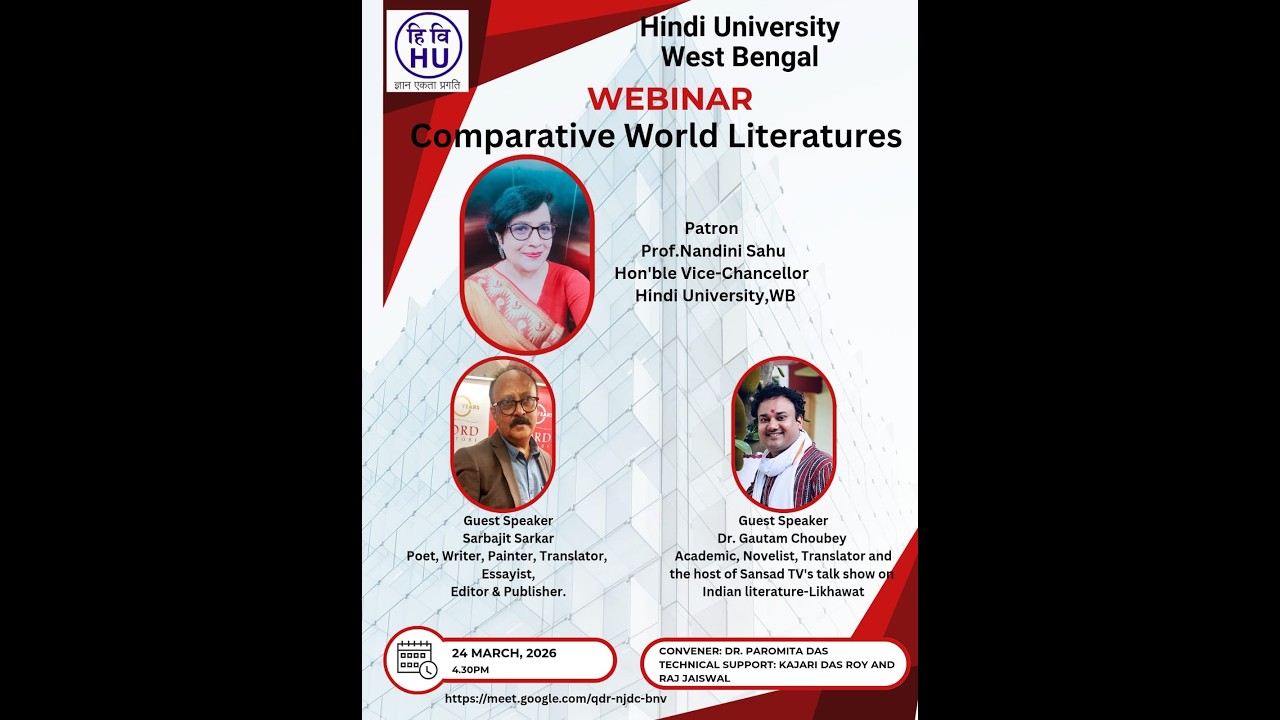
Hindi University, West Bengal Special Lecture Series
Hindi University
Overview
This video features a special lecture series on comparative world literature organized by Hindi University, West Bengal. The event highlights the importance of understanding literature beyond national and linguistic boundaries, fostering dialogue across cultures. Distinguished speakers Sarbajit Sarkar and Dr. Gautam Chave share their insights. Sarkar emphasizes literature's role in connecting people, promoting empathy, and acting as a form of resistance, drawing parallels between Bengali and English literature from his childhood. Dr. Chave delves into Leo Tolstoy's influence on Indian literature, exploring how Tolstoy's works were adapted and recontextualized by Indian writers like Premchand, challenging Eurocentric perspectives. The lectures underscore the dynamic nature of literature, its cross-cultural exchange, and its capacity to enrich understanding and foster intellectual openness in a globalized world. The event concludes with expressions of gratitude to the speakers, the university, and the participants.
Save this permanently with flashcards, quizzes, and AI chat
Chapters
- Welcome to the webinar on comparative world literature.
- Objective: Foster dialogue across languages and cultures.
- Introduction of speakers Sarbajit Sarkar and Dr. Gautam Chave.
- Message from Vice Chancellor Professor Nandini Sahu.
- Introduction of Dr. Gautam Chave and Sarbajit Sarkar.
- Appreciation for their contributions to literary studies.
- Highlighting Dr. Chave's work in research and translation.
- Acknowledging Sarbajit Sarkar's role as a writer and publisher.
- Emphasis on the enriching nature of the lectures.
- Childhood experience with Bengali (Kir Putul) and English (Oliver Twist) literature.
- Literature's ability to evoke empathy for marginalized people.
- Similarities in human emotions across different literatures and cultures.
- Literature as a carrier of culture, politics, geography, and history.
- Literature's role as an act of resistance and a unifying force.
- Comparative world literature studies beyond national traditions.
- Literature teaches empathy towards humanity and the universe.
- Literature encourages anthropomorphism over anthropocentrism.
- The concept of 'fibril' as a metaphor for interconnectedness in language and literature.
- Edward Glae's work on migration and cultural exchange.
- The importance and framework of South Asian literature in world comparative literature.
- Tension between linguistic diversity and regional unity in South Asia.
- The concept of 'Vasudhaiva Kutumbakam' (the world is one family).
- Resisting nationalist or linguistic frames in literature.
- The value of medieval poets and vernacular traditions.
- Leo Tolstoy's 150th birth anniversary celebrated in India.
- Tolstoy's influence opening Indian literature beyond the Anglophone world.
- Tolstoy's engagement with Indian philosophy (Buddhism, Vedas).
- Correspondence with Indian scholars and figures like Ramaswami Iyer and Tarak Nath Das.
- Tolstoy's 'A Letter to a Hindu' advocating non-violent resistance.
- Premchand's translation and Indianization of Tolstoy's didactic stories.
- Tolstoy's claim that his stories were of Indian origin.
- The dialogic encounter between European realism and Indian context.
- Tolstoy's influence on Hindi realist village stories.
- The cyclical nature of influence: India to Tolstoy and back.
- Tolstoy as a European sage familiar with Indian thought.
- Tolstoy's influence on Gandhi and the nationalist movement.
- Tolstoy's reception in India through Gandhi, the October Revolution, and Lenin.
- Nirmal Verma as an example of world literature, writing with a European sensibility.
- The essence of world literature lies in cross-cultural exchange and appropriation.
- Recap of the insightful presentations by Sarkar and Chave.
- Gratitude to the speakers, Vice Chancellor, and organizing team.
- Appreciation for participants' engagement.
- Formal conclusion of the webinar.
- Looking forward to future associations with Hindi University.
Key takeaways
- Comparative world literature transcends national and linguistic barriers, fostering cross-cultural understanding.
- Literature serves as a powerful tool for empathy, connection, and acts of resistance.
- Literary influences are cyclical and dialogic, with ideas traveling and transforming across cultures (e.g., Tolstoy and Indian literature).
- Challenging Eurocentric perspectives is crucial in the study of world literature.
- South Asian literature offers a unique model of unity amidst diversity, embodying inclusivity.
- Writers like Tolstoy, through their engagement with diverse philosophies and cultures, become bridges between civilizations.
- Adaptation and appropriation, not just translation, are key mechanisms in the circulation of world literature.
- Understanding literature comparatively helps us appreciate the global consciousness and interconnectedness of human experience.