8:12
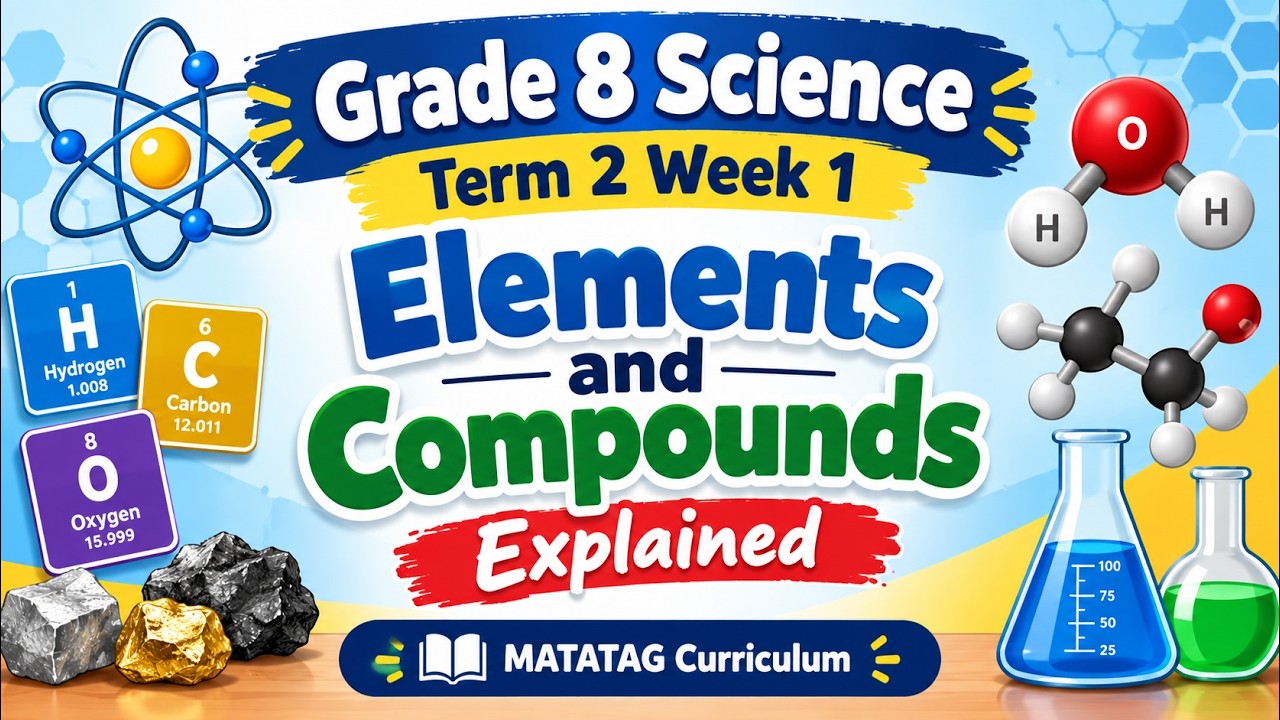
Grade 8 Science Term 2 Week 1 | Elements and Compounds Explained | MATATAG Curriculum
sipryan tv
Overview
This video introduces fundamental concepts in chemistry for Grade 8 students, focusing on elements and compounds as the building blocks of matter. It explains what pure substances are, how elements are defined by their unique proton count, and how compounds form from chemically bonded elements in fixed ratios. The video also contrasts metals and nonmetals, discusses the distribution of elements across Earth's subsystems (geosphere, hydrosphere, atmosphere, biosphere), and concludes with a quiz to reinforce learning.
How was this?
Save this permanently with flashcards, quizzes, and AI chat
Chapters
- Everything in the universe is made of atoms, the basic building blocks of matter.
- Atoms combine to form the vast variety of substances we encounter.
- Pure substances have a uniform and fixed chemical composition that cannot be altered by physical means like filtering.
Understanding pure substances is crucial because they represent the simplest, most fundamental forms of matter before chemical combinations occur.
Pure water and pure gold are examples of pure substances because their chemical makeup is identical regardless of the source and cannot be separated by simple physical methods.
- An element is a pure substance made of only one type of atom.
- Elements are the simplest pure substances and cannot be broken down into simpler forms through ordinary chemical reactions.
- The identity of an element is determined by its atomic number, which is equal to the number of protons in the nucleus of its atoms.
Knowing that elements are defined by their proton count helps us understand why different elements have distinct properties and how they form the basis for all other substances.
Carbon atoms always have 6 protons, nitrogen atoms always have 7, and oxygen atoms always have 8. Changing the proton count fundamentally changes the element.
- Compounds form when two or more different elements chemically bond together.
- When elements combine to form a compound, they lose their original properties and create a new substance.
- Compounds always maintain a fixed ratio of their constituent elements, which is essential for their identity as a pure substance.
- Molecules can be homonuclear (same element, like O2) or heteronuclear (different elements, like H2O).
Understanding compounds explains how diverse materials with unique properties are created from simpler elements, highlighting the importance of specific chemical bonds and ratios.
Sodium (a reactive metal) and chlorine (a toxic gas) combine to form sodium chloride (table salt), a safe and essential compound with entirely new properties.
- Elements exhibit distinct characteristics, broadly categorized as metals and nonmetals.
- Metals are typically shiny, excellent conductors of electricity, malleable, and have high tensile strength.
- Nonmetals are often dull, poor conductors (insulators), brittle if solid, and many exist as gases.
Recognizing the contrasting properties of metals and nonmetals helps explain their diverse uses in technology and construction, from electrical wiring to insulation.
Iron and steel are used for bridges due to their high tensile strength (metal property), while many nonmetals are used as insulators because they don't conduct electricity well.
- Elements are distributed across different Earth subsystems.
- The geosphere (rocky part) contains heavy elements like iron and silver.
- The hydrosphere (water bodies) is rich in hydrogen and oxygen.
- The atmosphere is primarily composed of nitrogen, helium, and oxygen gases.
- The biosphere (living things) is fundamentally based on carbon.
This distribution shows how the fundamental elements are organized within our planet and how life itself is intricately linked to specific elements like carbon.
Carbon atoms form the backbone of DNA and organic molecules in living organisms (biosphere), while iron is found in the Earth's crust (geosphere).
- Pure substances maintain a fixed chemical composition.
- An element's identity is determined by its number of protons.
- Compounds are formed by chemically bonded elements in fixed ratios.
- Properties like shininess and conductivity help distinguish metals from nonmetals.
- Elements are found in specific Earth subsystems (geosphere, hydrosphere, atmosphere, biosphere).
- Pure compounds cannot be separated by physical means; chemical reactions are required.
Testing knowledge through a quiz reinforces the key concepts and helps identify areas that may need further review, ensuring durable learning.
The quiz confirms that table salt (sodium chloride) is a compound because it's made of two different elements chemically combined, not a simple mixture.
Key takeaways
- Matter is composed of atoms, which are the fundamental building blocks that combine to form all substances.
- Elements are the simplest pure substances, defined by the unique number of protons in their atoms, and cannot be broken down further by chemical means.
- Compounds are formed when different elements chemically bond in precise, fixed ratios, resulting in new substances with properties distinct from their constituent elements.
- The physical properties of elements, such as conductivity and malleability, allow us to classify them as metals or nonmetals, influencing their practical applications.
- Elements are not randomly distributed but are found in characteristic ways across Earth's major systems, from the rocks beneath our feet to the air we breathe and the life that inhabits the planet.
- Distinguishing between elements and compounds is key; elements are pure, single-atom types, while compounds are specific chemical combinations of different elements.
Key terms
AtomPure substanceElementProtonAtomic numberCompoundChemical bondFixed ratioMoleculeMetalNonmetalGeosphereHydrosphereAtmosphereBiosphere
Test your understanding
- What defines a pure substance, and why is this definition important for understanding elements and compounds?
- How does the number of protons in an atom determine its identity as a specific element?
- Explain why a compound like water (H2O) has properties entirely different from hydrogen and oxygen individually.
- What are the key physical differences between metals and nonmetals, and how do these differences dictate their uses?
- How are elements distributed across Earth's major subsystems, and what is the significance of carbon for the biosphere?