10:08
Central Nervous System: Crash Course Anatomy & Physiology #11
CrashCourse
Overview
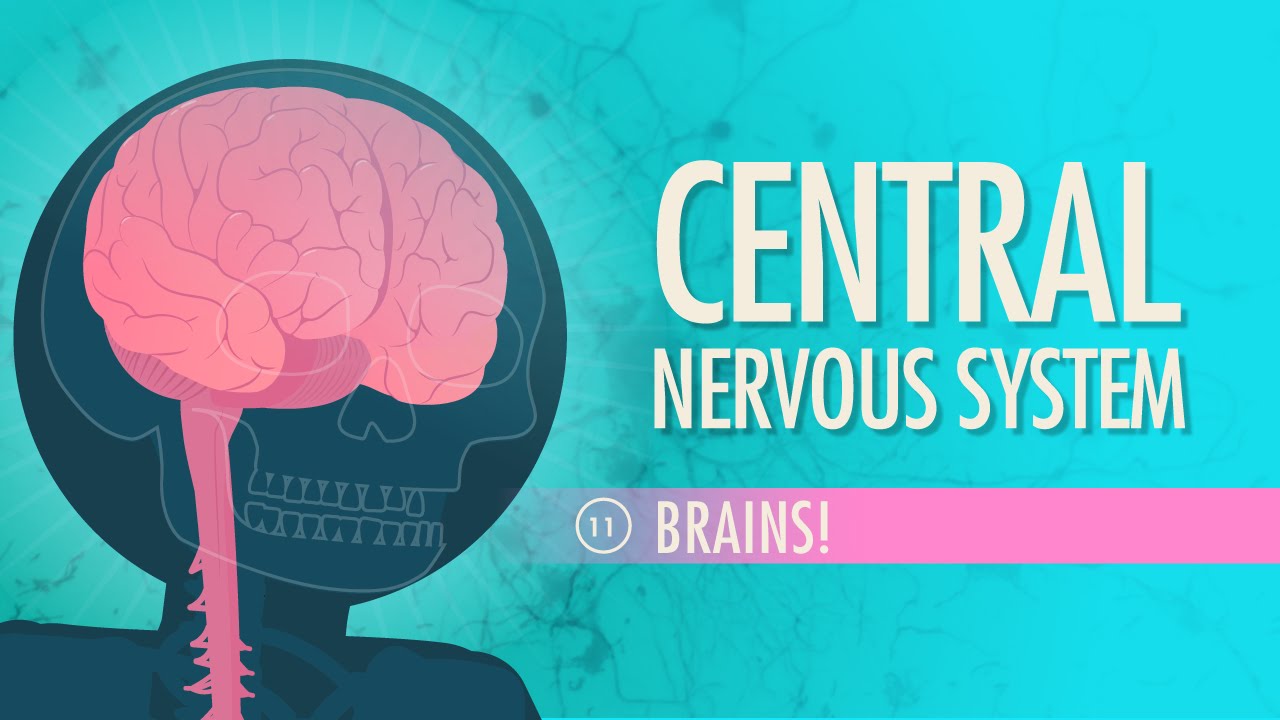
This video explores the Central Nervous System (CNS), focusing on the brain and spinal cord. It explains how the CNS develops from a neural tube into specialized structures with distinct functions, highlighting the importance of specific brain regions for various activities like language, motor control, and basic life support. The video uses examples of brain injuries to illustrate how damage to particular areas can lead to specific functional deficits, emphasizing that brain function is highly localized. It also touches upon the protective mechanisms of the CNS and its connection to the Peripheral Nervous System.
How was this?
Save this permanently with flashcards, quizzes, and AI chat
Chapters
- The Central Nervous System (CNS), comprising the brain and spinal cord, integrates sensory information and coordinates responses.
- Studying brain injuries, like strokes affecting speech (Broca's aphasia), reveals that specific brain areas have specialized functions.
- The principle of 'everything is local' applies to the brain, meaning distinct regions are responsible for particular tasks.
- The CNS is protected by bones, meninges, and cerebrospinal fluid, but remains vulnerable to injury.
Understanding that specific brain areas control specific functions is crucial for comprehending how the brain works and how injuries can impact abilities like speech, memory, or movement.
A stroke damaging Broca's area in the left hemisphere caused a patient to lose the ability to produce intelligible speech, though he could still understand it, demonstrating localized language function.
- The CNS begins as a neural tube in an embryo, which develops into the spinal cord and three primary brain vesicles: prosencephalon (forebrain), mesencephalon (midbrain), and rhombencephalon (hindbrain).
- These primary vesicles further divide into five secondary vesicles (telencephalon, diencephalon, mesencephalon, metencephalon, myelencephalon) which form the basis of adult brain structures.
- Different vesicles grow at different rates, leading to the formation of distinct major brain regions: brainstem, cerebellum, diencephalon, and cerebral hemispheres.
Tracing the developmental path from a simple neural tube to complex brain structures helps explain the organization and relative sizes of different brain components.
The prosencephalon (forebrain) develops into the telencephalon and diencephalon, with the telencephalon eventually forming the large, wrinkled cerebrum responsible for higher cognitive functions.
- The brainstem (midbrain, pons, medulla oblongata) regulates vital involuntary functions like breathing, heart rate, and consciousness.
- The cerebellum primarily coordinates muscular activity and balance.
- The diencephalon (thalamus, hypothalamus) is involved in regulating homeostasis, alertness, emotions, and basic drives, sometimes referred to as the 'reptilian brain'.
- The cerebrum, the largest part of the brain, is responsible for higher-level functions such as thinking, learning, memory, and voluntary movement.
Knowing the distinct roles of the brainstem, cerebellum, diencephalon, and cerebrum allows us to understand how basic survival functions are managed alongside complex cognitive processes.
The midbrain within the brainstem processes sensory information for rapid reflexes, like tracking a fast-moving object or reacting to a loud noise, before conscious thought occurs.
- The cerebrum's outer layer, the cerebral cortex, is highly folded (gyri and sulci) to maximize surface area for processing.
- The two cerebral hemispheres are connected by the corpus callosum, allowing communication between them.
- Each hemisphere is divided into four lobes: frontal (planning, motor control, Broca's area for speech), occipital (vision), parietal (sensory processing like touch and pain), and temporal (auditory processing, Wernicke's area for language comprehension).
Understanding the different lobes and their functions explains how we process sensory input, control our bodies, and perform complex cognitive tasks like language and planning.
Damage to the frontal lobe's Broca's area can impair speech production, while damage to the temporal lobe's Wernicke's area can affect language comprehension.
Key takeaways
- The Central Nervous System is composed of the brain and spinal cord, which work together to process information and control bodily functions.
- Brain function is highly localized, meaning specific areas are responsible for specific tasks, and damage to these areas results in corresponding functional deficits.
- The brain develops from a simple neural tube into complex, specialized structures with distinct roles, from basic life support to advanced cognition.
- The brainstem handles essential involuntary functions, the cerebellum manages motor coordination, the diencephalon regulates basic drives and emotions, and the cerebrum performs higher-level thinking.
- The cerebral cortex, divided into lobes, is responsible for processing sensory information, language, and complex cognitive functions.
- The protective layers and cerebrospinal fluid shield the brain, but its intricate structure makes it vulnerable to localized damage.
Key terms
Central Nervous System (CNS)Peripheral Nervous System (PNS)BrainSpinal CordNeural TubeVesicles (Prosencephalon, Mesencephalon, Rhombencephalon)Brainstem (Midbrain, Pons, Medulla Oblongata)CerebellumDiencephalon (Thalamus, Hypothalamus)CerebrumCerebral CortexLobes (Frontal, Occipital, Parietal, Temporal)Broca's AreaWernicke's AreaCerebrospinal Fluid (CSF)Meninges
Test your understanding
- How does the development of the neural tube into primary and secondary vesicles explain the organization of the adult brain?
- What are the primary functions of the brainstem, cerebellum, diencephalon, and cerebrum, and how do they differ?
- Explain the concept of localization of function in the brain, using examples of specific lobes and their associated abilities.
- Why is the brain's structure, despite its protective layers, still vulnerable to specific functional deficits?
- How do Broca's area and Wernicke's area contribute to language processing, and what happens when they are damaged?