Kontekstwalisadong Komunikasyon sa Filipino
Research Connect
Overview
This video introduces the course "Kontekstwalisadong Komunikasyon sa Filipino" (Contextualized Communication in Filipino) at Cavite State University. It details the syllabus, outlining course objectives, topics, requirements, and the grading system. The course emphasizes practical application of the Filipino language in various societal contexts, focusing on listening, speaking, and effective media use. It also highlights the university's core values (Truth, Excellence, Service) and the department's goals, aiming to produce morally upright and globally competitive graduates. The video breaks down the semester's learning outcomes and weekly topics, from self-introduction and understanding the syllabus to exploring various communication activities and contemporary social issues in the Philippines.
Save this permanently with flashcards, quizzes, and AI chat
Chapters
- The course, Genet 11 or Kontekstwalisadong Komunikasyon sa Pilipino, is a 3-credit lecture course focused on practical Filipino communication skills.
- It aims to enhance students' ability to use Filipino effectively in various academic and community settings, integrating language with culture and society.
- Key learning outcomes include effective use of Filipino in diverse situations, understanding communication through media, and connecting language to culture and interpersonal relationships.
- The syllabus serves as a guide for the semester, detailing course descriptions, objectives, topics, requirements, and the grading system.
- The university's core values are Truth (katotohanan), Excellence (kahusayan), and Service (paglilingkod), emphasizing integrity, dedication, and community contribution.
- Excellence involves not just high grades but also dedication, discipline, and giving one's best effort.
- Service highlights the importance of education for others and the community, fostering respect, teamwork, and empathy.
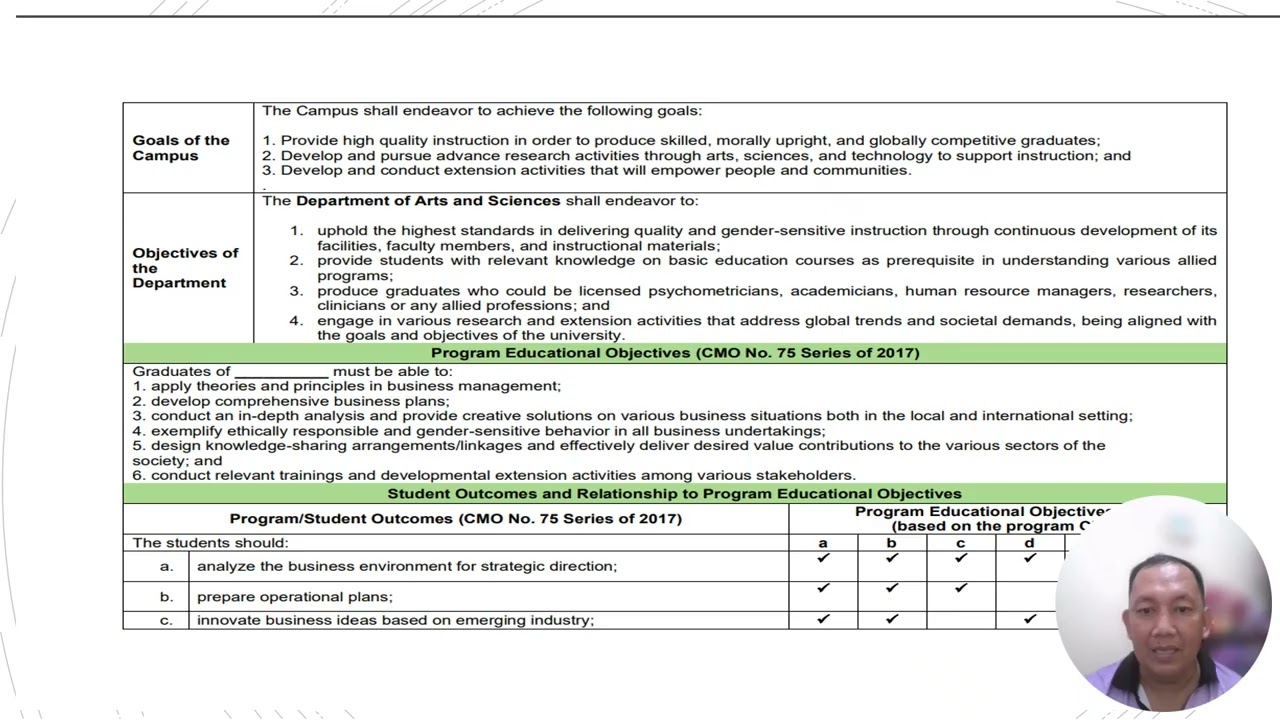
- The college and department aim for high-quality instruction, producing morally upright and globally competitive graduates, and advancing research and extension activities.
- Program outcomes are aligned with the university's mission, vision, and goals, focusing on promoting gender sensitivity, discipline, and global competitiveness.
- Students are expected to describe Filipino communication styles, explain the importance of the Filipino language, and use it effectively in various contexts.
- Key outcomes also include critically evaluating information sources, understanding the link between language, identity, and development, and expressing ideas through traditional and modern media.
- The course content is structured weekly, covering topics from self-introductions and syllabus orientation to specific communication activities and contemporary issues.
- The first week focuses on introductions, understanding the syllabus, course expectations, and orientation to distance/blended learning and university resources.
- Weeks 2 and 3 emphasize the significance of the Filipino language as a medium for contextualized communication, its role in national identity and development, and its use in various social settings.
- Students will learn to identify credible sources, process information, and express ideas using both traditional and modern media.
- Activities include self-introductions, syllabus review, orientation videos, pre-assessments, essay writing, and analyzing media content.
- This section delves into various Filipino communication practices, including informal ones like 'chismisan' (gossip) and 'umpukan' (small group gatherings).
- Formal communication methods like 'talakayan' (discussion) and 'pagbabahay-bahay' (house-to-house visits) are also explored.
- Students will analyze how these practices reflect Filipino culture, values, and social dynamics, using examples like songs and documentaries.
- Outcomes include describing diverse communication activities, explaining the role of Filipino as a primary communication tool, and analyzing their societal impact.
- The course addresses contemporary local and national issues such as corruption, environmental challenges (typhoons, climate change), and social problems like poverty and malnutrition.
- Students will learn to critically analyze news and articles, understand the communication strategies needed to address these issues, and develop ethical guidelines for media use.
- Emphasis is placed on media literacy, evaluating information, and understanding the impact of various social and economic factors on Filipino society.
- Activities include analyzing news reports, conducting interviews, creating infographics, and developing proposals for awareness campaigns.
- The final weeks focus on specific communication situations encountered in school, work, and society, including radio/TV programs, video conferencing, and social media.
- Students will practice creating persuasive presentations and communication materials tailored to different contexts, emphasizing ethical communication.
- The course culminates in a symposium on current issues and a final examination, assessing the students' comprehensive understanding and application of communication skills.
- The syllabus emphasizes that communication extends beyond the classroom, requiring adaptability across various platforms and situations.
Key takeaways
- Contextualized communication in Filipino is essential for understanding and participating effectively in Philippine society and culture.
- The university's core values of Truth, Excellence, and Service should guide academic and personal conduct.
- Developing critical media literacy is crucial for navigating information and combating misinformation.
- Filipino communication practices, both formal and informal, are deeply intertwined with cultural identity and social cohesion.
- Understanding and addressing contemporary social issues requires effective and responsible communication.
- Adaptability and ethical considerations are paramount when communicating across diverse platforms and situations.
- The Filipino language serves as a powerful tool for national identity, development, and unity.
Key terms
Test your understanding
- How does the course 'Kontekstwalisadong Komunikasyon sa Filipino' aim to enhance students' practical communication skills?
- What are the three core values of the university, and how do they relate to academic integrity and personal development?
- Explain the significance of the Filipino language as a tool for national identity and development, as discussed in the course.
- How do informal Filipino communication practices like 'chismisan' and 'umpukan' reflect cultural values?
- What strategies can be employed to critically evaluate information sources, especially in the context of contemporary social issues?