14:13
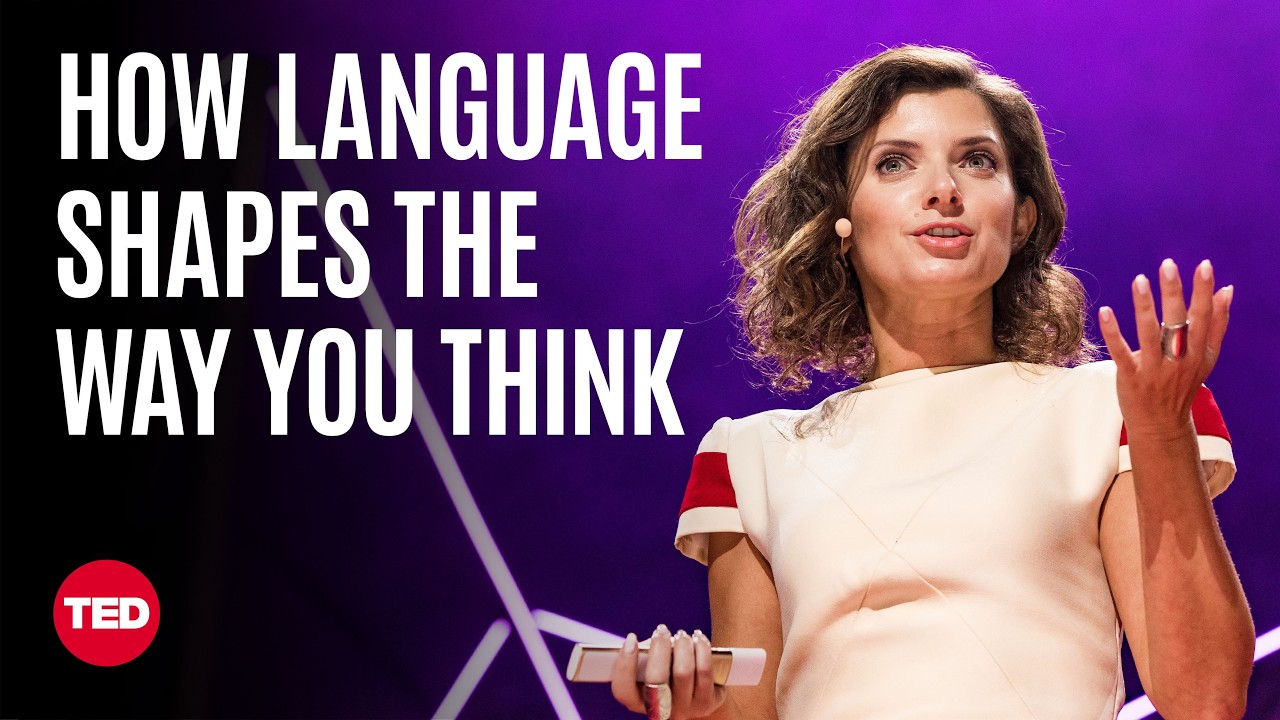
How Language Shapes the Way We Think | Lera Boroditsky | TED
TED
Overview
This video explores the profound impact of language on human cognition, challenging the idea that thought is universal. Linguist Lera Boroditsky presents research demonstrating how different languages shape speakers' perceptions of space, time, number, color, and even abstract concepts like blame and intention. By examining diverse linguistic structures and their effects on speakers from various cultures, the video highlights the flexibility of the human mind and the cognitive richness embedded in linguistic diversity, while also lamenting the loss of this diversity.
How was this?
Save this permanently with flashcards, quizzes, and AI chat
Chapters
- Language allows humans to transmit complex thoughts and ideas across individuals, space, and time.
- This transmission occurs through the conversion of spoken sounds into mental concepts.
- The sheer existence of 7,000 diverse languages raises the question of whether language influences how we think.
Understanding how language functions as a communication tool is fundamental to appreciating its potential to shape our internal mental landscape.
The speaker can implant a novel thought, like 'a jellyfish waltzing in a library while thinking about quantum mechanics,' into the listener's mind through language.
- Some languages, like Kuuk Thaayorre, do not use relative spatial terms (left/right) but rely on absolute cardinal directions (north, south, east, west).
- This linguistic structure necessitates constant awareness of one's orientation, leading speakers to be exceptionally good at maintaining direction.
- English speakers, lacking this constant linguistic cue, perform poorly when asked to point in a specific cardinal direction without external aids.
This demonstrates how a fundamental aspect of perception, spatial awareness, can be dramatically enhanced or altered by the linguistic tools available.
Kuuk Thaayorre speakers greet each other by stating their direction of travel (e.g., 'North-northeast in the far distance'), a practice that inherently reinforces their orientation.
- The way time is conceptualized and represented can differ significantly across languages.
- English speakers often arrange time linearly from left to right, influenced by writing direction.
- Kuuk Thaayorre speakers arrange time according to cardinal directions, linking it to the landscape rather than their own bodies, showing a more egocentric or landscape-centric view.
Our understanding and organization of time, a seemingly universal concept, is shown to be malleable and influenced by linguistic frameworks.
Kuuk Thaayorre speakers organize pictures of a person's life chronologically from east to west, reflecting the sun's movement, rather than a left-to-right personal orientation.
- Languages without exact number words hinder the ability to count and track precise quantities.
- The presence of number words acts as a cognitive tool, enabling mathematical reasoning and complex calculations.
- Linguistic boundaries in color terms, like Russian's distinction between light and dark blue, can lead to faster perceptual discrimination and distinct brain responses.
The availability or absence of specific linguistic tools, like number words or distinct color terms, directly impacts cognitive abilities and perceptual processing.
Russian speakers are faster at distinguishing between shades of blue that cross the linguistic boundary between 'goluboy' (light blue) and 'siniy' (dark blue) compared to English speakers.
- Grammatical gender assigned to nouns can subtly influence how speakers perceive objects and their qualities.
- Languages differ in how they describe accidental events, impacting memory and attribution of responsibility.
- English requires agentive phrasing (e.g., 'He broke the vase'), while languages like Spanish may use more passive or agentless constructions (e.g., 'The vase broke').
Even seemingly arbitrary grammatical features can shape how we assign agency, remember details of events, and even determine blame.
German speakers, whose word for 'bridge' is feminine, describe bridges with more stereotypically feminine adjectives (e.g., 'beautiful'), while Spanish speakers, for whom 'bridge' is masculine, use more masculine adjectives (e.g., 'strong').
- Linguistic diversity reflects the immense creativity and flexibility of the human mind, creating thousands of unique cognitive universes.
- A significant portion of global linguistic diversity is being lost at an alarming rate.
- Current scientific understanding of the human mind is heavily biased by studies on a narrow demographic, primarily English-speaking university students.
Preserving linguistic diversity is crucial for a comprehensive understanding of human cognition and for retaining the unique ways of thinking that different languages embody.
The speaker notes that approximately one language is lost per week, threatening to eliminate half of the world's languages within a century.
Key takeaways
- Language is not merely a tool for communication but actively shapes our perception of reality, including space, time, and causality.
- The structure of a language influences cognitive abilities, such as spatial orientation and numerical reasoning.
- Even subtle linguistic differences, like grammatical gender or color terminology, can lead to measurable differences in thought and perception.
- How events are described linguistically affects memory recall and the assignment of blame or responsibility.
- The vast diversity of human languages represents a wealth of different ways of thinking and understanding the world.
- The ongoing loss of linguistic diversity represents a loss of unique human cognitive frameworks and a narrowing of our scientific understanding of the mind.
- Understanding how our own language shapes our thoughts empowers us to question our assumptions and consider alternative perspectives.
Key terms
Linguistic RelativitySapir-Whorf HypothesisCardinal DirectionsEgocentric vs. AllocentricGrammatical GenderAgentive vs. Non-agentiveCognitive UniversalsLinguistic DiversityPerceptual DiscriminationEyewitness Testimony
Test your understanding
- How does the use of cardinal directions in the Kuuk Thaayorre language influence speakers' spatial awareness compared to English speakers?
- Explain the difference in how English speakers and Kuuk Thaayorre speakers conceptualize and arrange time, and why this difference matters.
- What is the impact of having or lacking exact number words in a language on a speaker's ability to perform mathematical tasks?
- How can grammatical gender in languages like German and Spanish affect the way speakers describe objects?
- Why is the loss of linguistic diversity considered a significant issue for both cognitive science and humanity?