17:09
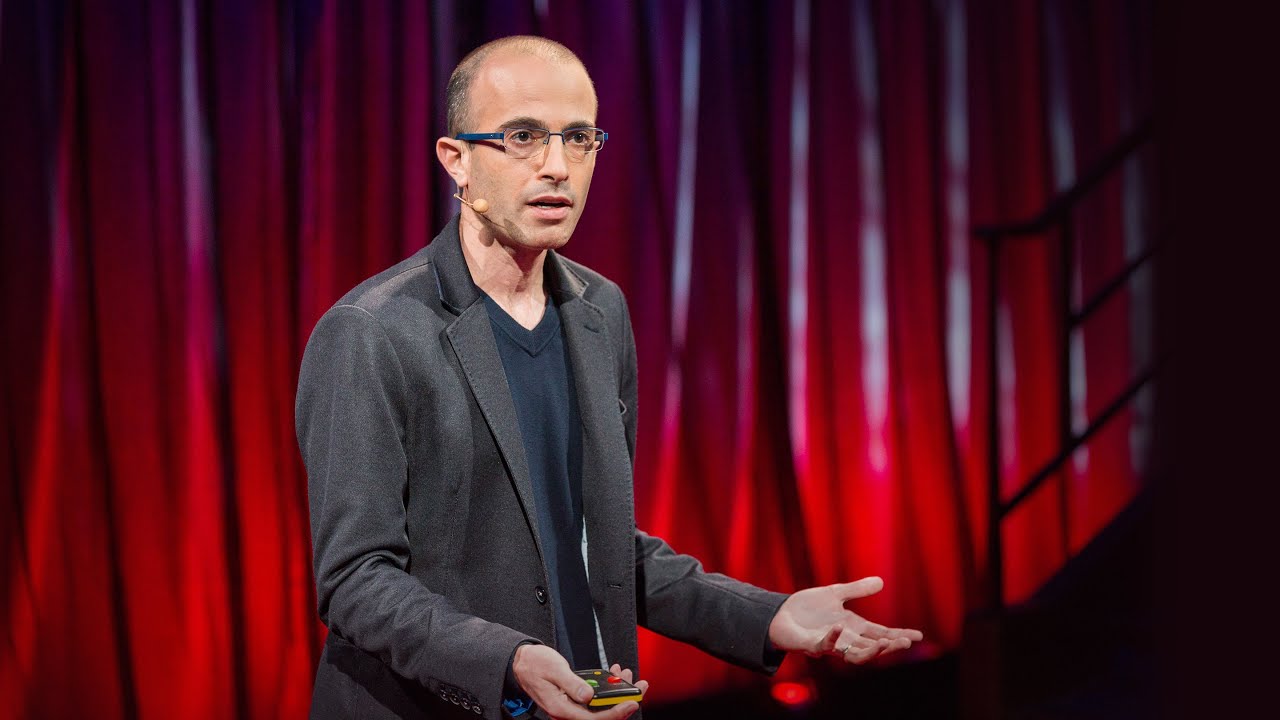
Why humans run the world | Yuval Noah Harari | TED
TED
Overview
This video explores how Homo sapiens evolved from insignificant animals to the dominant species on Earth. The speaker, Yuval Noah Harari, argues that our unique ability to cooperate flexibly in large numbers, enabled by our capacity to create and believe in shared fictions (like gods, nations, money, and corporations), is the key to our success. This shared imagination allows us to build complex societies and achieve large-scale goals, distinguishing us from other animals. The talk also touches upon future challenges, including the potential for widespread human redundancy due to AI and the possibility of biological stratification.
How was this?
Save this permanently with flashcards, quizzes, and AI chat
Chapters
- Seventy thousand years ago, humans were biologically insignificant animals with little impact on the planet.
- Our current global dominance is not due to individual superiority; humans are biologically similar to chimpanzees.
- The crucial difference lies in our collective ability to cooperate flexibly in large numbers, a trait unique to Homo sapiens.
Understanding this shift highlights that our species' success is rooted in a collective, rather than individual, advantage.
Comparing a thousand humans cooperating effectively in a stadium to a thousand chimpanzees descending into chaos.
- Social insects like ants and bees cooperate in large numbers but lack flexibility; their social structures are rigid.
- Social mammals like wolves and chimpanzees cooperate flexibly but only in small groups, requiring personal knowledge of each individual.
- Humans uniquely combine flexible cooperation with the ability to operate in vast, anonymous groups.
This comparison clarifies why other species, despite social structures, haven't achieved global dominance.
Bees cannot overthrow their queen and establish a republic; chimpanzees cannot organize large-scale cooperation without knowing each other personally.
- Our ability to cooperate in large numbers stems from our unique capacity to create and believe in shared fictions or imagined realities.
- Unlike other animals that communicate only about objective reality, humans use language to construct and share stories.
- These shared stories create common norms, values, and laws, enabling mass cooperation.
This explains the 'how' behind our large-scale cooperation, revealing the fundamental role of imagination in human society.
Promising a chimpanzee future bananas in 'chimpanzee heaven' for a present banana is impossible, but humans readily believe in concepts like God or afterlife rewards.
- Legal systems are based on fictions like human rights, which are not objective biological realities but agreed-upon stories.
- Nations and states (e.g., France, Germany) are imagined communities, powerful because millions believe in them.
- Corporations are legal fictions, and money itself is a highly successful, universally believed story about value.
This demonstrates that abstract concepts driving human civilization are not objective truths but powerful, shared beliefs.
A dollar bill has no inherent value, but it can be exchanged for real goods because everyone collectively believes in its worth.
- Humans live in a dual reality: the objective world of trees and rivers, and a constructed fictional reality of nations, gods, and corporations.
- Over time, this fictional reality has become more powerful than the objective one, influencing even the survival of natural elements.
- Future challenges may include a large class of 'useless people' made redundant by AI, and potential biological stratification between upgraded elites and the rest.
This frames our current reality and poses critical questions about the future trajectory of humanity and the role of technology.
The survival of natural resources now depends on decisions made by fictional entities like 'Google' or 'the World Bank'.
Key takeaways
- Human dominance stems from the unique ability to cooperate flexibly in very large numbers, not individual prowess.
- This large-scale cooperation is enabled by our capacity to create, share, and believe in collective fictions or imagined realities.
- Concepts like nations, laws, human rights, and money are powerful social constructs, not objective biological facts.
- Shared belief in these fictions allows millions of strangers to work together towards common goals.
- While cooperation can build cathedrals and economies, it also underpins negative constructs like prisons and concentration camps.
- The most powerful forces shaping our world today—like corporations and money—exist solely within our collective imagination.
- Future technological advancements may create new societal divisions, potentially rendering large segments of the population economically redundant.
Key terms
Homo sapiensCooperationFlexibilityLarge numbersShared fictionsImagined realityObjective realityLegal fictionsCorporationsMoneyUseless people
Test your understanding
- How does the ability to cooperate flexibly in large numbers differentiate humans from other animals like chimpanzees and ants?
- What is the role of 'shared fictions' in enabling large-scale human cooperation?
- Provide examples of how abstract concepts like human rights, nations, and money function as powerful fictions.
- Explain the concept of 'dual reality' as described by the speaker and its implications for the natural world.
- What potential societal challenges does the speaker foresee arising from advancements in artificial intelligence?