28:40
SI Base Units and Derived Units - Physics and Chemistry
The Organic Chemistry Tutor
Overview
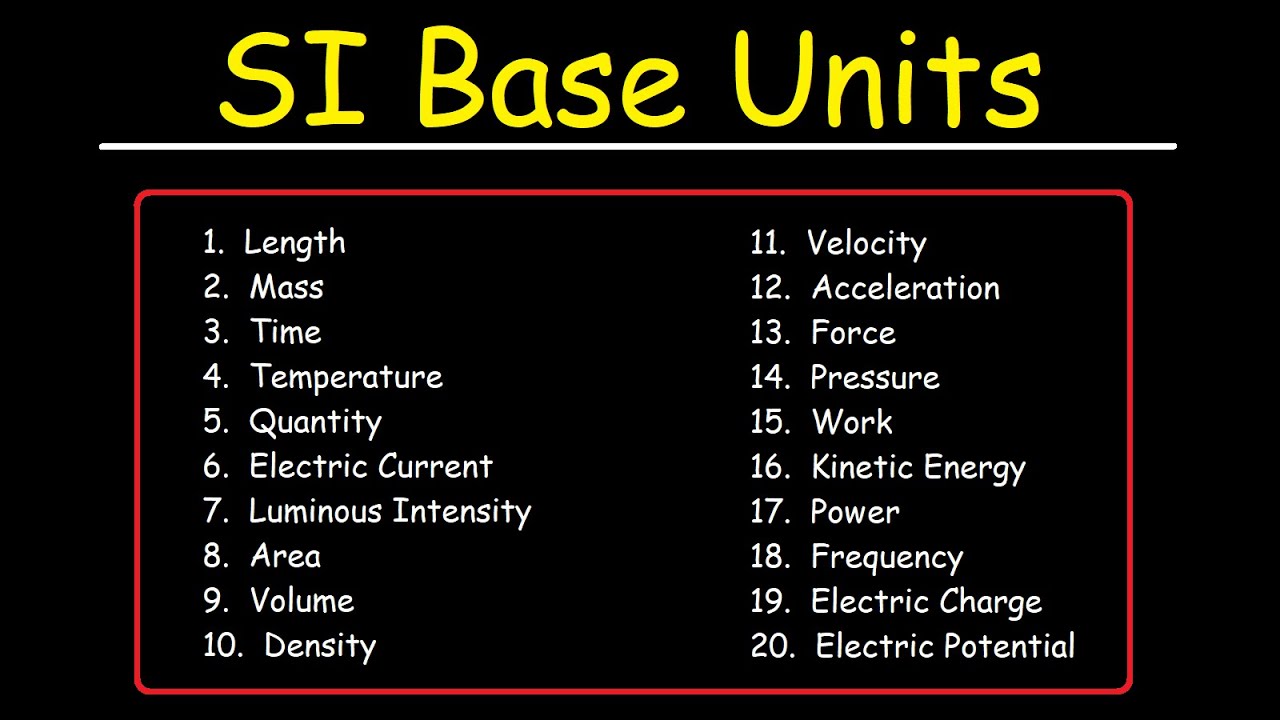
This video introduces the International System of Units (SI), focusing on the seven base units and various derived units used in physics and chemistry. It explains the base units for length (meter), mass (kilogram), time (second), temperature (Kelvin), amount of substance (mole), electric current (ampere), and luminous intensity (candela). The video then details how derived units, such as those for velocity, acceleration, force, area, volume, pressure, density, work, energy, power, momentum, frequency, charge, and resistance, are constructed from the base units. It also provides common conversion factors and practical examples for each unit.
How was this?
Save this permanently with flashcards, quizzes, and AI chat
Chapters
- The SI system provides a standardized set of units for scientific measurement.
- There are seven fundamental SI base units: meter (length), kilogram (mass), second (time), Kelvin (temperature), mole (amount of substance), ampere (electric current), and candela (luminous intensity).
- Each base unit has a specific definition and is used as the foundation for other units.
Understanding SI base units is crucial for consistent and accurate scientific communication and experimentation across different fields and countries.
The meter is the SI base unit for length, even though we commonly use kilometers, feet, or inches.
- Familiarity with common conversion factors for length (e.g., km to m, miles to km) and mass (e.g., kg to g) is essential for practical calculations.
- Time is measured in seconds, with standard conversions to minutes, hours, and days.
- A light-year is a unit of distance, not time.
Accurate conversions between different units of length, mass, and time are necessary for solving problems that involve measurements from various sources.
One kilogram is equal to one thousand grams, a common conversion used in both physics and chemistry.
- Temperature can be converted between Celsius and Kelvin using a simple addition formula (K = C + 273.15).
- The mole is a unit representing a very large quantity (Avogadro's number: 6.02 x 10^23), commonly used in chemistry to count atoms or molecules.
- Like a dozen represents 12 items, a mole represents a specific, large number of items.
These units are fundamental for understanding chemical reactions and the behavior of matter at the atomic and molecular level.
A mole of any substance contains 6.022 x 10^23 elementary entities, such as atoms or molecules.
- Derived units are created by combining base units.
- Velocity (or speed) is derived from length and time, resulting in units like meters per second (m/s).
- Acceleration, the change in velocity over time, is derived as meters per second squared (m/s²).
- Force, defined by Newton's second law (F=ma), is derived from mass and acceleration, with the SI unit being the Newton (N), equivalent to kg·m/s².
These derived units allow us to quantify motion and the interactions between objects, forming the basis of classical mechanics.
Acceleration is measured in meters per second squared (m/s²) because it's a change in velocity (m/s) divided by time (s).
- Area is derived as length squared (e.g., square meters, m²).
- Volume is derived as length cubed (e.g., cubic meters, m³), with liters and milliliters also common, especially in chemistry.
- Pressure is defined as force per unit area (e.g., Pascals, Pa), derived from Newtons and square meters (N/m²).
- Pressure can also be measured in other units like atmospheres (atm), torr, or millimeters of mercury, particularly in chemistry.
Understanding these units is essential for describing spatial dimensions, capacity, and the effects of forces distributed over surfaces.
A rectangular area is calculated by multiplying its length (in meters) by its width (in meters), resulting in square meters (m²).
- Density is mass per unit volume (e.g., kg/m³ or g/cm³), indicating how much mass is packed into a given space.
- Work and energy share the same unit, the Joule (J), defined as force times distance (N·m).
- Power is the rate at which work or energy is transferred or converted, measured in Watts (W), where 1 Watt equals 1 Joule per second (J/s).
- Energy can also be measured in calories, kilocalories, or electron volts, while power can be expressed in horsepower.
These concepts quantify how matter is distributed, the capacity to do work, and the speed at which that work is accomplished.
The density of aluminum is 2.7 g/cm³ in chemistry, which is equivalent to 2700 kg/m³ in physics units.
- Momentum is a measure of mass in motion, calculated as mass times velocity (kg·m/s).
- Frequency measures how often a cycle occurs per second, with the unit Hertz (Hz), equivalent to 1/second.
- Electric charge is measured in Coulombs (C), and electric current (the flow of charge) is measured in Amperes (A), where 1 Ampere equals 1 Coulomb per second (C/s).
- Electrical resistance is measured in Ohms (Ω), defined as Volts per Ampere (V/A).
These units are fundamental for understanding the dynamics of moving objects, wave phenomena, and the principles of electricity.
An electric current of one Ampere means that one Coulomb of electric charge flows past a point in one second.
- Electrical potential and voltage are measured in Volts (V), representing energy per unit charge (Joules per Coulomb, J/C).
- Voltage is specifically the difference in electric potential between two points.
- The video reiterates that the meter, kilogram, second, Kelvin, mole, ampere, and candela are the seven SI base units.
- All other units discussed, such as velocity, force, energy, and power, are derived units.
Understanding electrical potential and the distinction between base and derived units provides a comprehensive framework for physics and chemistry measurements.
One Volt means there is one Joule of electric potential energy for every one Coulomb of charge.
Key takeaways
- The SI system provides a universal standard for scientific measurements, built upon seven base units.
- Derived units are combinations of base units that describe more complex physical quantities like velocity, force, and energy.
- Understanding common conversion factors is essential for applying scientific principles in practical contexts.
- The mole is a critical unit in chemistry for quantifying large numbers of atoms or molecules.
- Distinguishing between units of power (like Watts) and energy (like Watt-hours or Joules) is important, especially in electrical contexts.
- Units like pressure, density, and momentum help describe the state and motion of matter.
- Electrical units such as Amperes, Volts, and Ohms are derived from base units and are fundamental to understanding circuits.
Key terms
SI Base UnitsMeterKilogramSecondKelvinMoleAmpereCandelaDerived UnitsVelocityAccelerationForceNewtonAreaVolumePressurePascalDensityWorkEnergyJoulePowerWattMomentumFrequencyHertzElectric ChargeCoulombElectric CurrentElectrical ResistanceOhmElectric PotentialVolt
Test your understanding
- What are the seven SI base units and what physical quantities do they measure?
- How are derived units, such as acceleration and force, constructed from SI base units?
- Why is the mole unit important in chemistry, and what quantity does it represent?
- What is the difference between power and energy, and what are their respective SI units?
- How does the concept of electric current relate to electric charge and the SI base unit for current?