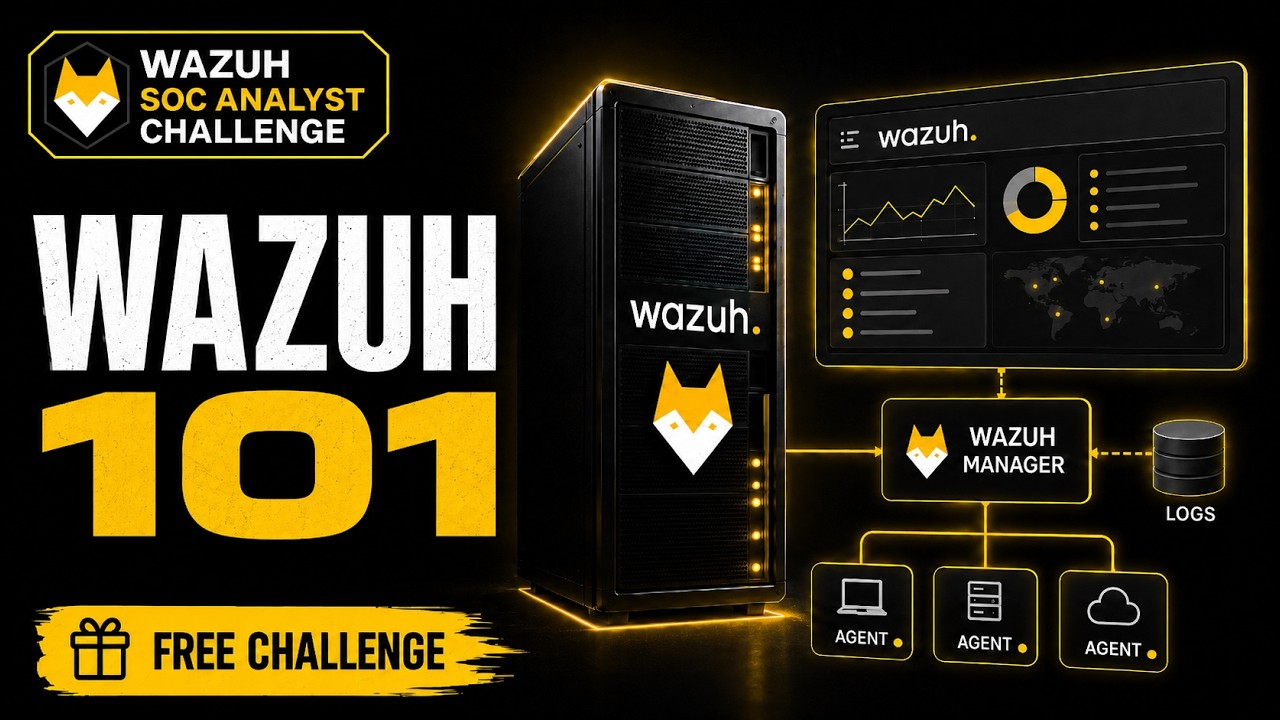
Wazuh 101: What is Wazuh?
MyDFIR
Overview
This video introduces Wazuh, a free and open-source security platform designed to provide centralized logging, visibility, and compliance for small to medium-sized businesses. It explains how Wazuh integrates XDR and SIEM capabilities, protecting on-premises, virtual, containerized, and cloud workloads. The video breaks down Wazuh's architecture into four core components: agents for data collection, a server for analysis, an indexer for storage and search, and a dashboard for visualization and management. It also highlights key modules like File Integrity Monitoring (FIM) and Active Response, and emphasizes the value of building a Wazuh instance for aspiring SOC analysts to learn practical cybersecurity skills.
Save this permanently with flashcards, quizzes, and AI chat
Chapters
- Small businesses often struggle with fragmented security logs across different systems (endpoints, cloud, servers).
- This lack of centralized logging leads to poor visibility and an inability to prove compliance with security standards.
- Credential theft and subsequent breaches are common issues exacerbated by this lack of oversight.
- Wazuh is a free, open-source security platform combining Extended Detection and Response (XDR) and Security Information and Event Management (SIEM) capabilities.
- It protects diverse environments, including on-premises servers, virtual machines, containers, and cloud infrastructure.
- Wazuh centralizes logs from various sources, including cloud platforms (AWS, Azure, GCP) and code repositories (GitHub), providing crucial visibility.
- It offers built-in compliance mapping for standards like PCI DSS, GDPR, and HIPAA, simplifying audit preparations.
- Wazuh consists of four main components: Agents, Server, Indexer, and Dashboard.
- Agents are installed on endpoints (servers, laptops, cloud instances) to collect data and can monitor network devices agentlessly via Syslog.
- The Wazuh Server acts as the 'brain,' analyzing collected data using decoders, rules, and threat intelligence to detect threats (IOCs) and manage agents.
- The Wazuh Indexer stores and indexes alerts, enabling fast searching and retrieval of historical event data.
- The Wazuh Dashboard provides a web-based interface for visualizing data, managing configurations, and reviewing security findings.
- Wazuh can integrate with other security tools like Elastic Stack, Open Search, Splunk, VirusTotal, Yara, and Suricata for enhanced capabilities.
- File Integrity Monitoring (FIM) is a key module that alerts on any changes (creation, modification, deletion) to monitored files and directories.
- Active Response enables automated actions based on triggered alerts, such as blocking malicious IP addresses or disabling user accounts.
- These integrations and modules allow for the consolidation of endpoint telemetry, network telemetry, and threat intelligence.
- Building a Wazuh instance in a lab environment is free and provides hands-on experience.
- It allows aspiring SOC analysts to learn a broad range of valuable cybersecurity skills, including agent deployment, log analysis, rule tuning, FIM, and automated response.
- The troubleshooting process, where you inevitably break and fix things, is where the deepest learning occurs and provides valuable talking points for interviews.
- Skills learned with Wazuh are transferable to other SIEM and security platforms, as the underlying analytical thinking remains consistent.
Key takeaways
- Wazuh provides a unified, open-source solution for centralized logging, threat detection, and compliance management.
- Its modular architecture (Agents, Server, Indexer, Dashboard) allows for scalable protection across diverse environments.
- Key features like File Integrity Monitoring and Active Response automate critical security tasks.
- Wazuh integrates with other security tools, enhancing its detection and response capabilities.
- Hands-on experience with Wazuh is highly beneficial for aspiring SOC analysts, developing transferable skills and practical problem-solving abilities.
- Troubleshooting and learning from errors are integral parts of mastering security tools like Wazuh.
Key terms
Test your understanding
- What problem does Wazuh aim to solve for small businesses?
- How does Wazuh combine XDR and SIEM capabilities?
- What are the four main components of the Wazuh architecture and what is the primary function of each?
- Explain the purpose of File Integrity Monitoring (FIM) and Active Response within Wazuh.
- Why is setting up a Wazuh lab environment recommended for aspiring SOC analysts?