33:36
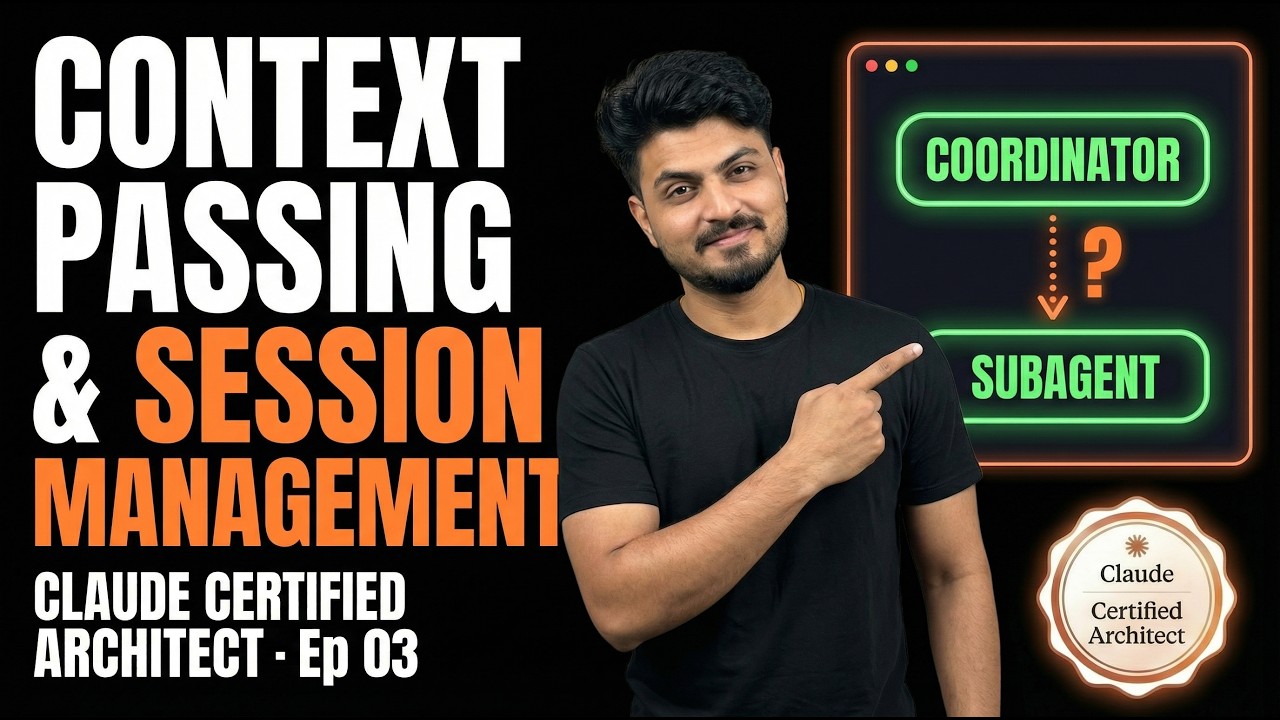
Claude Certified Architect Ep 03 | Subagent Context Passing & Session Management | Full Course
Peace Of Code
Overview
This video explains how to manage context and sessions effectively in multi-agent systems using Claude. It details the problem of sub-agents losing context from the coordinator and introduces solutions like structured context passing and claim-source mappings to maintain attribution. The video also covers session management patterns such as named session resumption, forking sessions for parallel exploration, and deciding when to start fresh versus resuming an existing session, emphasizing the importance of explicit communication about changes to the agent.
How was this?
Save this permanently with flashcards, quizzes, and AI chat
Chapters
- Sub-agents, by default, start with no memory of previous interactions or context from the coordinator.
- The coordinator is responsible for explicitly passing necessary context to sub-agents.
- Without proper context passing, multi-agent systems fail because sub-agents cannot perform tasks effectively.
- A common mistake is assuming sub-agents will infer context, leading to errors or hallucinations.
Understanding this fundamental limitation is crucial for designing reliable multi-agent systems, preventing the breakdown of complex workflows.
An analyst (sub-agent) receiving a task to synthesize research findings, but having no access to the previous analyst's discoveries because the coordinator didn't pass them.
- The prompt given to a sub-agent is its entire world; it starts with a clean slate.
- A 'bad prompt' might vaguely refer to previous findings (e.g., 'Here are some research notes'), leaving the sub-agent clueless.
- A 'good prompt' explicitly includes structured data, like an array of findings with source URLs and titles, passed via the task tool call.
- Effective prompt engineering ensures the sub-agent receives all necessary information to perform its task accurately.
Well-crafted prompts are the primary mechanism for injecting relevant information into sub-agents, directly impacting their ability to produce correct and useful outputs.
Passing a JSON array of research findings, each with a source URL and title, to a synthesis agent, rather than just a general instruction to 'synthesize findings'.
- Source attribution is often lost when raw data is summarized into plain text before being passed to the next agent.
- Claim-source mappings, where each claim is explicitly paired with its source ID, prevent loss of attribution.
- When two sources present conflicting information, the sub-agent should not resolve it silently.
- Conflicts should be annotated with a conflict object, marking the resolution state as 'unresolved' and escalating to the coordinator for a final decision.
Maintaining clear attribution and properly handling conflicts ensures the integrity and trustworthiness of information processed by the multi-agent system, especially in research or critical applications.
A claim about a technical detail is paired with its source URL, and if another source contradicts it, both claims and their sources are flagged in a 'conflict' object for the coordinator to review.
- Session management allows agents to pick up where they left off without starting from scratch.
- Named session resumption involves starting a session with a specific name and resuming it later using that name.
- When resuming, it's critical to explicitly inform the agent about any changes made since the last session.
- Agents cannot automatically detect changes in files or dependencies; explicit communication is required.
This pattern enables continuity in agent workflows, saving time and computational resources by leveraging prior work, but requires careful management of change notifications.
Using the command `claude --resume <session_name>` and then informing the agent, 'The requirements.txt file has been updated; please reanalyze it.'
- Forking a session creates independent branches from a shared baseline, similar to Git branching, allowing parallel exploration of different approaches.
- Deciding whether to resume or start fresh depends on the validity of the prior context.
- Start fresh when tool results are stale or when extended context degrades the model's reasoning.
- When starting fresh, inject a summary of prior findings framed as hypotheses to validate, not as established facts.
Choosing the right session management strategy—resuming, forking, or starting fresh—optimizes agent performance and prevents errors caused by outdated or degraded context.
Creating two forked sessions (Fork A and Fork B) from a baseline session to explore two different refactoring approaches for a piece of code.
- Anti-patterns include passing raw summaries between agents, letting sub-agents silently resolve conflicts, and resuming sessions with heavily changed codebases without notification.
- Fork sessions are for parallel exploration, not for handling targeted file updates (which are better suited for resumption).
- When faced with a heavily changed codebase, starting a fresh session is often more appropriate than resuming.
- A flowchart helps decide between resuming, forking, or starting fresh based on the nature of the task and changes.
Recognizing and avoiding common anti-patterns and following a structured decision process ensures the robustness and efficiency of complex multi-agent architectures.
Avoiding the anti-pattern of passing summarized prose between agents; instead, use structured context with claim-source mappings.
Key takeaways
- Sub-agents lack inherent memory; coordinators must explicitly pass context.
- Effective prompt engineering is paramount for providing sub-agents with the necessary information.
- Structured data, including claim-source mappings, is essential for maintaining attribution and trust in multi-agent outputs.
- Handle conflicting information by annotating it and escalating to the coordinator, rather than letting sub-agents resolve it.
- Session management patterns (resumption, forking) enable workflow continuity but require explicit communication of changes.
- The decision to resume, fork, or start fresh depends on the staleness of context and the nature of the task.
- Avoid architectural anti-patterns like passing raw summaries or silent conflict resolution.
Key terms
Sub-agentCoordinatorContext PassingPrompt EngineeringAttribute PreservationClaim-Source MappingsConflict ResolutionSession ManagementNamed Session ResumptionFork SessionArchitectural Anti-patterns
Test your understanding
- Why is explicit context passing critical when invoking a sub-agent in Claude?
- How does structured context passing, as opposed to plain text summaries, improve the reliability of multi-agent systems?
- What is the recommended approach for handling conflicting information found by different sub-agents?
- Under what conditions should a developer choose to start a fresh session versus resuming an existing one in Claude?
- Explain the difference between named session resumption and forking a session, and when each might be used.