5:22
How to check for phonological dyslexia
Dyslexia Improvements
Overview
This video outlines practical steps educators can take to identify potential phonological dyslexia in children, distinguishing it from other learning challenges and visual stress. It emphasizes observing a child's ability to decode and manipulate sounds within words, particularly with unfamiliar or nonsense words. The process involves checking for strong performance in non-literacy areas, ruling out visual issues, and assessing the child's capacity to break down and blend sounds. The video also touches on the genetic component and the spectrum nature of dyslexia, cautioning against premature labeling.
How was this?
Save this permanently with flashcards, quizzes, and AI chat
Chapters
- Phonological dyslexia can be screened by teachers in short intervals, though less comprehensively than psychological assessments.
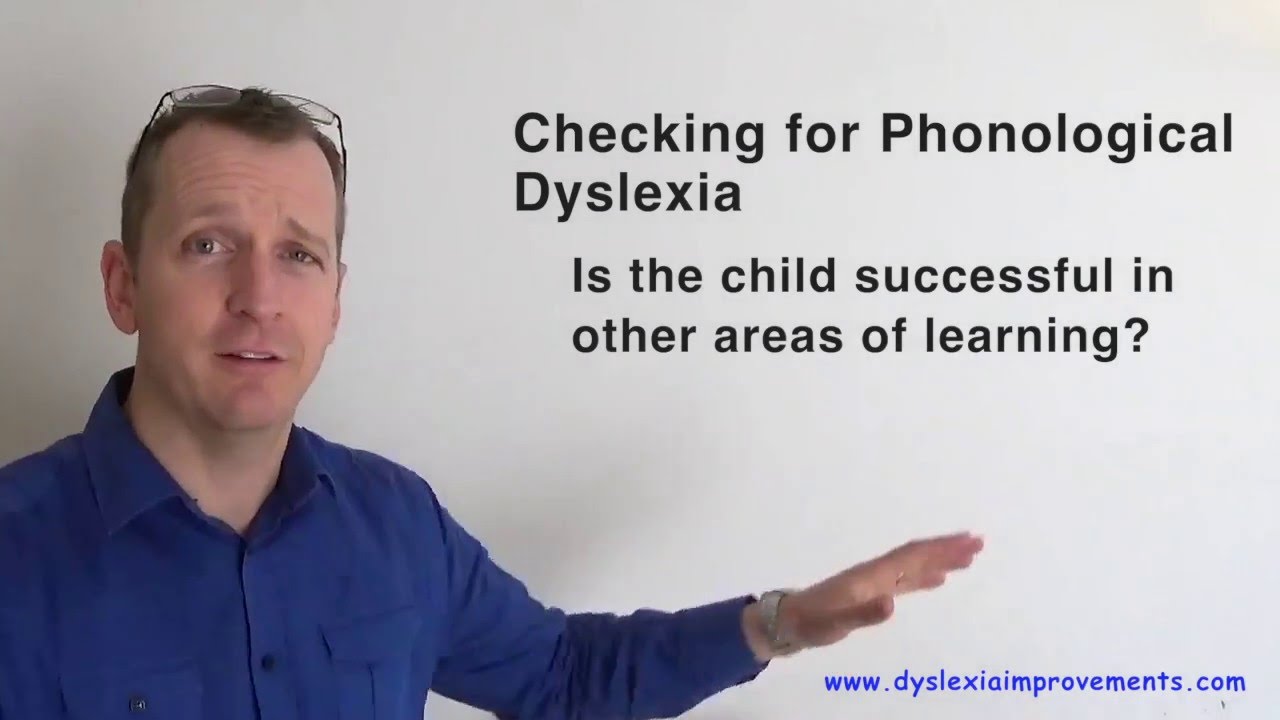
- A key indicator is a child being bright and capable in other academic areas (like math or science) but struggling significantly with reading.
- It's crucial to rule out visual stress (e.g., shimmering words) as the cause of reading difficulties, as this requires different interventions.
- Phonological dyslexia is distinct from general learning struggles; if a child struggles with everything, reading difficulties are less surprising.
Identifying potential phonological dyslexia early requires differentiating it from other issues like visual stress or general academic struggles, ensuring the correct support is sought.
A child who excels at complex math problems but cannot read simple words is a potential indicator, unlike a child struggling across all subjects.
- Children should be able to mentally break apart and blend sounds within words (phonological processing).
- Tasks like removing a sound from a word (e.g., 'space' without 's' is 'pace') or substituting sounds (e.g., 'shame' with 'm' replaced by 'k' becomes 'shake') test this ability.
- Difficulty or significant slowness in performing these tasks, especially in older children, suggests a phonological processing deficit.
- Compound words (e.g., 'dragonfly') and syllable segmentation ('drag-on-fly') also reveal a child's ability to deconstruct words.
The ability to manipulate sounds is fundamental to decoding unfamiliar words, making these phonological processing skills a core diagnostic area for dyslexia.
Asking a child what the word 'split' becomes if you remove the 'l' tests their ability to blend sounds; a slow or incorrect answer suggests difficulty.
- Children with phonological dyslexia often rely heavily on memorized sight words rather than sounding out unfamiliar words.
- Testing with made-up (nonsense) words is vital; a child should be able to sound these out relatively quickly.
- Significant struggle or inability to sound out nonsense words is a strong indicator of phonological dyslexia.
- Jumbling letters or reading them in the wrong order within a word (e.g., 'spirit' as 'sprint', 'expect' as 'accept') can also signal issues.
Nonsense word decoding directly assesses a child's ability to apply phonics rules, bypassing reliance on memorization and revealing underlying decoding weaknesses.
A child taking a very long time to sound out a made-up word like 'erod' suggests difficulty with phonological decoding.
- Phonological dyslexia often has a genetic component, meaning it can run in families.
- Knowing if a parent has dyslexia is an additional indicator.
- Dyslexia exists on a spectrum (mild, medium, severe) and isn't a simple yes/no diagnosis.
- It's important not to rush to label a child; diagnosis involves evaluating multiple factors and is often complex, even for experts.
Understanding that dyslexia is a spectrum and can be hereditary provides a broader context for assessment and emphasizes the need for careful, multi-faceted evaluation rather than quick judgments.
If a child's parent has a diagnosed reading difficulty, it increases the likelihood that the child's own reading struggles may be related to dyslexia.
Key takeaways
- Phonological dyslexia is characterized by difficulties in processing and manipulating sounds within words, impacting decoding skills.
- A discrepancy between a child's overall intelligence/ability in other subjects and their reading proficiency is a significant clue.
- Always rule out visual stress before concluding that reading difficulties stem from phonological dyslexia.
- The ability to decode nonsense words is a critical test for identifying phonological dyslexia, as it bypasses memorization.
- Phonological processing skills, like blending and segmenting sounds, are foundational for reading and are often impaired in dyslexia.
- Dyslexia is a spectrum, and a diagnosis should be made cautiously after considering multiple indicators.
- Family history of dyslexia can be an important contributing factor to consider.
Key terms
Phonological DyslexiaPhonological ProcessingDecodingSight WordsNonsense WordsVisual StressSkopic SensitivityErin SyndromePhonicsBlending SoundsSegmenting Sounds
Test your understanding
- How does a child's performance in non-reading subjects help identify potential phonological dyslexia?
- Why is it important to rule out visual stress when assessing reading difficulties?
- What is the significance of a child's ability to sound out nonsense words in diagnosing phonological dyslexia?
- Explain how tasks involving sound manipulation (like removing or substituting sounds) reveal phonological processing abilities.
- What does it mean that phonological dyslexia exists on a spectrum, and why should labels be applied cautiously?