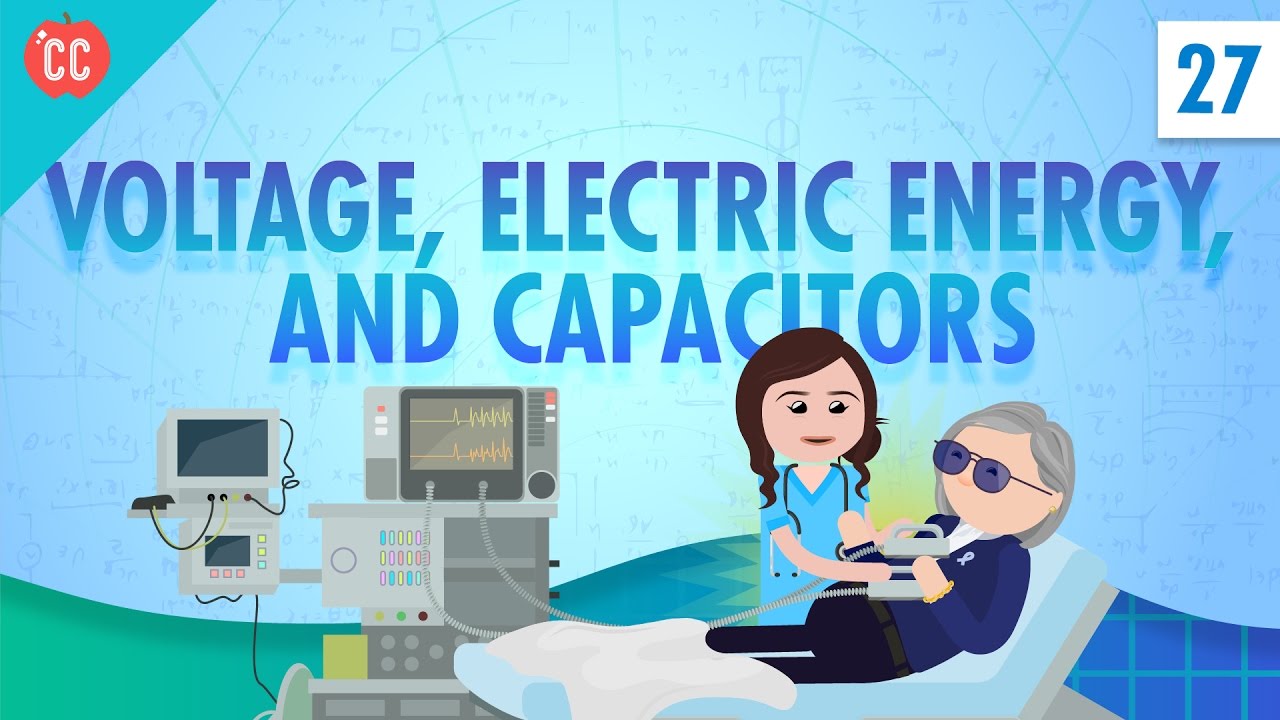
Voltage, Electric Energy, and Capacitors: Crash Course Physics #27
CrashCourse
Overview
This video explains the fundamental concepts of electric potential energy, electric potential (voltage), and capacitance, using a defibrillator as a practical example. It details how electric fields create forces that do work, leading to potential energy. The video defines voltage as electric potential difference per unit charge and explains its relationship to the electric field and distance. It then delves into capacitors, describing their structure, how they store energy, and the factors influencing their capacitance, such as plate size, distance, and the presence of a dielectric material. Finally, it touches upon calculating stored energy and energy density within the electric field.
Save this permanently with flashcards, quizzes, and AI chat
Chapters
- Capacitors store energy as electric potential energy, similar to how gravity gives objects potential energy.
- A defibrillator uses a large capacitor to deliver a jolt of stored electrical energy to restart a heart.
- Electric potential energy arises from the position of a charge within an electric field.
- Work done on a charge moving in an electric field changes its potential energy.
- Electric potential is defined as the electric potential energy per unit charge.
- Voltage is the difference in electric potential between two points, measured in Volts (Joules per Coulomb).
- Equipotential lines connect points of equal electric potential (voltage).
- For a parallel-plate capacitor, equipotential lines are parallel to the plates and perpendicular to the electric field.
- For a point charge, equipotential lines are concentric circles around the charge.
- A capacitor stores energy by accumulating opposite charges on its conductive plates, creating a voltage difference.
- Capacitance is a measure of how much charge a capacitor can store per unit of voltage, measured in Farads.
- Capacitance is determined by the physical properties of the capacitor: the area of the plates, the distance between them, and the material in between.
- Dielectrics are insulating materials placed between capacitor plates to increase capacitance and prevent charge leakage.
- Polar molecules in dielectrics align with the electric field, effectively weakening it and allowing more charge storage at the same voltage.
- The potential energy stored in a capacitor is calculated as one-half the charge times the voltage.
- Energy density describes the amount of energy stored per unit volume within the electric field.
Key takeaways
- Electric potential energy is stored by charges in an electric field, and this energy can be released to do work.
- Voltage is the difference in electric potential per unit charge and is a key factor in how electrical devices function.
- Capacitors are devices that store electrical energy by accumulating charge on conductive plates separated by an insulator.
- Capacitance is a property of a capacitor that quantifies its ability to store charge, influenced by its physical dimensions and materials.
- Dielectric materials enhance a capacitor's ability to store charge and energy by increasing capacitance.
- The energy stored in a capacitor is directly proportional to the square of the electric field between its plates.
Key terms
Test your understanding
- How does the concept of electric potential energy relate to the work done by an electric field?
- What is the difference between electric potential and voltage, and how are they measured?
- How do the physical characteristics of a capacitor, such as plate area and separation, affect its capacitance?
- What role does a dielectric material play in a capacitor, and how does it influence energy storage?
- How can the energy stored within a capacitor's electric field be calculated?