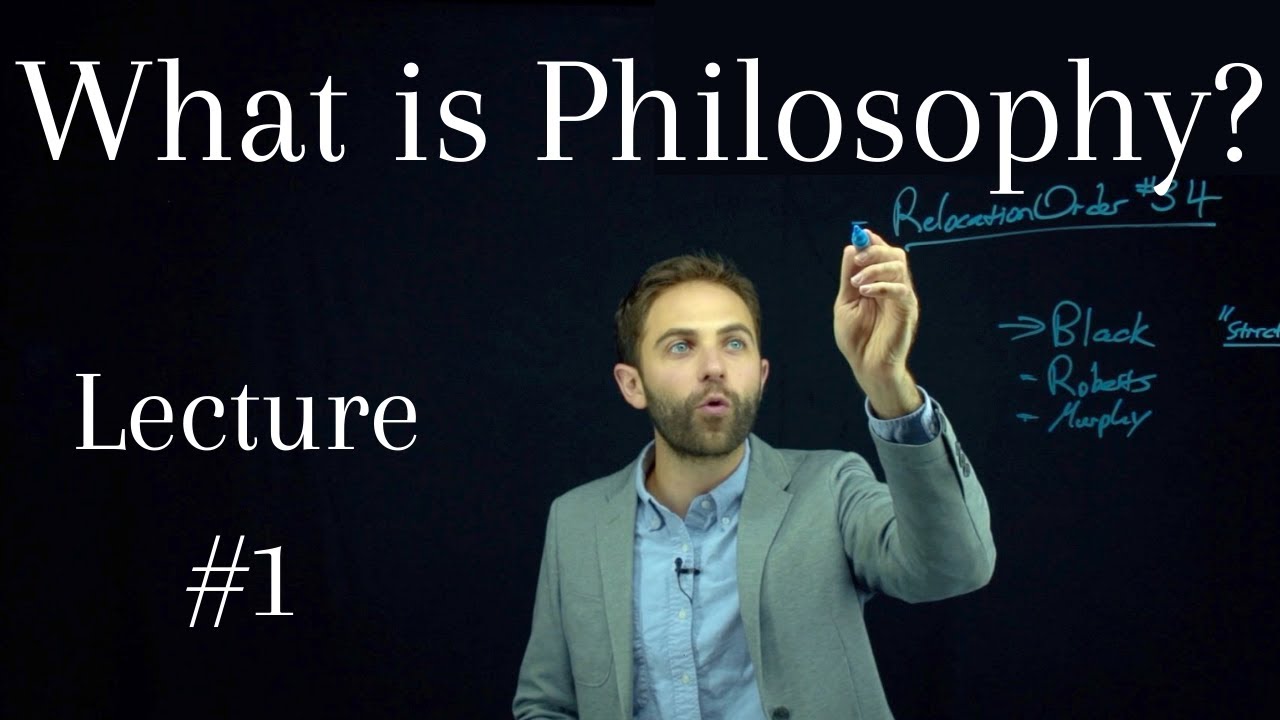
What is Philosophy? - First Lecture of the Semester
Jeffrey Kaplan
Overview
This video explains what philosophy is by distinguishing it from other ways of knowing and problem-solving. It clarifies that philosophy isn't about subjective opinions or empirical observation, nor is it purely mathematical. Instead, philosophy tackles questions that can't be answered by science or math, relying instead on rigorous argumentation and rational thought. The video also addresses common objections to philosophy, such as the idea that 'anything goes' or that it produces nothing of value, arguing that philosophy's unique method leads to valuable insights and develops critical thinking skills, which are reflected in standardized test performance and even earning potential.
Save this permanently with flashcards, quizzes, and AI chat
Chapters
- Philosophy, derived from Greek 'love of wisdom,' is an academic discipline focused on rigorous inquiry.
- It's distinct from casual or 'stoner' discussions; philosophers take deep questions very seriously.
- Philosophy differs from religion by relying on rational argument rather than revelation and by allowing freedom in conclusions.
- It addresses fundamental questions about existence, free will, morality, society, and consciousness.
- Empirical questions can be answered through observation and experimentation (e.g., biology, physics).
- Non-empirical questions, like those in mathematics, are answered through proofs and calculations based on stipulated definitions and axioms.
- We cannot observe abstract concepts like numbers or geometric shapes; we interact with representations (numerals, drawings).
- Mathematical truths are derived from definitions and axioms we create, not from observing the physical world.
- Philosophy deals with questions that are neither empirical nor answerable by mathematical proofs from stipulated definitions.
- These are often 'leftover' questions that don't fit neatly into scientific or mathematical categories.
- Questions about how society *ought* to be arranged (normative) are philosophical, not empirical (how it *is* arranged).
- Philosophical questions are answered through reasoned arguments and rational thought, not observation or calculation.
- Objection 1: 'Anything goes' because there's no empirical or mathematical proof. Counter: Some arguments are logically better than others; rigor in reasoning matters.
- Objection 2: Philosophy produces nothing of value. Counter: Philosophy produces clear, rational arguments and well-supported answers to important questions.
- The value of philosophy lies in its ability to tackle profound questions, like the nature of consciousness after death, which are deeply meaningful.
- The question of whether philosophy is worthwhile is itself a philosophical question, demonstrating its self-referential nature.
- Consequence 1: Philosophical answers are often controversial due to the lack of empirical or mathematical certainty.
- This controversy is actually a good sign, as the definition of philosophy itself is a philosophical and thus controversial question.
- Consequence 2: Philosophy is hard because it relies only on ordinary tools (words, clear thinking, argument) used with exceptional care and precision.
- Like a chemist refining basic mixing techniques, philosophers hone everyday reasoning skills to an expert level.
- Philosophy majors perform well on standardized tests like the LSAT, GMAT, and GRE, often outperforming other majors.
- This success is attributed to the rigorous argumentation and clear thinking skills developed in philosophy.
- Philosophy majors also tend to have competitive mid-career salaries, often exceeding those in business or economics.
- Deciding on a major based on salary or test scores is itself a philosophical question, highlighting the pervasive relevance of philosophical thinking.
Key takeaways
- Philosophy is the rigorous, serious pursuit of wisdom through rational argument, tackling questions beyond empirical or mathematical resolution.
- Distinguishing between empirical (observable) and non-empirical (provable via definitions) questions clarifies the unique domain of philosophy.
- Philosophy addresses fundamental 'ought' questions and abstract concepts that science and math cannot resolve.
- Arguments in philosophy are evaluated based on their logical structure and clarity, not just personal opinion.
- Philosophy's value lies in its ability to produce well-reasoned answers to life's most important questions, not necessarily in producing physical objects.
- The practice of philosophy hones critical thinking, argumentation, and clear communication skills, which have broad practical applications.
- The decision of what to study or how to live is itself a philosophical question, underscoring its relevance to personal and societal choices.
Key terms
Test your understanding
- How does philosophy differ from empirical science in its methods and the types of questions it addresses?
- What distinguishes philosophical questions from mathematical questions, according to the video?
- Explain the two main objections to the practice of philosophy presented in the video and how they are countered.
- Why are philosophical questions often considered controversial, and what does this imply about the nature of philosophical inquiry?
- How does the video suggest that the skills developed through studying philosophy translate into practical benefits like performance on standardized tests and career success?