21:44
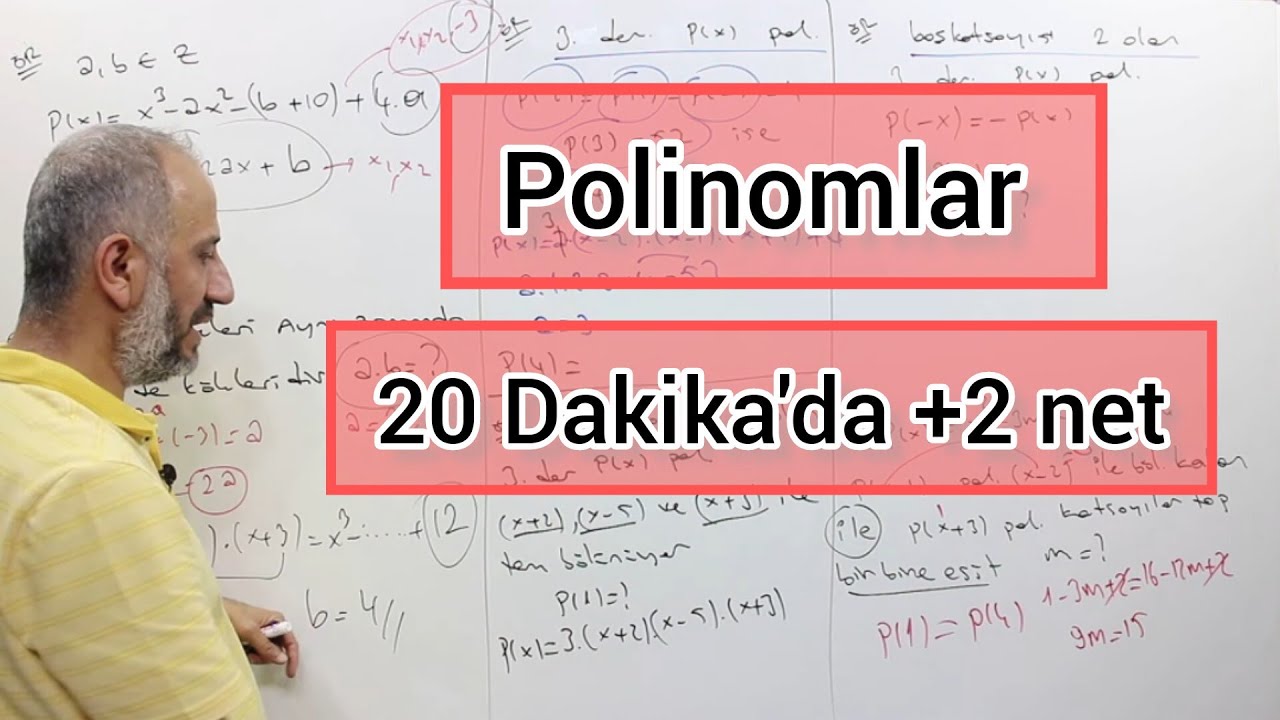
20 Dakika'da Polinomlar | +2 Net #öğrenmegarantili
Matematiğin Güler Yüzü
Overview
This video provides a comprehensive guide to solving polynomial problems, focusing on common question types and techniques. It covers evaluating polynomials at specific values, finding coefficients, determining sums of coefficients for even and odd-powered terms, and understanding polynomial division and remainders. The video also delves into properties of polynomial roots, including how to find them and their relationships, and explores concepts like even and odd functions in the context of polynomials. Several example problems are worked through step-by-step to illustrate these concepts.
How was this?
Save this permanently with flashcards, quizzes, and AI chat
Chapters
- A polynomial's variable must have a non-negative integer exponent.
- To find P(0), set the polynomial's argument (e.g., x+1) to 0 and solve for x, then substitute that value into the polynomial.
- To find P(1), set the polynomial's argument to 1 and solve for x, then substitute that value.
- The sum of coefficients is found by evaluating the polynomial at x=1.
Understanding how to evaluate polynomials at specific points is fundamental for solving a wide range of algebraic problems and understanding polynomial behavior.
To find P(0) for a polynomial like P(x+1), set x+1=0, so x=-1. Then substitute -1 into the polynomial expression.
- To find the sum of coefficients of even-powered terms, calculate (P(1) + P(-1)) / 2.
- To find the sum of coefficients of odd-powered terms, calculate (P(1) - P(-1)) / 2.
- These formulas apply to the polynomial itself, so substitute 1 and -1 into the given polynomial expression.
This technique provides a shortcut to finding specific coefficient sums without needing to expand or manipulate the polynomial extensively.
For a polynomial P(x), the sum of its even-powered terms' coefficients is found by evaluating P(1) and P(-1), adding them, and dividing by 2.
- When a polynomial P(x) is divided by (x-a), the remainder is P(a).
- Polynomial long division is used when the quotient is required or when the remainder is not simply found by the Remainder Theorem.
- If a remainder is given as a linear expression (e.g., ax+b), polynomial division is necessary to find it.
- The relationship P(x) = D(x) * Q(x) + R(x) (where D is divisor, Q is quotient, R is remainder) is key for solving problems involving division.
Mastering polynomial division and understanding the Remainder Theorem are crucial for simplifying complex polynomial expressions and solving equations.
To find the remainder of (5x^2 + 6x + 4) divided by (x-2), substitute x=2 into the polynomial: 5(2)^2 + 6(2) + 4 = 20 + 12 + 4 = 36.
- If 'r' is a root of a polynomial P(x), then (x-r) is a factor of P(x).
- The product of the roots of a polynomial is related to the constant term and the leading coefficient.
- When a polynomial Q(x) is a factor of P(x), all roots of Q(x) are also roots of P(x).
- Problems involving roots often require using Vieta's formulas (relationships between roots and coefficients).
Understanding the connection between roots and factors allows for efficient factorization and solving of polynomial equations.
If P(-3) = 0, then (x+3) is a factor of the polynomial P(x).
- An even function satisfies P(-x) = P(x). Its graph is symmetric about the y-axis.
- An odd function satisfies P(-x) = -P(x). Its graph is symmetric about the origin.
- Even and odd functions cannot have terms with odd powers (for even functions) or even powers (for odd functions), respectively, unless they are zero coefficients.
- For even functions, only even powers of x (including the constant term, x^0) are present.
Recognizing whether a polynomial is even or odd simplifies problems by revealing structural properties and reducing the number of unknown coefficients.
A polynomial like P(x) = 2x^4 + Bx^2 + C is an even function because all its terms have even powers of x.
- If two polynomials are equal, their corresponding coefficients must be equal.
- Problems may provide relationships between polynomial values (e.g., P(a) = P(b)) to help find unknown coefficients.
- Substituting strategic values for x (like 1, -1, 0, or values that simplify expressions) is key to solving for unknowns.
- Sometimes, solving for one unknown (like a coefficient) requires setting up and solving a system of equations derived from different evaluations of the polynomials.
This chapter demonstrates how to use given conditions and algebraic manipulation to solve for unknown coefficients and determine specific polynomial values.
If P(x) = Q(x), and P(x) = ax^2 + bx + c, then substituting x=1 gives P(1) = a+b+c, which can be equated to Q(1) to form an equation.
- For expressions like P(x^3), substitute x^3 wherever 'x' appears in P(x).
- When dealing with nested functions or specific evaluations like P(x) + 2P(-x), substitute values for x and solve the resulting system of equations.
- Problems involving cube roots or specific powers might require recognizing patterns or simplifying expressions before substitution.
- The remainder of P(x) when divided by (x-a)^n can be found using derivatives or specific substitution patterns.
These advanced techniques allow for solving more complex polynomial problems that go beyond basic evaluation and division.
To find P(x) + 2P(-x) = some expression, you might substitute 'x' and '-x' into P(x) and solve the two resulting equations simultaneously.
Key takeaways
- Polynomials are defined by non-negative integer exponents.
- Evaluating P(a) is equivalent to finding the remainder when P(x) is divided by (x-a).
- The sum of coefficients of a polynomial P(x) is always P(1).
- Even and odd function properties significantly simplify polynomial analysis by relating P(x) and P(-x).
- Understanding the relationship between roots and factors (x-r) is fundamental for solving polynomial equations.
- Polynomial long division is a critical tool when the Remainder Theorem is insufficient.
- Strategic substitution of values for x is a powerful technique for solving for unknown coefficients in polynomial equations.
Key terms
PolynomialExponentCoefficientRootFactorRemainder TheoremPolynomial DivisionEven FunctionOdd FunctionVieta's Formulas
Test your understanding
- How do you find the sum of the coefficients of only the even-powered terms in a polynomial P(x)?
- What is the relationship between a root 'r' of a polynomial P(x) and its factors?
- Explain the process of finding the remainder when a polynomial is divided by a linear factor (x-a).
- How can you determine if a polynomial is an even or odd function, and what does this imply about its terms?
- Describe a strategy for solving for unknown coefficients in a polynomial when given multiple evaluation conditions (e.g., P(1)=5, P(2)=10).