RSA ANIMATE: Changing Education Paradigms
The RSA
Overview
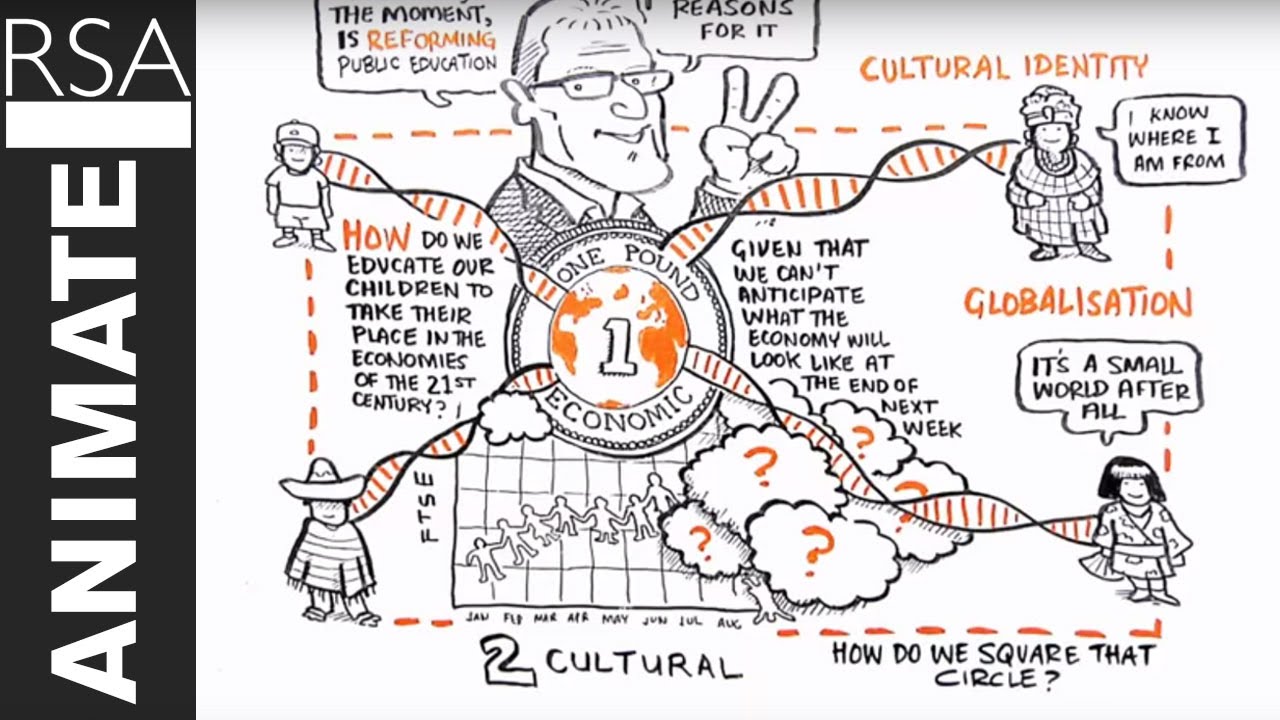
This video argues that current public education systems, designed for the industrial era, are failing to meet the needs of the 21st century. It highlights two main drivers for educational reform: economic shifts and cultural identity in a globalized world. The speaker contends that the traditional model, focused on a narrow definition of academic intelligence and standardized learning, stifles creativity and divergent thinking. This leads to student disengagement and a rise in conditions like ADHD, which are exacerbated by standardized testing. The video proposes a paradigm shift towards valuing diverse intelligences, fostering collaboration, and creating more stimulating learning environments that awaken, rather than anesthetize, students' innate capacities.
Save this permanently with flashcards, quizzes, and AI chat
Chapters
- Countries worldwide are reforming education due to economic uncertainty and the need to preserve cultural identity amidst globalization.
- The current education system, rooted in the Enlightenment and Industrial Revolution, is outdated and fails to prepare students for the future.
- Students are increasingly alienated because the system doesn't value their interests or provide a clear path to future success.
- The traditional promise of a job with a college degree is no longer a guarantee.
- Public education systems were established in the 19th century, driven by industrial economic needs and an Enlightenment view of intelligence.
- This model assumes intelligence is primarily deductive reasoning and academic ability, creating a false dichotomy between 'smart' and 'non-smart' individuals.
- Schools are structured like factories, with age-based cohorts, bells, and segregated subjects, promoting conformity over individual learning styles.
- Standardized testing and curricula further reinforce this industrial, conformity-driven approach.
- The perceived epidemic of ADHD and the widespread use of medication are questioned as a response to children's natural reactions to overstimulation and boring curricula.
- Children today are bombarded with information from various digital platforms, making it difficult to focus on traditional schooling.
- The rise in ADHD diagnoses correlates with the increase in standardized testing, suggesting a link between the pressure to conform and the labeling of inattentiveness.
- Medicating children to 'anesthetize' them is contrasted with the goal of 'waking them up' to their potential.
- True intelligence involves divergent thinking – the ability to generate multiple solutions and perspectives, a key component of creativity.
- A longitudinal study showed that 98% of kindergarteners exhibited genius-level divergent thinking, but this capacity significantly declined by adolescence.
- The decline is attributed to formal education, which teaches students there is only one right answer and penalizes deviation.
- Education should foster collaboration, recognize diverse human capacities beyond academics, and create environments that encourage original ideas.
Key takeaways
- The current education system is a relic of the industrial age and needs fundamental reform to address 21st-century economic and cultural realities.
- Standardized curricula and testing stifle creativity and divergent thinking, leading to student disengagement and the misdiagnosis of conditions like ADHD.
- True learning requires valuing diverse forms of intelligence and fostering collaboration, not just academic achievement.
- Education should aim to awaken students' innate curiosity and potential, rather than suppressing it through conformity and rote learning.
- The decline in divergent thinking from childhood to adolescence is a direct consequence of educational practices that prioritize single correct answers.
- Shifting the educational paradigm involves moving away from industrial-era models towards approaches that celebrate individuality and creative problem-solving.
Key terms
Test your understanding
- Why are countries currently reforming their public education systems, according to the video?
- How does the video argue that the current education system is modeled on industrialism, and what are the consequences of this model?
- What is the relationship the video suggests between standardized testing and the rise of ADHD diagnoses?
- How does the study on divergent thinking illustrate the impact of education on children's cognitive abilities?
- What fundamental shifts does the video propose for the future of education?