17:51
Grade 11-General Mathematics | HOW TO COMPUTE SALARY & WAGE?
Math Teacher Gelo
Overview
This video explains how to compute salary and wage, differentiating between the two and introducing related concepts like overtime pay and benefits. It details various compensation structures, including fixed salaries paid monthly or bi-weekly, and hourly wages. The video provides formulas and examples for converting between annual, weekly, bi-weekly, monthly, semi-monthly, and quarterly pay periods. It also touches upon non-monetary benefits and working conditions that employers provide, such as health insurance and various types of leave.
How was this?
Save this permanently with flashcards, quizzes, and AI chat
Chapters
- Compensation is any payment, in cash or in kind, given to employees for their work.
- Salary is a fixed, regular payment, often expressed annually and paid monthly or bi-weekly.
- Wage is typically based on an hourly rate, calculated by multiplying hours worked by the hourly rate.
- Wages are often associated with blue-collar jobs, while salaries are common for managerial or professional roles.
Distinguishing between salary and wage is crucial for understanding how different types of employees are paid and for accurately calculating their earnings.
A salary example is receiving 20,000 pesos per month, which can be expressed as an annual sum of 240,000 pesos. A wage example is earning 100 pesos per hour and working 8 hours to receive 800 pesos.
- Overtime pay is additional compensation for work performed beyond the standard 8 hours per day.
- Benefits are non-monetary forms of compensation, such as health insurance or paid leave.
- Working conditions are employer-provided circumstances like reasonable work hours and rest periods.
- Examples of benefits include maternity/paternity leave, medical insurance, and government contributions like SSS (for private) or GSIS (for government employees).
Understanding these additional components helps employees recognize their full compensation package beyond their base pay and appreciate the legal and ethical obligations of employers.
Maternity leave is a benefit, typically lasting 3 months (105 days), while paternity leave might be around 1 week (7 days).
- To convert annual salary to weekly, divide by 52 weeks (since 365 days / 7 days/week ≈ 52 weeks).
- To convert annual salary to bi-weekly (two-week periods), divide by 26 (52 weeks / 2).
- To convert annual salary to monthly, divide by 12 months.
- Semi-monthly salary is calculated by dividing the annual salary by 24 (12 months * 2 periods/month).
- Quarterly salary is found by dividing the annual salary by 4.
These conversion formulas allow for a clear understanding of earnings across different pay frequencies, which is essential for budgeting and financial planning.
An annual salary of 495,600 pesos divided by 52 weeks results in a weekly salary of 9,530.77 pesos.
- Example 1 demonstrates calculating weekly, bi-weekly, monthly, and semi-monthly salaries from a given annual salary.
- Example 2 shows how to find a monthly salary when given a weekly salary, first by calculating the annual salary and then converting it to monthly.
- Calculations often require rounding to two decimal places for currency.
Working through practical examples solidifies the understanding of the formulas and helps learners apply them to real-world scenarios.
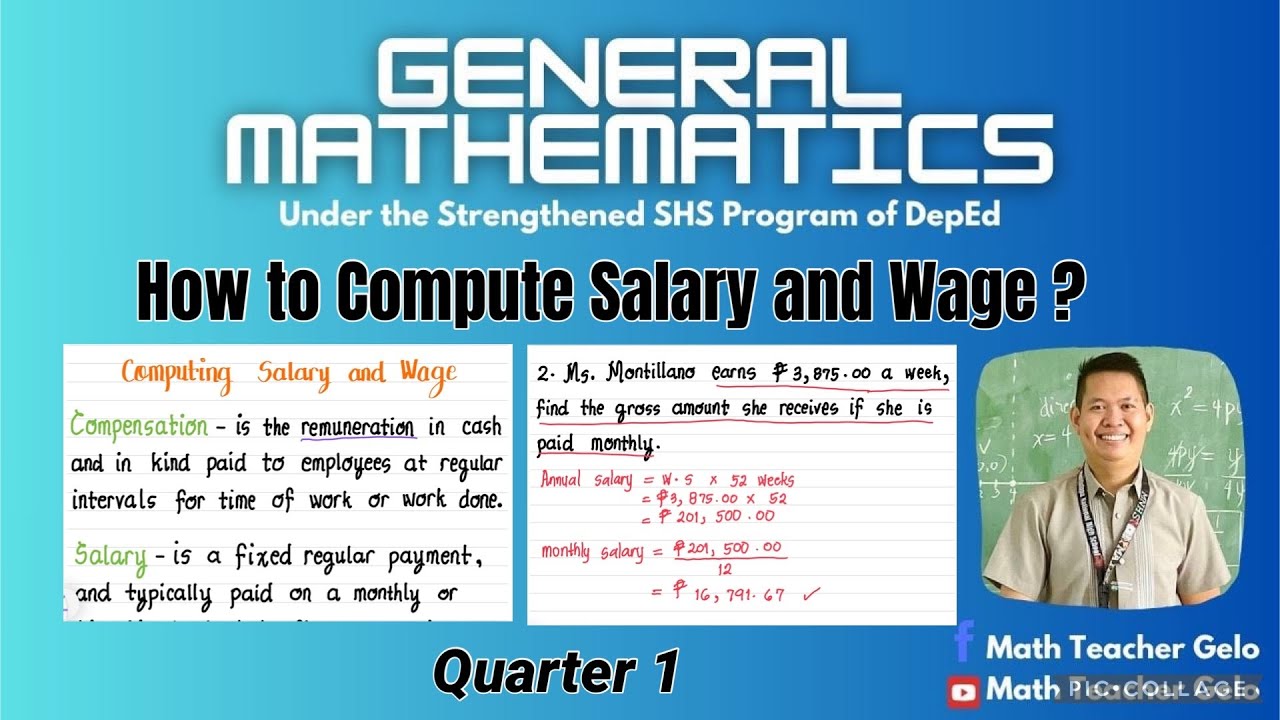
If Miss Montiliano earns 3,875 pesos a week, her annual salary is 3,875 * 52 = 201,500 pesos. Her monthly salary is then 201,500 / 12 = 16,791.67 pesos.
Key takeaways
- Salary is a fixed periodic payment, while wages are based on hourly rates.
- Overtime pay compensates for work exceeding the standard daily hours.
- Benefits and working conditions are crucial non-monetary aspects of employment.
- Understanding pay period conversions (weekly, bi-weekly, monthly, etc.) is vital for financial management.
- Annual salary is the base figure from which most other pay period calculations are derived.
- Accurate calculation requires knowing the correct divisor for each pay frequency (e.g., 52 for weekly, 12 for monthly).
- Non-monetary benefits like health insurance and various types of paid leave are important components of total compensation.
Key terms
CompensationSalaryWageOvertime PayBenefitsWorking ConditionsAnnual SalaryWeekly SalaryBi-weekly SalaryMonthly SalarySemi-monthly SalaryQuarterly SalarySSSGSIS
Test your understanding
- What is the fundamental difference between how salary and wages are typically calculated?
- How does overtime pay function as additional compensation for employees?
- Why is it important to understand the conversion formulas between different salary pay periods?
- How would you calculate an employee's monthly salary if their annual salary is known?
- What are some examples of non-monetary benefits that employers might provide to their employees?