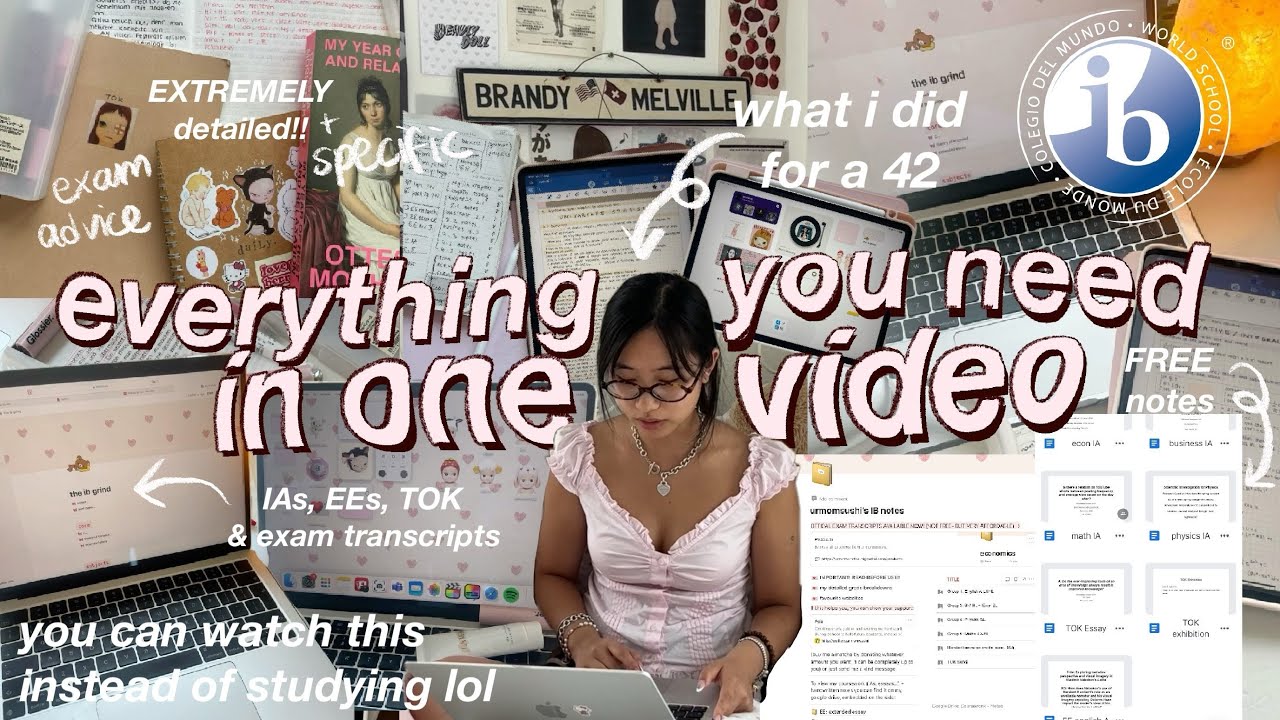
EVERYTHING I did for a 42- IB ☆ 🖇️ guide to ALL SUBJECTS, IAs, EEs (+ FREE notes & exam transcript)
urmomsushi
Overview
This video provides a comprehensive guide to achieving a high score in the International Baccalaureate (IB) Diploma Programme, focusing on strategies for all subjects, Internal Assessments (IAs), and the Extended Essay (EE). The creator shares personal insights, study techniques, and free resources, including Notion notes and a Google Drive of coursework, to help students navigate the demanding curriculum. The advice covers subject-specific approaches, exam preparation, and effective study habits, emphasizing understanding over rote memorization and leveraging resources like past papers and mark schemes. The goal is to demystify the IB and demonstrate that achieving top scores is attainable with the right strategies and consistent effort.
Save this permanently with flashcards, quizzes, and AI chat
Chapters
- The video offers an in-depth guide to scoring high in the IB, covering all subjects, coursework, and exam components.
- Free resources, including a Notion website with compiled notes and a Google Drive of coursework, are available to viewers.
- The creator's approach emphasizes understanding and strategic preparation rather than just memorization.
- Choosing a Language A or B for the EE can increase the likelihood of scoring an A.
- For literature EEs, focus on literary techniques and devices rather than content, using resources like Wikipedia's citation sections for deeper research.
- The TOK essay and exhibition encourage personal reflection and connection to real-world objects and concepts.
- CAS is a mandatory component that requires completion but should not be prioritized over academic subjects.
- Limit reading to five key texts: one for the HL essay, two for the oral, and two for Paper 2.
- Develop a structured essay skeleton for Paper 1 and Paper 2, focusing on key terms and sophisticated vocabulary.
- For Paper 1 (unseen texts), prioritize careful reading and planning, using a 'rule of three' for devices and themes, and dedicating ample time to planning.
- Paper 2 requires a comparative analysis of two books, focusing on literary devices and thematic overlap, rather than trying to cover too many texts.
- Take Language B HL only if fluent; otherwise, it's a significant challenge.
- For Paper 1 (written work), thoroughly learn text types and memorize structural skeletons and key phrases.
- A balance of memorized elements (20%) and genuine language proficiency (80%) is crucial for success in written tasks.
- Oral exams require fluency and the ability to build vocabulary; native speakers can often achieve full marks by freestyling.
- Business Management is writing-intensive, similar to a language subject; mastering the mark scheme is crucial.
- Structure answers precisely according to question point values (e.g., 2-point definition, 4-point definition + example).
- For Paper 1's case study, memorize the pre-release information to save time during the exam.
- Paper 2 involves financial math, which is basic arithmetic but requires understanding formulas and structures like final accounts and ratios.
- Paper 3 requires analytical skills to interact with given information, focusing on motivation theories, pros/cons, and business longevity, rather than strict syllabus recall.
- Focus heavily on Microeconomics and Macroeconomics for Paper 1, as Global Economics questions are often obscure.
- Master economic terminology and graphs; understanding how graphs move is more important than rote memorization.
- Integrate real-world examples, preferably from your home country, to illustrate economic concepts.
- Paper 2 is calculation-based, focusing on national economic indicators; mastering formulas and picking the easier country comparison is key.
- Consistent practice with past papers is the most critical strategy for mathematics.
- Recognize patterns in questions asked across Paper 1 (no calculator) and Paper 2 (calculator).
- For Paper 1, memorize key formulas to save time, and learn when to move on from difficult questions.
- For Paper 2, master the use of the GDC (calculator) for shortcuts and complex calculations like integration and differentiation.
- Understanding formulas and their application is more important than memorizing definitions.
Key takeaways
- Leverage free online resources like Notion and Google Drive for organized study notes and coursework examples.
- Prioritize understanding core concepts and analytical skills over rote memorization across all subjects.
- Strategic text selection and structured essay planning are crucial for maximizing scores in language and literature subjects.
- Mastering mark schemes and question structures is vital for subjects like Business Management and Economics.
- Consistent practice with past papers is the most effective method for improving performance in mathematics.
- Focus on applying knowledge to real-world examples, especially in subjects like Economics, drawing from personal experience or local context.
- Don't be discouraged by challenging teachers or difficult subject matter; consistent effort and strategic preparation can lead to high scores.
- The IB is challenging but achievable; focus on understanding the requirements and employing effective study habits.
Key terms
Test your understanding
- How can focusing on literary techniques rather than content improve an Extended Essay in Language A?
- What is the recommended strategy for selecting texts for Language A Paper 2 and the oral component?
- Why is understanding the mark scheme particularly important for subjects like Business Management, and how should answers be structured accordingly?
- How can students effectively use real-world examples in Economics Paper 1, and what is the advantage of using examples from one's home country?
- What is the role of consistent practice and pattern recognition in preparing for Mathematics AA SL exams, and how does it differ between Paper 1 and Paper 2?