6:22
Lesson 2A: Why do we need AI Fluency? | AI Fluency: Framework & Foundations Course
Anthropic
Overview
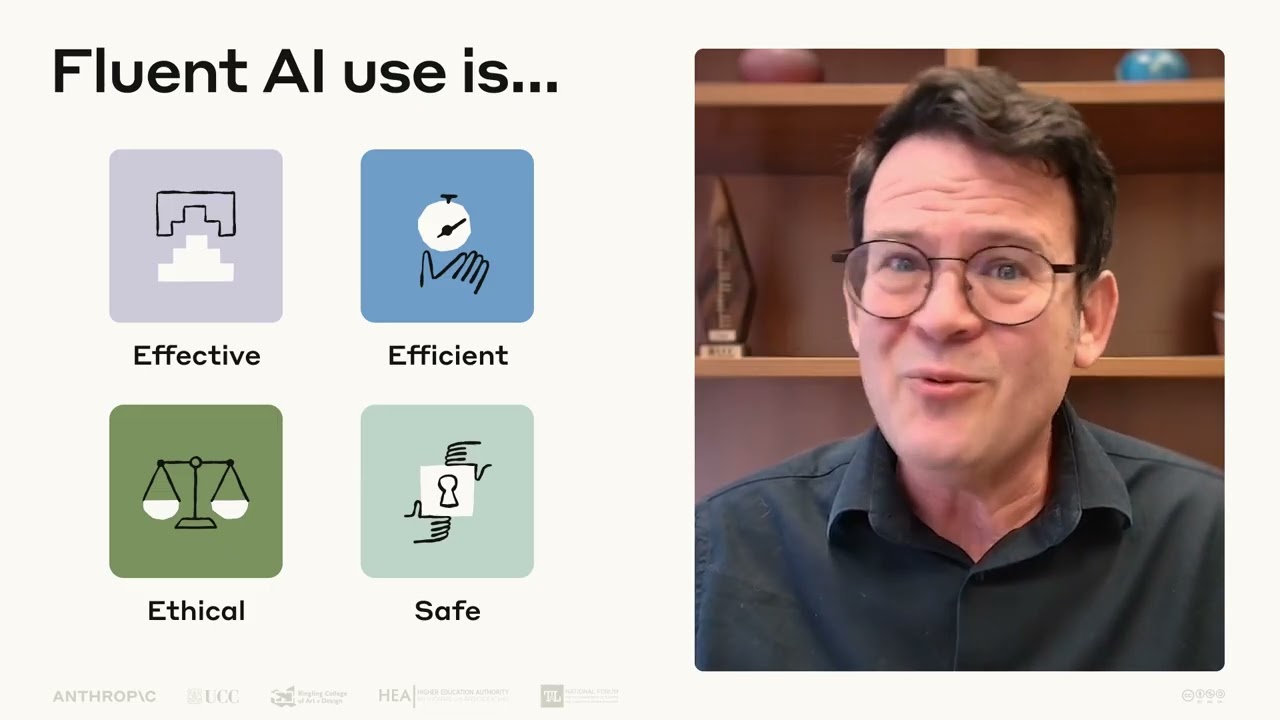
This video introduces the concept of AI fluency, explaining why it's essential in today's rapidly evolving technological landscape. It moves beyond basic prompt engineering to define AI fluency as a set of practical skills, knowledge, insights, and values for effective, efficient, ethical, and safe interaction with AI. The video outlines three primary modes of AI engagement—automation, augmentation, and agency—and emphasizes that true fluency involves understanding how to leverage these modes to maximize AI's potential as a collaborator, not just a tool.
How was this?
Save this permanently with flashcards, quizzes, and AI chat
Chapters
- AI is rapidly changing how we work and live, offering powerful tools and virtual collaborators.
- Simply having access to AI doesn't equate to knowing how to use it effectively or responsibly.
- AI fluency is more than just knowing specific prompts; it's a holistic set of adaptive skills, knowledge, insights, and values.
- The goal of AI fluency is to interact with AI systems effectively, efficiently, ethically, and safely.
Understanding why AI fluency is crucial helps learners recognize the importance of developing these skills to navigate the current technological landscape and future advancements.
Experiencing frustration when an AI gives an unexpected response or struggling to articulate needs to an AI highlights the gap between AI access and AI fluency.
- AI engagement can be categorized into three main modes: automation, augmentation, and agency.
- Automation involves using AI to complete specific tasks based on clear instructions, like summarizing a document or creating an image.
- Augmentation is a collaborative process where AI acts as a partner to enhance human creativity and problem-solving, such as brainstorming story ideas or refining complex thoughts.
- Agency involves setting up AI to work independently on your behalf, like categorizing emails or managing website interactions, by defining its behavior patterns rather than specific actions.
Distinguishing between these modes helps learners understand the diverse ways AI can be utilized, moving beyond simple task execution to more sophisticated forms of collaboration and independent operation.
Using AI to draft an email (automation) versus brainstorming character development with an AI by bouncing ideas back and forth (augmentation) versus setting up an AI to automatically sort incoming emails by urgency (agency).
- AI can function not only as a tool but also as a medium, a partner, or a co-creator.
- This shift redefines AI's role in creative and problem-solving work.
- Engaging with AI as a collaborator requires developing new skills and adapting our roles.
- The AI fluency framework addresses these necessary competencies.
Recognizing AI's evolving role beyond a simple tool encourages learners to develop the advanced skills needed to effectively partner with AI in complex tasks.
Key takeaways
- AI fluency is a critical skill set for navigating the modern world, enabling effective and responsible interaction with artificial intelligence.
- True AI fluency involves a combination of practical skills, knowledge, insights, and ethical values that adapt with technological changes.
- The three modes of AI engagement—automation, augmentation, and agency—offer different levels of interaction and require distinct approaches.
- Augmentation and agency modes leverage AI's unique capabilities for deeper collaboration and problem-solving, often leading to more creative outcomes.
- AI is evolving from a simple tool into a sophisticated partner or co-creator, necessitating new skills and a more adaptive mindset from users.
- Developing AI fluency is an ongoing process of learning and adaptation, essential for maximizing the benefits of AI while mitigating its risks.
Key terms
AI FluencyAutomationAugmentationAgencyPrompt EngineeringEthical AI InteractionResponsible AI UseCollaborative AI
Test your understanding
- What is the core difference between simply having access to AI and being AI fluent?
- How does the 'augmentation' mode of AI engagement differ from 'automation'?
- Why is it important to understand the 'agency' mode of AI interaction?
- What are the key components that constitute AI fluency, beyond just technical skills?
- How does viewing AI as a collaborator, rather than just a tool, change the skills required for effective interaction?