ECE 3821: Displacement Current
Chris Rouse
Overview
This video introduces the concept of displacement current, the final missing piece in Maxwell's equations. It begins with a demonstration showing how a magnet falling through a copper tube is slowed down by induced currents, illustrating Lenz's Law. The lecture then delves into Ampere's Law, highlighting its inconsistency when applied to a charging capacitor. Maxwell's crucial addition, the displacement current term (related to the time rate of change of electric flux density), resolves this inconsistency and completes Maxwell's equations. The video explains why this term is often negligible at low frequencies but becomes significant at high frequencies, leading to the concept of electromagnetic waves.
Save this permanently with flashcards, quizzes, and AI chat
Chapters
- A magnet dropped through a non-conductive tube falls quickly due to gravity.
- When dropped through a conductive copper tube, the magnet falls much slower.
- This slowing is caused by induced currents in the copper, which create a magnetic field opposing the magnet's motion (Lenz's Law).
- The induced electric fields (EMF) exist even without the conductor, but the conductor allows current to flow, creating a measurable effect.
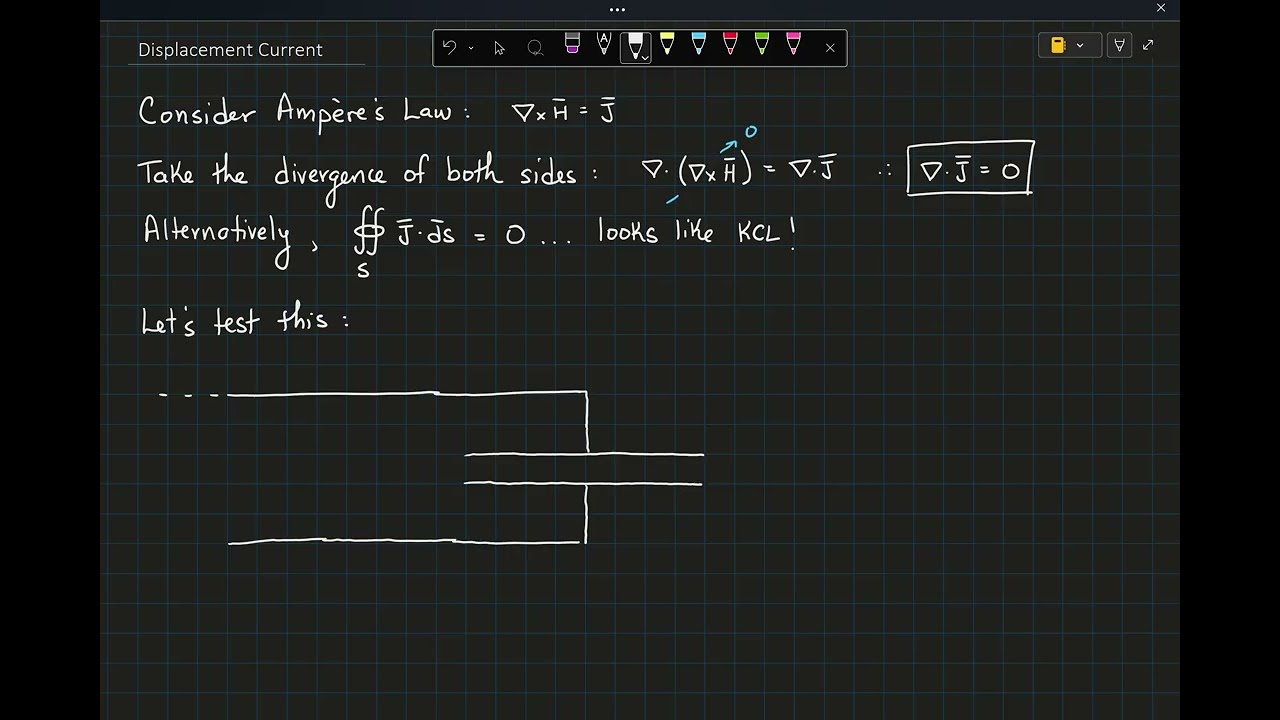
- Ampere's Law relates the curl of the magnetic field (H) to the current density (J).
- Taking the divergence of Ampere's Law implies the divergence of current density is zero, which holds for steady currents (DC).
- The continuity equation (divergence of J equals negative rate of change of charge density) shows that current density can be non-zero when charge density changes.
- Applying Ampere's Law to a charging parallel-plate capacitor reveals an inconsistency: the conduction current through the plates is zero, but a magnetic field is still present.
- Maxwell resolved the inconsistency in Ampere's Law by adding a term related to the time rate of change of the electric displacement field (D).
- This new term is called the displacement current density (J_D = dD/dt).
- It accounts for the changing electric field between the capacitor plates, which acts like a current in generating a magnetic field.
- This addition ensures that Maxwell's equations satisfy charge conservation and are consistent for both static and dynamic fields.
- The four complete Maxwell's equations now describe all classical electromagnetic phenomena.
- They include Gauss's Law, Gauss's Law for Magnetism, Faraday's Law, and the Ampere-Maxwell Law.
- These equations predict the existence of self-propagating electromagnetic waves, a concept that revolutionized physics.
- The equations unify electricity, magnetism, and light.
- The displacement current term (dD/dt) is often very small at low frequencies (like mains power, 60 Hz) because epsilon_0 * mu_0 is small.
- In such cases, the magneto-quasi-static (MQS) approximation, which ignores displacement current, is valid.
- At high frequencies, the displacement current becomes significant and cannot be ignored.
- This is why electromagnetic waves, which require time-varying E and B fields to sustain each other, are a high-frequency phenomenon.
Key takeaways
- Changing magnetic fields induce electric fields (Faraday's Law), and changing electric fields induce magnetic fields (Maxwell's addition to Ampere's Law).
- Lenz's Law explains how induced currents oppose the change in magnetic flux that created them.
- Ampere's Law alone is insufficient to describe situations with time-varying electric fields, such as charging capacitors.
- Maxwell's addition of the displacement current term (dD/dt) to Ampere's Law resolves this inconsistency and completes the set of Maxwell's equations.
- The four Maxwell's equations unify electricity, magnetism, and light, predicting the existence of electromagnetic waves.
- At low frequencies, the displacement current is often negligible, allowing for approximations like the magneto-quasi-static (MQS) approach.
- The significance of displacement current becomes apparent at high frequencies, enabling phenomena like electromagnetic wave propagation.
Key terms
Test your understanding
- How does the presence of a conductor affect the fall of a magnet, and what fundamental electromagnetic principle does this demonstrate?
- Why does Ampere's Law, in its original form, fail when applied to a charging capacitor, and what specific scenario highlights this failure?
- What is displacement current, and how does Maxwell's addition of this term modify Ampere's Law?
- What are the four complete Maxwell's equations, and what fundamental phenomena do they collectively describe?
- Under what conditions is the magneto-quasi-static (MQS) approximation valid, and why is it useful?