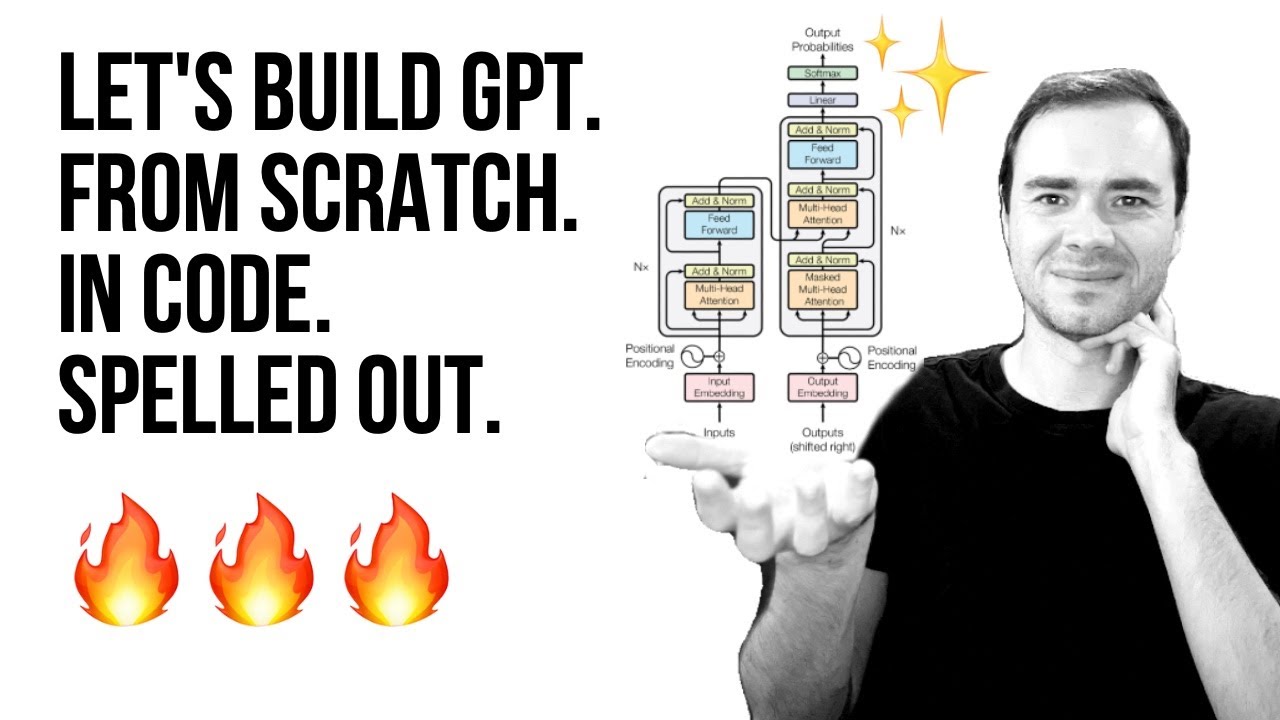
Let's build GPT: from scratch, in code, spelled out.
Andrej Karpathy
Overview
This video explains the core concepts behind large language models like ChatGPT by building a simplified version from scratch. It starts by introducing language models as sequence completion systems and highlights the Transformer architecture as the key innovation. The tutorial then walks through setting up a character-level language model using Python and PyTorch, training it on a small dataset (Tiny Shakespeare), and demonstrating text generation. It covers essential components like tokenization, embeddings, positional encoding, and the fundamental self-attention mechanism, explaining how these elements work together to enable models to understand and generate human-like text.
Save this permanently with flashcards, quizzes, and AI chat
Chapters
- ChatGPT is a powerful AI that generates text by predicting the next word or token in a sequence.
- Language models are probabilistic, meaning they can produce different outputs for the same input.
- The Transformer architecture, introduced in the 'Attention Is All You Need' paper, is the foundation of modern language models like GPT.
- GPT stands for Generative Pre-trained Transformer, highlighting its core components.
- Instead of replicating large-scale models, we'll build a character-level Transformer.
- A small, manageable dataset like 'Tiny Shakespeare' is used for training.
- The model learns to predict the next character based on preceding characters in the text.
- The goal is to understand the underlying mechanics of the Transformer architecture.
- Text is converted into a sequence of integers (tokens) for the model to process.
- A character-level tokenizer maps each unique character to an integer.
- More advanced tokenizers use subword units (like BPE) for larger vocabularies and shorter sequences.
- The dataset is split into training and validation sets to monitor overfitting.
- Models are trained on small 'chunks' or 'blocks' of data, not the entire dataset at once.
- Each chunk contains multiple training examples, predicting the next character at each position.
- A Bigram model predicts the next character based only on the immediately preceding character.
- The loss function (cross-entropy) measures how well the model's predictions match the actual next characters.
- The model learns embeddings for each token (character) and for its position in the sequence.
- Token embeddings capture the meaning or identity of a character.
- Positional embeddings add information about where a character appears in the sequence.
- These embeddings are combined to provide a richer input representation to the model.
- Self-attention allows each token to 'look' at other tokens in the sequence to gather context.
- Tokens emit 'query' (what I'm looking for) and 'key' (what I contain) vectors.
- The dot product of queries and keys determines the 'affinity' or 'attention score' between tokens.
- These scores are used to create a weighted sum of 'value' vectors, effectively focusing on relevant information.
- Masking prevents tokens from attending to future tokens, maintaining the autoregressive property.
- A Transformer block typically includes self-attention layers and feed-forward networks.
- Multi-head attention uses multiple self-attention mechanisms in parallel to capture different types of relationships.
- The model is trained using an optimizer (like Adam) to minimize the loss function.
- Training involves iterating through batches of data, calculating gradients, and updating model weights.
- Performance is tracked using training and validation loss to detect overfitting.
Key takeaways
- Language models predict the next element in a sequence, making them probabilistic systems.
- The Transformer architecture, particularly its self-attention mechanism, revolutionized natural language processing.
- Building models from scratch, even simplified versions, is key to understanding their inner workings.
- Tokenization converts text into numerical representations that machine learning models can process.
- Embeddings (token and positional) provide rich input features by capturing identity and context.
- Self-attention enables models to weigh the importance of different parts of the input sequence when making predictions.
- Training involves optimizing model parameters using data and a loss function to minimize prediction errors.
Key terms
Test your understanding
- How does a language model like ChatGPT generate text, and why is it considered probabilistic?
- What is the significance of the Transformer architecture in modern AI, and what problem does self-attention solve?
- Explain the process of tokenization and why it's necessary for training language models.
- How do token embeddings and positional embeddings contribute to a model's understanding of text?
- Describe the core mechanism of self-attention: how do 'query', 'key', and 'value' interact to produce context-aware representations?